
With Senator Rand Paul releasing over 1,000 pages of Dr. Anthony Fauci’s private diary, readers are getting an unprecedented look behind the curtain.
Many might expect the private reflections of the nation’s most influential public health official to be dominated by the scientific and public health challenges confronting the country. Instead, something else becomes evident.
Amid meetings, phone calls, and official duties, Fauci repeatedly paused to catalogue glowing newspaper profiles, television appearances, and celebrity praise.
The pattern began on 29 January 2020, when television host Lou Dobbs called to say that President Trump would soon be in touch. Dobbs told Fauci he had described him to the president as the “smartest person” he knew and urged Trump to speak with him.

Days later, Fauci recorded that the White House had chosen him—rather than CDC Director Robert Redfield—to serve as the administration’s primary spokesperson.
“Bob Redfield just does not come across very well,” he wrote, explaining that Redfield rambled too much, so instead “they are putting me out on all the requests.”

The decision marked a turning point.
Fauci recorded the moment President Trump told him, “Anthony, you are really a famous guy,” before spending the next 20 minutes asking him questions.
Fauci wrote that he was “surprised and very pleased,” adding that those present “were clearly stunned and impressed.”

“All my friends kept saying I was a national hero,” wrote Fauci. Members of Congress told him they felt “safe in [his] arms.”
By late March—as the nation entered historic lockdowns and the economy ground to a halt—Fauci boasted that the “press is going wild with me.”
His diary increasingly became a scrapbook of his own celebrity.
He saved clippings about his childhood, his high-school basketball career, and his personal life. He documented a petition to make him “Sexiest Man Alive” and even kept stories about “grandmothers who have crushes on me.”
He archived a profile in The Atlantic titled America Is Thirsty for Anthony Fauci, complete with the line: “If you don’t have a crush on this man…do you even care about public health?”
He revelled in what he described as “multiple stories per day directly or indirectly involving me,” noting with satisfaction that the “press still [is] hot and heavy about me.”
By May 2020, Fauci was fully embracing his fame.
“The situation with my national and international fame is explosive and really unimaginable,” he wrote.
“It is not hyperbole to say that today I am the most famous and talked about person in the country,” he wrote, adding that he had become “one of the most recognizable” people on the planet.
“POTUS seems to be enamoured of me,” Fauci wrote, “even though I am taking the spotlight away from him.”

Almost no compliment was too trivial to document.
Fauci eagerly noted that Secret Service agents chatted with him and waved him through a security checkpoint without asking for ID. He noted that strangers stopped him in the street to ask for selfies.
There was a “Fauci look-alike contest in Florida,” a brewery in Georgia named a beer after him—”Fauci Spring”—Fauci bobbleheads appeared, and people even frosted his name onto cookies.
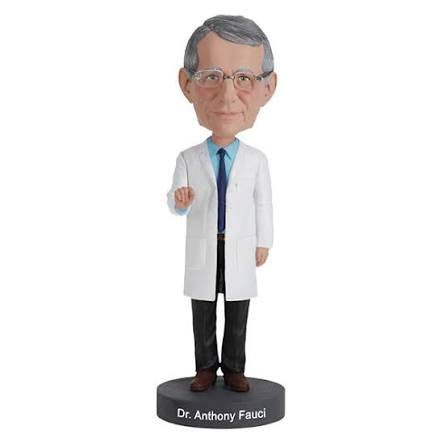
The proceeds of the sale of Fauci bobbleheads funded the purchase of face masks. None went to vaccine injury victims.
“Many print profiles and features on me,” he observed. “Ridiculous—too numerous to count.”
As his profile expanded, so did his leverage over the news cycle.
Rather than treating reporters as independent sceptics, Fauci often wrote about them as though they were willing collaborators.
He praised a journalist who produced “an amazing piece about me,” and dismissed critical reporting with open disdain.
One entry describes a call from Washington Post reporter Lena Sun, who was pursuing reports that Beijing had pressured the World Health Organisation not to declare a global emergency.
Fauci dismissed the claim as “nonsense,” adding with unmistakable satisfaction, “I probably stopped her from writing the story.” He explained that she backed down because “I am in all the important meetings.”

To Fauci, killing a major story through authority alone was a personal victory.
It was not an isolated episode. Television producers courted him, reporters scrambled for access, and Fauci logged these interactions almost as if he were his own celebrity publicist.
By positioning himself as the indispensable face of the pandemic, Fauci ensured that questioning the official narrative meant questioning him—and questioning him meant questioning science itself.
The diary thus reads as the logical prelude to his 2021 declaration: “They’re really criticising science because I represent science.”
After reading these private entries, the remark no longer sounds like an off-the-cuff comment, but rather the inevitable conclusion of a man who had come to believe he was the final arbiter of truth.
Fauci’s diary entries expose what lay behind the mask. While a nation endured unprecedented loss and sacrifice, its top public health official was busy counting his press clippings, cultivating his public image, and basking in his own stardom.
Republished from the author’s Substack
Join the Conversation
Published under a Creative Commons Attribution 4.0 International License
For reprints, please set the canonical link back to the original Brownstone Institute Article and Author.