
[Below is an excerpt from the excellent new book, Kill Switch: The History of How Viruses Shaped Humanity and Led to COVID-19, by Richard Burt. We highly recommend it. This portion of Chapter 16 provides an unforgettable explanation of how and why Covid dissidents were so few and far between within academia and industry. Game theory provides the answer. The chapter ends with a robust critique of the Bayh-Dole Act.]
World War II ended when America dropped the atomic bombs named “Little Boy” and “Fat Man” on Hiroshima and Nagasaki. Hundreds of thousands of Japanese died in an instant and of radiation poisoning over the subsequent years. Several American politicians, military brass, and university academics advocated for preemptive war against Russia to prevent it from acquiring nuclear bombs. Francis Matthews, Secretary of the Navy, advocated becoming “aggressors for peace.” The mathematician John von Neuman, who was a pioneer in game theory, remarked: “If you say bomb them tomorrow, I say why not bomb them today?”
Once Russia detonated its own nuclear bomb in 1949, America’s nuclear monopoly ended. In its place, a nuclear arms race jumped into the stratosphere. Nuclear weapons forever changed warfare in unpredictable ways. Because unorthodox thinking was needed, the US military funded an outside non-military corporation called RAND, an abbreviation for research and development.
The RAND Corporation had carte blanche to hire whomever they wanted, to study whatever they wanted, to be independent of the military, and to go outside of the usual military thinking no matter how bizarre. The military needed options. RAND employed individuals
from various fields, including mathematicians who studied game theories on how people settle conflicts. Game theory strives to understand how people solve conflicts to their best interest in different situations. Let us look at some of these situations.
Cooperative Game Theory
The Prisoners’ Dilemma: One-Time Choice to Collaborate or Defect
Developed in 1950 by RAND mathematicians Merrill Flood and Melvin Dresher, the theoretical game known as the prisoners’ dilemma involves two equal participants who are given a one-time choice to collaborate or defect. In this scenario, the two prisoners have been arrested for a crime and have been kept in solitary confinement with no means of communication. Each prisoner is then interviewed by the authorities in separate rooms regarding who is guilty for the offense. Here are the rules:
- If neither prisoner says who did the crime, they both spend one year in jail.
- If only one of the prisoners says the other did the crime, the snitch goes free and the other spends four years in jail.
- If both prisoners say the other person did the crime, they both spend two years in jail.
In the prisoners’ dilemma, when both people collaborate to keep their mouths shut, they receive a far shorter sentence than if both attempted to defect (i.e., snitch on each other). However, most pairs defect, insofar as if the other person snitches and they do not, the one prisoner will go free, while the other will spend four years (i.e., twice as much time) in prison.
According to game theory, the prisoners’ dilemma reveals that people determine their course of action compared to the other party,
not on the overall good for both. As the expression goes: “People want to see you do well but not better than them.”
Tit for Tat: Repetitive Choice to Collaborate or Defect
An iterative (repetitive) version of the prisoners’ dilemma was designed by political scientist Robert Axelrod. He called it “tit for tat.” The rules are the same as for prisoners’ dilemma, except that (1) you get a positive reward of money (or points) depending on whether you collaborate or defect; and (2) you will have to choose to collaborate or defect multiple times against the same opponent. You must consider what your counterpart will do in the next round based on your prior response. The goal is to win as much money (or points) as possible. Here is an example:
- If both individuals collaborate, both get twenty dollars.
- If only one collaborates, he gets nothing, while the one who defected gets forty dollars.
- If neither collaborates and both defect, both get ten dollars.
Axelrod asked mathematicians to design different response strategies to optimize points, such that one of the pair always collaborates; one always defects; one defects only after the other defected in the prior response; one would randomly defect; one defects two consecutive times after a defection by the other player; and other combinations. Axelrod had a computer run two strategies against each other for 200 iterations and then had each strategy go up against every other strategy. He ran 15 strategies against each other and then repeated the entire computer tournament multiple times.
The top performing strategies all emphasized collaboration and forgiveness. The best strategy collaborated and forgave the other person when they chose to defect but was not a pushover. The winning strategy retaliated when the opponent defected, but only once after each opponent’s defection. Collaboration was profitable, whereas repeated retaliation and sustained noncollaboration was not profitable.
Game theory strategies run on computers reaffirmed what many of the world’s major religions have been saying for millennia: Do unto others as you would have done unto yourself; confront injustice but then forgive transgressions.
During the Cold War, America and Russia had been locked into a permanent defect (noncollaborative) response. Both sides spent a fortune on nuclear proliferation trying to one-up each other. Game theory pointed to another mutually beneficial and cost-saving strategy. America and Russia eventually switched strategies, moving from each side being stuck in a permanent noncollaborative, defect response to each side collaborating on arms reduction. Under supervision from the other side, each side began a mutually beneficial gradual dismantling of nuclear warheads.
In the above two game theory scenarios, the two participants in the game (the two criminals in the prisoners’ dilemma, or America versus Russia in tit for tat) were roughly equivalent in power. In real life, however, one participant—especially if that participant is the government—typically possesses significantly greater resources. Let’s extend traditional game theory to include unequal participants—that is, participants with unequal power. When there are unequal participants, game theory is either covertly or overtly forced.
Forced Game Theory
Unequal Participants: Repetitive Collaborate or Defect
In terms of game theory, let us look at a junior researcher’s options in writing a paper supervised by more powerful people who have a vested interest in the paper’s conclusion and who also control the researcher’s future funding opportunities. The goal is not to ascribe motive to anyone. None of us have any idea what is in another person’s mind.
The intent is not to question honesty or sincerity in writing a conclusion for Covid-19 origin such as: “We do not believe that any type of laboratory scenario is possible.” Instead let us, from a hypothetical game theory scenario, analyze how uniformity of opinion may be shaped when participants in the group have markedly unequal resources, reputation, and power.
The National Institute of Allergy and Infectious Diseases—the same institution headed by Fauci for nearly 40 years—distributes $6 billion every year in research funding. It is the major funding source for genetic manipulation to create new viruses. It was funding coronavirus research at the Wuhan Institute of Virology. NIAID has a conflict of interest and a self-invested bias in the outcome of your paper. It also controls the grant funding of virologists doing research. If you collaborate, your paper will be published in a prestigious journal.
Publications are one of the currencies used to acquire academic promotions. You would also become a part of an exclusive inner circle that would likely pay future collaborative dividends, such as being subsequently awarded a multi-million-dollar NIH contract. If you defect and maintain that the Covid-19 virus has a man-made signature, your paper will have trouble getting published. Members of the impromptu committee (or their friends) would likely be the reviewers and would probably reject your paper.
If your paper finally was published, it would likely be in a fairly obscure journal. And if that journal learned that the most influential and largest research funding agency in the world refused to be a part of your publication, your paper would likely be retracted. Your academic career could be irrevocably forestalled or perhaps finished.
Like the fictional character Mr. Andersen (Neo) in the 1999 movie The Matrix, you have now entered the world of game theory. Like in the novel Dark Matter by Blake Crouch, you are now confronted with a choice that will alter the subsequent course of your reality. In the theoretical world of game theory, you have one self-preservation choice: collaborate. For players with markedly unequal resources, the weaker player’s “rational” move to advance is always to collaborate.
Unequal Participants: Collaborate or DOPE
In the real world, people in the game may not even know that the game is being played on them by the collaborating group. In this game, DOPE stands for Do not have the Opportunity to ParticipatE. To understand this “collaborate or DOPE” game, we need to understand the flow of money; that is, who is unknowingly paying (i.e., the DOPEs) and who is receiving the money (i.e., the collaborators).
To understand how this game is played by pharmaceutical companies, the NIH, and universities, we need to be aware of the Bayh-Dole Act. The 1980 Bayh-Dole Act is a bipartisan piece of legislation sponsored by Indiana Democratic Senator Birch Bayh and Republican Kansas Senator Bob Dole. It was a well-intentioned law that was designed to accelerate practical applications of research by allowing the NIH, universities, and drug companies to share profits generated from taxpayer-funded research. It gave the NIH and universities ownership of taxpayer-funded research that they could license to drug companies for a share of the profits from sales.
The unforeseen consequence of the Bayh-Dole Act was that universities, the National Institutes of Health, and pharmaceutical companies became joined at the hip in sharing profits from pushing drugs and vaccines upon an innocent public. How does this work in practice? The collaborators in this game are universities, the National Institutes of Health, and drug companies. The researcher is a pawn in the game. The indirect beneficiaries are legacy news and political action committees. The DOPEs are the taxpayers and patients. Here are the rules.
Researcher: pawn. A researcher’s creative thoughts, persistence, networking, decades of education, experience, creativity, and writing skills are all used to obtain a grant. Whatever the grant amount, an additional 50 to 90 percent is automatically taken by the university for what are euphemistically called “indirect” costs (see chapter 6). Then comes the researcher’s hard work to do the experiments, interpret the results, and make the discovery. The researcher may even pay out-of-pocket to patent his or her invention.
Because of the Bayh-Dole Act, the researcher’s intellectual property is not owned by the researcher. It is also not owned by the taxpayer who paid for it. The researcher, depending on the owner’s “generosity,” may get a small fraction of the owner’s profit. So who is the owner that moves the chess pieces (does the terms) with the drug company? University Collaborator. Because of the Bayh-Dole Act, the university owns the intellectual property rights to a researcher’s thoughts and work.
The university writes the license and determines the rules a drug company must follow, including who they can hire and what the drug company can say. The university may write into the license that they can audit the company’s books and hiring policies and limit a company’s “free speech.” Universities can also award themselves hundreds of thousands or millions of dollars in milestone payments and additional drug royalties in the ballpark of 5 to 8 percent of the total pre-tax sales profits. Since 1980, whenever you buy a drug or a vaccine, you are also paying money to a tax-free university, despite the fact that many of these prestigious higher education institutions already have tax-free endowments exceeding tens of billions of dollars.
Since the medieval period, people have invested in a corporation in return for stock shares. If the corporation lost money, they lost their investment. If it made money, investors were awarded a share of the profits. Those who knowingly and voluntarily took the risk got the reward or suffered the loss. After the Bayh-Dole Act, the people who do the investing when it comes to drug and vaccine research, i.e., the taxpayers, receive nothing except a very expensive drug that many cannot afford.
The university essentially has it both ways; it benefits from the researcher’s grant without the risk or doing the work. The researcher’s grant already pays them indirect payments that cover more than their facility and administrative costs. Then like the drug company, the university benefits from the profits of every drug or vaccine sold. Universities are now de facto tax-exempt for-profit companies.
Since the Bayh-Dole Act, universities and even hospitals that have no research facilities have changed their modus operandi. They now make a new hire sign terms of employment, in which they surrender intellectual property rights. If you refuse, you do not get hired. Even if you are working on something totally unrelated on your own time while at home, universities and hospitals are demanding intellectual property ownership. In medieval feudalism, employers owned indentured servants, who were legally obligated to work without pay. Since the Bayh-Dole Act, universities and more recently hospitals righteously, shamelessly, and legally claim ownership of an employee’s mind.
Drug company: collaborator. Research is like gold mining. It is expensive, and most of the time it does not pay off. It is in a multinational pharmaceutical drug company’s financial interest to allow the American taxpayers to pay for the research. If the researcher hits a rich deposit of gold ore, the university will place a claim on the mine, and a pharmaceutical company will license the claim (the research) from the university.
Drug companies got another bonanza when in 1997 the US Food and Drug Administration allowed direct-to-customer advertising via television, radio, print, and online. Only two countries in the world, America and New Zealand, allow drug companies to advertise directly to the customer. Since 1997, drug companies have become drug and vaccine pushers via commercials with subliminal messages of smiling beautiful drug users or innuendos of fear or guilt for not buying their drug or vaccine.
After 1980, drug company profits skyrocketed. Americans are now spending about $600 billion a year on prescription drugs. To alert people, Marcia Angell, the former editor of the New England Journal of Medicine, wrote a book called The Truth About the Drug Companies: How They Deceive Us and What to Do About It.
National Institutes of Health: collaborator. The extent to which the National Institutes of Health (NIH) and its employees profited from the Bayh-Dole Act is not transparent. Before Covid-19, articles began appearing that criticized the NIH for not disclosing royalties and conflict of interest on self-enrichment from taxpayer-funded research.
After Covid-19 and in response to a lawsuit from the watchdog group OpenTheBooks.com, the NIH was forced to release records on royalty payments from drug companies during the interval of October 2021 to September 2023. During that time of Covid-19 vaccine mandates, the NIH received $710 million in royalties from drug companies. This may explain why, despite the Covid-19 catastrophe, the NIH wanted to spend $168,000 on a museum exhibit in honor of Fauci. The journal Science reported that an NIH researcher could only receive $150,000 per year in royalties, with the rest going to the NIH bureaucracy.
It is ironic that the NIH—a government conglomeration that funded genetic alteration of benign viruses to turn them into human pathogens (see chapter 15)—is receiving a windfall largesse in profits from Covid-19 vaccines. As Fauci, the director of National Institute of Allergy and Infectious Diseases, wrote in his autobiography: “My NIAID group was focused on creating vaccines and working with pharmaceutical companies to develop treatments.” The NIH is the authority on who should get vaccinated and how often the vaccine and its boosters should be injected. The NIH has demanded that Covid-19 boosters be done indefinitely on everyone regardless of the level of neutralizing antibody that already exists in the blood. When the regulator, authority on safety, and producer are on the same money train, it is a conflict of interest.
Corporate media: beneficiary. Corporate news organizations obtain a significant portion of their revenue from drug company advertising. This drives profits and supports the extravagant salaries of legacy news broadcasters, some of whom are paid many tens of millions of dollars every year. Investigation into drug or vaccine profits is not in a news program’s interests, since it could boomerang back to collapse the network’s revenue stream. When doing the general good for society means getting fired, the general good gets ignored.
Political action committee: beneficiary. A drug company cannot directly give money to a politician, but it may do so indirectly by giving money to a political action committee (PAC) to influence the election. The PAC then exercises its “free speech” on unlimited commercials for or against a political candidate. Like a wolf pack, a PAC gangs up to shred any politician not in line with its drug company donors.
As mentioned in chapter 11, drug company contributions to Texas Governor Rick Perry’s campaign through two different PACs may have been a factor in Perry’s (unsuccessful) attempt to make HPV vaccines mandatory for teenage girls. If they did not get the vaccine, the girls would not be allowed to get an education. Is the end result of denying education to twelve- and thirteen-year-old girls, unless the ruling class gets its way, any different whether it occurs in America or in Afghanistan?
Who pays: The DOPE. American citizens are not informed that they are paying for this game. Sick and suffering citizens who paid for the medical research are left vulnerable and defenseless with unaffordable bills. As Senator Bernie Sanders said on the Senate floor: “The top 10 drug companies made over $112 billion in profit and while they pay their CEOs exorbitant compensation packages, one out of 4 Americans cannot afford to pay for the medicine they need.”
In game theory, a few individuals collaborate within a group to enrich their own self-interest. Due to the Bayh-Dole Act, powerful institutions are psychologically, emotionally, and financially tone-deaf to public suffering. In the “drug DOPE” game, citizens who pay for the research and pay for the expensive drugs are always stuck with paying the bill. The “drug DOPE” game is an unending way to shift wealth into the pockets of a select, privileged few. It polarizes society into the haves and the have-nots. The “drug DOPE” game monetizes illness and suffering to the advantage of those who already have nearly all the chips on their side of the table.
The Root Cause
In Citizens United v. the Federal Election Commission, the US Supreme Court ruled that companies can give unlimited money to PACs so as not to restrict a company’s right to “free speech.” Companies should have free speech (which universities oddly limit in their licenses). What the majority in the Supreme Court missed is that companies, very wealthy individuals, and other powerful institutions should not have the right to manipulate society in secret by buying elections for their profit and against the common good of society. Such behavior used to be considered corruption.
Supreme Court Justice John Paul Stevens said in dissent that this landmark ruling is “a rejection of the common sense of the American people, who have recognized a need to prevent corporations from undermining self-government.” The word “corporation” is from the Latin verb corporatio, “to form into a body.” Due to the Bayh-Dole Act, companies, universities, and the government are now one giant collaborating cabal or hidden super “corporation.” As the Italian fascist ruler Benito Mussolini once said: “Fascism is the merger of state and corporations.” They all share in a “piece of the action.”
Like water that runs around a rock, money from the well-intended Bayh-Dole Act has found its way around the common good of society. It has been twisted for the financial advantage of drug companies, government bureaucracies, and well-endowed and tax-exempt universities at the expense of its citizens (Figure 16.1).
President George Washington in his farewell speech warned about the addiction to and abuse of money and power. He warned of the “necessity of reciprocal checks of political power, by dividing and distributing it into different depositories and constituting each the guardian of the Public Weal against invasions by the others.” Government institutions cannot be trusted to investigate themselves. To restate the obvious, it is in the self-interest of institutionalists to look the other way in order to climb the ladder.
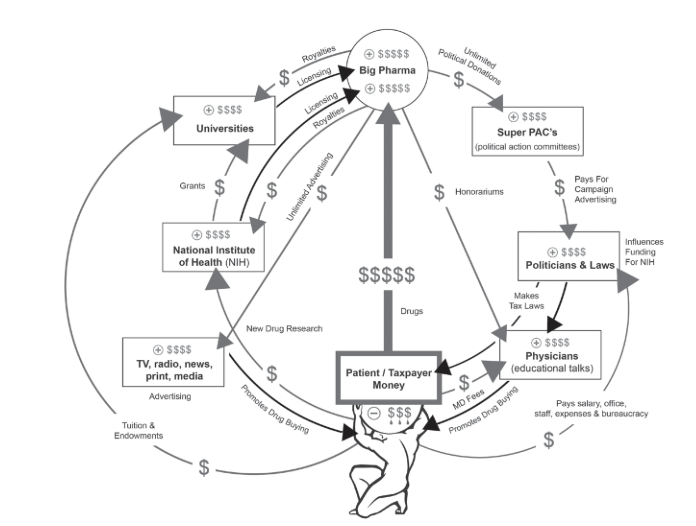
Remedies
To avoid throwing the proverbial baby out with the dirty bathwater when it comes to suggesting solutions to this immensely complex cycle of money, it is prudent to begin modestly by shining lights on drug advertising, PACs, and the Bayh-Dole Act as well as by emphasizing the importance in medical care of noncoerced consent. Drug company direct-to-customer advertising is pushing drugs and vaccines on society for corporate (and university) profit. It is making the public dependent, drug-seeking “addicts” and blurs the line between drug companies and drug dealers. In analogy to cigarette advertising that was terminated for the common good, direct-to-customer drug advertising should be terminated.
If PACs remain legal, they should be forced to publish in large print with each advertisement their officers’ names and salaries as well as a list of each of its donors, including the company and names of the company’s chairman and CEO and how much they donated. If they object to that minimal level of transparency, they are not interested in freedom of speech. Their motivation is freedom to deceive.
The Bayh-Dole Act’s unanticipated consequence is a frightening and fraternizing nepotism of policies and profit between government bureaucracies, universities, and drug companies. University and NIH royalties on taxpayer-funded research should be terminated. If a university objects, its privileged tax-exempt status should be revoked. Universities and their assets are tax-exempt, and they can accept tax-deductible donations because they are supposed to be charitable organizations that “provide for the public good.” The Bayh-Dole Act unintentionally stained that privilege and obligation by universities.
Researchers who do the work and whose intellectual energy made it happen should be the only ones getting royalties. And those should be much higher than what universities parsimoniously “dole” out. Respecting a researcher’s intellectual rights would attract the best and brightest from around the world to hasten new discoveries.
Summary
With the advent of molecular biology, new man-made lethal viruses that never previously existed are being created. Would it not make sense to design a fail-safe kill switch into that technology? Safeguards like inclusion of a suicide gene that can be activated to kill the virus or requirement for an intermediary construct that provides an essential protein. As we move into the unknown, should we not reemphasize traditional kill switches like outside investigation, separation of powers, and informed consent?
A civilized society resolves conflict through informed consent. It respects the rights of the individual to know the game at play, to be included and benefit from it, to decline to play, to decide for him or herself, and to not be doped or bullied. The difference between a gift and theft is consent. The difference between making love and rape is consent. The difference between giving a medication and committing assault is consent.
The first step toward inclusivity is transparent non-coerced consent. The final and most sacred kill switch is transparent noncoerced consent. Instead of taking “a share of the loot” from the drug-DOPE game, we need our universities, the National Institutes of Health, and our medical system to enshrine the principle of non-coerced consent.
Join the Conversation
Published under a Creative Commons Attribution 4.0 International License
For reprints, please set the canonical link back to the original Brownstone Institute Article and Author.