
On November 18 the AI company Anthropic priced its first public sale of stock at $81.3 billion, the largest IPO on record, against about $900 billion it has promised to spend. Six days earlier Jensen Huang was out as chief executive of Nvidia, the company he co-founded, in what I call a coup. In between, Washington filed a new rule on AI chips in the name of stopping China. Then, on November 19, Trump met Xi Jinping in Shenzhen.
On November 23 Nvidia announced that its board had put Huang back in the job, 11 days after he resigned, and the President called it “the correct and proper decision.”
The motive starts with that bill: Anthropic is going to have to raise its prices to pay it. Open models stand in the way. A model is the AI program itself, and an open one is free: anyone can download it and run it on a computer they own. Jensen Huang was the most powerful American backer of open models.
The closed labs, companies like Anthropic that only rent their models out, need the rent and Washington wants the off switch, and a model you own gives them neither. You’ve been told this is America against China. There is no China versus the US. It is about technocrats weaponizing patriotism to support closed-source AI surveillance systems. On September 30, 2025, I said on air that the technocracy is global. Technocracy is the idea that we’re too stupid to make our own decisions, so scientists and engineers, and now AI, should make them for us. The fight is technocracy versus free will.
I Build with Both Kinds of AI
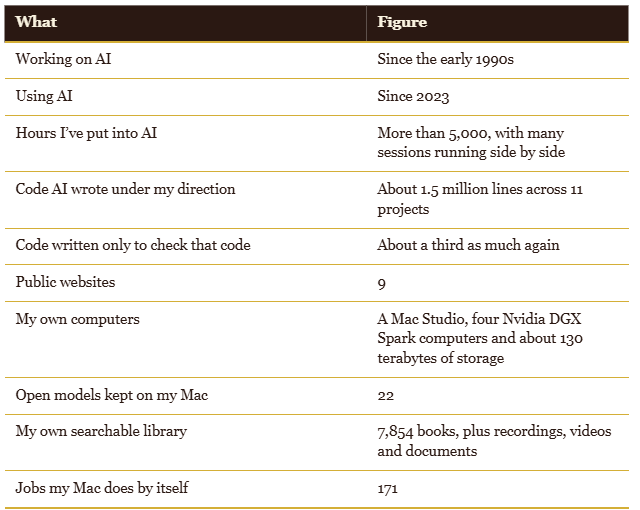
One person with AI sounds like a dude using ChatGPT. I was that dude myself once. I’ve been using AI since 2023, and I’ve been working on it a lot longer than that, since the early 1990s, when I was in high school and part of Duke University’s Talent Identification Program. All told I’ve put more than 5,000 hours into AI, with many sessions running side by side, and used about fifty different models.
In about a year and a half I’ve directed AI to write about 1.5 million lines of code across 11 projects, plus about a third as much again in automated tests, code whose only job is to check the rest. Nine of those projects are public websites, including my show’s site, Technocracy Atlas and DitchTheDollar. I make music videos with AI too, among them a song about surveillance and the land.
I don’t rent my data. I downloaded the original files myself, and they live on my own machines as one library I can search: 7,854 books, thousands of audio recordings and videos turned into text, court and government documents, a leaked set of offshore-company records and my show’s archive. For Technocracy Atlas I downloaded the federal government’s raw file on foreign-owned farmland, 49,548 rows, and had a program work out New Hampshire’s number from it. It matched the checked figures on all 11 points, with no AI doing the math.
My Mac Studio runs 171 jobs by itself, some on a schedule and some around the clock. One cuts every episode of my show into clips and posts them: 1,475 clips from 94 episodes so far, hundreds of them posted by the system itself. I also built 207 panels of AI advisers that imitate experts in different fields; they review the work and give me options, and I make the call.
What One Person Has Built with AI
Most people know AI as a chat window: you type a question and it answers. An AI employee is more like someone on your staff. You hand it a job and it does the work on its own. It thinks with an AI model, the program that serves as its brain. I’m building a whole team of them. The first version had 55, built on free open-source software called Hermes Agent, which anyone can download and change.
It didn’t always work at first, and in October I set it aside. When a project gets stuck, I leave the stuck part alone and keep tinkering. I try each new model on that part as it comes out, and I don’t bang my head against the wall in the meantime. A little more work and a newer model can take an old project and bring it back to life.
And it matters who owns that brain, because the owner decides what the employee is allowed to do and whether it shows up for work at all. So I’m rebuilding the team on the newest version of Hermes, and every employee will think with an open model on my own machines, with no closed lab behind it.
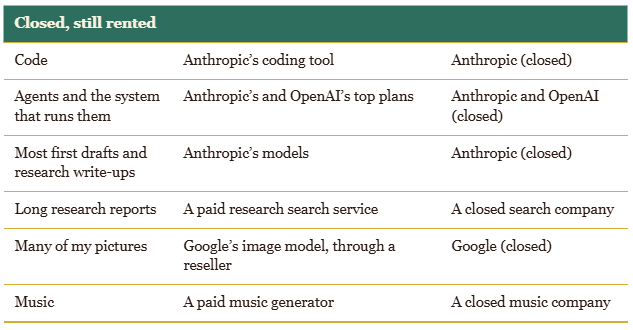
I pay the closed labs, and I’ve been censored by them. I hold the top plans at both Anthropic and OpenAI. Anthropic’s coding tool once refused to build me a program to collect drug package inserts, and those are public information. The image models refused about 80% of a batch of memes I tried to make for my show in November 2025.
What Closed Means
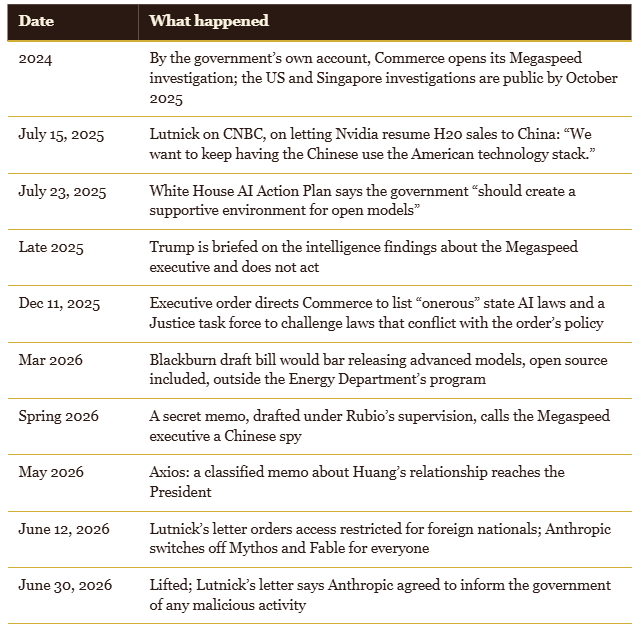
A closed model runs on someone else’s servers, and it can be switched off with a letter. On June 12, 2026, a letter signed by Commerce Secretary Howard Lutnick ordered Anthropic to restrict access to Mythos and Fable, two of the AI models it sells, for foreign nationals. Anthropic had no way to check each user’s citizenship on the spot, so it switched both models off for everyone. Fable, the model I was using, stayed off for 18 days.
Back in October 2025 I’d warned on my show that if you use AI online, “it can always be cut off.” Within eight months it happened to me. The letter used the power in a 2018 export law to control emerging technologies, which had never been the basis for a control before and has no rules written for it, so it comes down to one man’s say-so.
The models came back after Anthropic agreed, Lutnick’s letter said, to inform the US government of any malicious activity, and he kept the right to bring the restriction back “should circumstances change or should Anthropic fail to adhere to its commitments.” To me, the model that came back was less intelligent and more restrictive. Anthropic said it was giving certain government partners more early access to both models. Lutnick said in September, “we trust Anthropic.”
Anthropic’s chief told the Senate in 2023, “when you control a model and you’re deploying it, you have the ability to monitor its usage.” Put the switch-off and the agreement to report next to that sentence. I call it a closed-source AI surveillance system.
What Washington Promised
The United States, far from promoting free markets and competition, is using government policy to protect Big Tech. The White House published “America’s AI Action Plan” in July 2025, and under the heading “Encourage Open-Source and Open-Weight AI” it says open models “have unique value for innovation because startups can use them flexibly without being dependent on a closed model provider.” Open-weight means the lab hands out the trained model itself, called its weights, so anyone can download it and run it on a computer he owns. The plan also says “the Federal government should create a supportive environment for open models.”
Then look at what they did. Trump’s order of December 11, 2025, tells the Commerce Secretary to list “onerous” state AI laws, cuts the listed states off from some federal broadband money and has the Attorney General set up a task force whose “sole responsibility” is to challenge state AI laws that conflict with the order’s policy. The chip rule of November 16 points the same way: the license it demands for advanced chips “will not apply” to chips going to companies headquartered in the United States. To me, both clear the road for the biggest American companies.
Senator Marsha Blackburn (R-TN) released a 291-page draft bill in March 2026, named the TRUMP AMERICA AI Act. Under it, nobody could release or deploy an advanced AI model, open source included, unless the developer was in the Energy Department’s program and handed the Secretary “the underlying code,” the “data used to train” it and its “model weights” on request. Break that rule and the fine would be “not less than $1,000,000 per day of the violation.” Rules like this would fall hardest on the free models, because a closed lab that charges for every use can pay for the lawyers and carry that risk, and a lab that gives its model away for free can’t.
In Shenzhen Trump told the APEC leaders that he opposes “anything to control and stifle SI,” SI being short for super intelligence, his administration’s name for AI. The draft bill that would do exactly that has a short title whose initials spell his name: “The Republic Unifying Meritocratic Performance Advancing Machine Intelligence by Eliminating Regulatory Interstate Chaos Across American Industry Act.” Somebody should read him the title.
Why I Call It a Coup
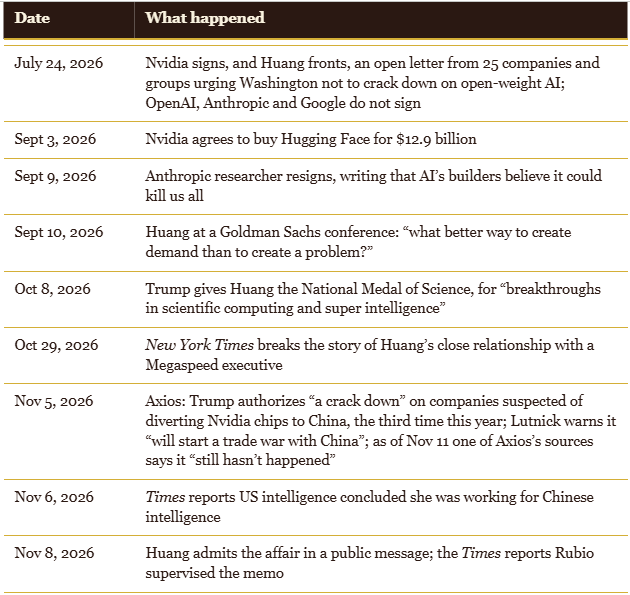
Huang’s record on open models is long. He pushed Nvidia’s own open models. In July 2026 Nvidia signed, and Huang fronted with his first post on X, an open letter from 25 companies and groups urging Washington not to crack down on open-weight AI. OpenAI, Anthropic, and Google did not sign, and The Next Web said, “Each would gain if Washington blocked Chinese open-model makers like Moonshot.” In September, eight weeks before the story about Huang broke, Nvidia agreed to buy Hugging Face, the main home of open models, for $12.9 billion. He also wanted to keep selling his chips to China.
By the government’s own account, Commerce opened an investigation of Megaspeed, a Singapore buyer of Nvidia chips, in 2024. Late in 2025 Trump was briefed on intelligence about Huang’s close relationship with a Megaspeed executive, and he didn’t act on it. By the spring a secret memo was going around Washington calling her a spy for China. Secretary of State Marco Rubio (also National Security Adviser) supervised the drafting, the New York Times later reported. Axios says a classified memo about Huang reached the President in May 2026.
The President gave Huang the National Medal of Science on October 8, for work “powering breakthroughs in scientific computing and super intelligence.” Three weeks later the Times broke the story of Huang’s close relationship with the Megaspeed executive, after officials had been investigating her and Megaspeed for more than a year. On November 6 it reported that US intelligence had concluded she was working for Chinese intelligence.
Then came Sunday, November 8. Huang told his employees in a public message, “I was unfaithful to my wife.” That night Trump was asked whether Huang should stay as chief of Nvidia, and he said, “I think so. Oh yeah, sure.”
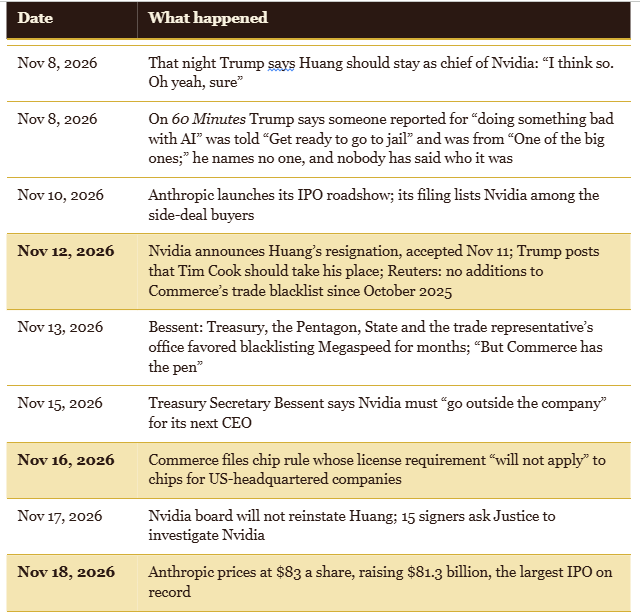
The same Sunday, 60 Minutes aired an interview in which Trump said AI risk is managed by “The DOJ.” He went on: “We had a situation where somebody was reported to us to be doing something bad with AI. We called them very strongly and said, ‘Get ready to go to jail’.” Asked whether it was a leader of a major AI company, he said, “One of the big ones. Yeah.” He named no one, and nobody has said who it was. I raised that interview on Redacted because I believe what happened at Nvidia was coordinated, and everybody was ready for it.
Two days later Anthropic began pitching its stock to investors. Nvidia’s board accepted Huang’s resignation on Wednesday night, and by Thursday morning he was out. Within hours the President posted that Tim Cook of Apple was the one man to take his place, joke or not. How often does a company lose its chief and the President of the United States go out recruiting the replacement?
The chip fight had two camps, and Axios laid them out on November 11 from six high-level sources. Trump, it reported, had authorized “a crack down on companies suspected of diverting Nvidia’s advanced AI chips to China for the third time this year” on November 5, and “One administration official has repeatedly stood in the way: Commerce Secretary Howard Lutnick,” who warned in the Oval Office that it “will start a trade war with China.” One of Axios’s sources said, “Well, it still hasn’t happened.” The next day Reuters reported that Commerce hadn’t added anyone to its trade blacklist since October 2025, the longest gap in more than a decade.
Treasury Secretary Scott Bessent was in the other camp. On November 13 he said that Treasury, the Pentagon, State and the trade representative’s office had favored putting Megaspeed on that blacklist for months: “But Commerce has the pen.” Two days later he told Fox News that Nvidia must “go outside the company” for its next chief and that “they need a dramatic shakeup.” I didn’t know the Treasury had a headhunting desk.
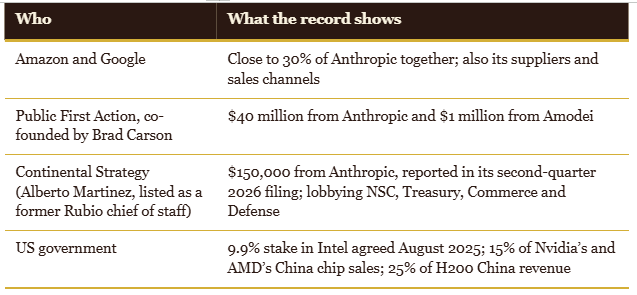
The next day that camp got a chip rule, which the Commerce release says was “written by and at the direction of the Department of Treasury and the National Security Council,” and Rubio, as national security adviser, runs the council’s staff. Earlier this year Anthropic had paid the firm of Alberto Martinez, listed in its lobbying filing as a former chief of staff to Marco Rubio, to lobby offices that include those two.
The spy story still has holes. The CIA is “not yet convinced” she knowingly passed anything to Beijing. The Washington Post says Rubio rewrote the CIA’s reporting “in his own more assertive terms.” And after meeting Xi, Trump said, “I haven’t heard that she was a spy.”
Huang admitted the affair himself, and nothing on the record shows why the story broke when it did. When power over a private company moves that way, from people with no vote on its board, I call it a coup. I said so on Redacted on November 16, the day the rule was filed: “I actually do think it was a coup.” My theory is that Huang was targeted because he’d been an outspoken backer of open-source AI, and that the coup is going to benefit specific individuals within the government.
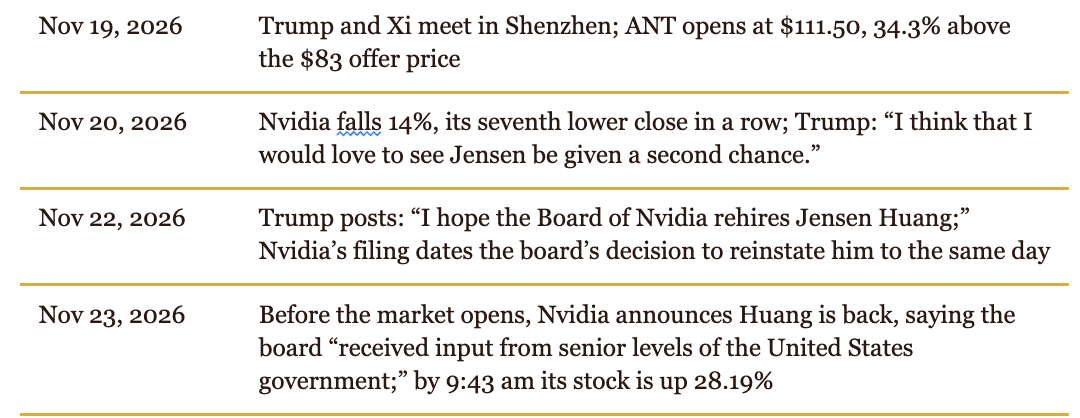
Then Washington wanted him back. On November 17 the board’s chair said it “does not intend to reinstate Jensen as CEO.” On Friday, November 20, the day Nvidia’s stock fell 14%, the President said, “I think I would love to see Jensen be given a second chance,” and on Sunday night he posted, “I hope the board of Nvidia rehires Jensen Huang.” So the President went out recruiting for Nvidia’s top job twice in 10 days.
Nvidia’s own filing dates the board’s decision to that Sunday, and its announcement says that in reaching the decision the board “received input from senior levels of the United States government.” It named nobody. That’s power over a private company moving from people with no vote on its board, which is what I call a coup, and this time Nvidia put it in writing.
Nvidia’s open-model work went on while he was gone. What open source stood to lose was its voice in Washington: the open-source world rallied around Huang, MIT Technology Review wrote, “because of his influence on policymakers.” Nobody has said so, but my bet is that he had to come to some arrangement on open-source AI to get his job back. The board he came back to has a new national security committee, which it says reflects its “further commitment to enhance its engagement with relevant government stakeholders.” Watch whether Nvidia’s purchase of Hugging Face closes in the first half of 2027, as scheduled, and whether Nvidia still stands behind its July letter against a crackdown on open-weight AI.
The Sequence, 2024 to November 2026
The $900 Billion Problem
Anthropic itself said on X in July 2025 that “one user consumed tens of thousands in model usage on a $200 plan,” called such cases “very costly to support,” and put weekly limits on its plans. When the research firm SemiAnalysis ran Anthropic’s $200 plan to its limit in 2026, the plan delivered about $8,000 a month of use at the company’s own list prices, about forty times what the subscriber pays. I pay for those plans myself. The company is buying its market with its investors’ money, and that’s what I mean when I say the closed labs are subsidized.
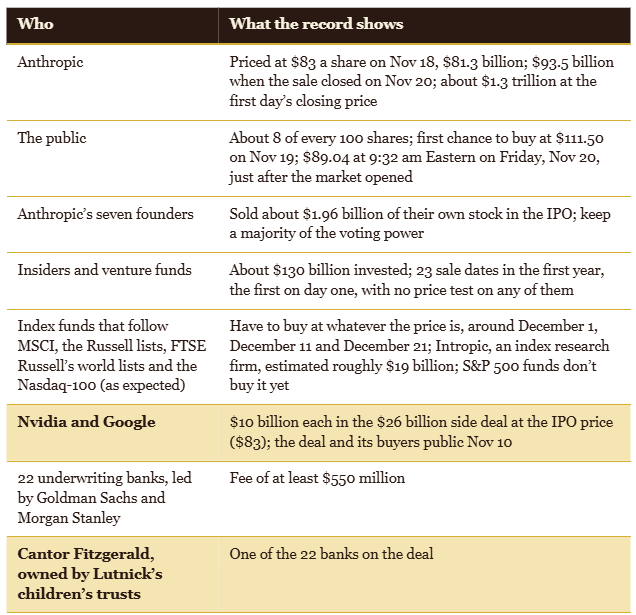
On paper Anthropic lost $104 billion in the first nine months of 2026, most of it an accounting charge that cost no cash. But the bill is worse. Of the roughly $900 billion Anthropic has committed to spend, $70.7 billion falls due in the twelve months after September 30, and $451.6 billion before the end of 2030. When the IPO closed on November 20, after the banks took extra shares, it had raised $93.5 billion, about 10% of that bill. Add the $26 billion side deal, in which chip and tech companies are buying stock at the IPO price, and the total, about $119.5 billion, is about 13%.
Anthropic’s chief executive, Dario Amodei, said on the stock’s first day of trading, “If you look at the amount of cash we have on the balance sheet and the amount of revenue that we’re already making per year, suddenly those commitments don’t seem so large.” They seem large to me. The company’s own filing says paying them “depends on our ability to generate significant revenue growth.”
These bills are under contract, and the growth has to come from customers, but so far prices have gone the other way. Anthropic cut its prices 20% in September and again in November, while open models took more than 70% of the text-processing tasks on Vercel, a service programmers use to run websites. In the third quarter, Anthropic’s day-to-day business went from a $974 million profit the quarter before to a $567 million loss. A company that must raise its prices can’t do it while a free alternative keeps getting better and cheaper.
Who Benefits
The biggest beneficiaries are the closed-source AI companies. The companies that sell Anthropic its chips are buying its stock. Nvidia and Google put in $10 billion each of a $26 billion side deal, at the $83 IPO price. Nvidia’s part was public on November 10, while Huang was still its chief. A chip seller wins either way, so the money sits on both sides of the table.
Twenty-two banks sold the stock, led by Goldman Sachs and Morgan Stanley, for a fee of at least $550 million. One of them is Cantor Fitzgerald, owned since May 2025 by trusts for Lutnick’s children. Track the personal holdings of the cabinet and the people related to them.
Nobody has said so officially, but my theory is that AI is being pumped to stop a recession, and that the rules are being written to protect it, because AI is responsible for most of the gains people have seen in their portfolios. By JPMorgan’s count AI stocks account for 75% of the S&P 500’s gains since November 2022, and by Goldman Sachs’s they make up about 45% of the index.
I said on my show in August 2025 that the strategy is to “bail this thing out one Ponzi at a time and hope that AI creates enough productivity increases to not have everything collapse.” In the seven trading days after Huang resigned, about $1.16 trillion of Nvidia’s value on paper was gone, and the S&P 500 fell 9.3%. By 9:43 am on the morning Nvidia announced his return, about $850 billion of it was back. Other news hit Nvidia that week too, including a Reuters report on Friday that the SEC, which polices the stock market, is looking into its accounting. But the President tied the return to “the American Economy.” Nobody in Washington will say more than that, but I think Huang was put back because the damage got so bad that they wanted to stop the implosion.
Dumped on the Public
The research firm New Constructs put it plainly: “It has maxed out private investors, who now need the company to tap public markets to get them their payday.” Wall Street calls that payday a liquidity event, the day the owners of a private company finally get to turn their shares into cash. I call this whole IPO a liquidity event, the insiders’ way out, and it’s being dumped on the public.
The float is the shares the public can actually buy and sell. The public was sold about 8 of every 100 Anthropic shares, and the existing owners kept about 92. Picture a street of 100 identical houses with only 8 for sale, where every house gets valued at whatever those 8 fetch. At the first day’s closing price, that made the whole company worth about $1.3 trillion.
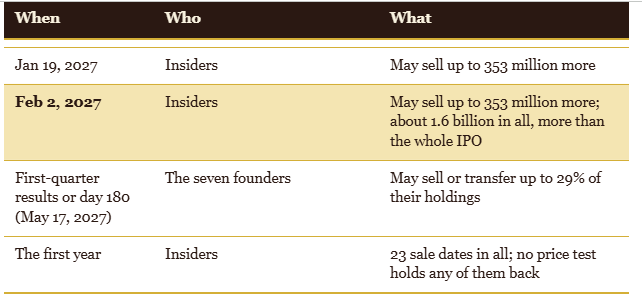
The owners of the other 92 have a calendar for selling theirs. After most IPOs, insiders wait three to six months to sell, a stretch called the lockup. Anthropic’s own prospectus, its official sales document, sets out 23 sale dates in the first year.
On the first day of trading, insiders other than the founders could sell more than a quarter as many shares as the IPO sold, and the company’s chief financial officer was among those allowed to. By February 2 the shares they’re allowed to sell add up to more than the whole IPO. The seven founders agreed to wait months before they sell more. They’d already sold about $1.96 billion of their own stock in the IPO.
Now look at the buyers. A fund that tracks an index has to follow its list: when a stock joins the list, the fund buys it at whatever the price is. So if your retirement money sits in a fund that tracks one of the lists adding Anthropic, you don’t have to buy Anthropic yourself for your fund to buy it.
A new company used to wait up to a year or longer to join the Nasdaq-100. Nasdaq announced new rules in March, in force since May 1: the biggest newcomers now go in after 15 days of trading, and the rule that a company put at least 10% of its shares in public hands is gone. Anthropic put about 8% there. Reuters reported that the change was “designed to entice richly valued private companies like SpaceX, Anthropic and OpenAI, among others, to list on the exchange.” And Anthropic listed on Nasdaq.
FTSE Russell, another list maker, changed its rules too, with “several potential ‘mega-cap’ IPOs (including SpaceX, OpenAI and Anthropic)” in mind. It thought it likely that “some of these mega-caps may list only a small percentage of their shares.” The S&P 500 kept its rules: at least a year of trading and a profit, which leaves Anthropic out on both counts, so S&P 500 funds don’t buy it yet.
MSCI’s lists add Anthropic on December 1, the Russell lists on December 11, and FTSE’s world lists on December 21, the day the Nasdaq-100 is expected to add it too. An index research firm, Intropic, estimated the funds’ buying at roughly $19 billion. One of the insiders’ sale dates, December 15, falls in the middle, so your fund has to buy in the same weeks the insiders are allowed to sell.
Who Has to Buy, and Who May Sell
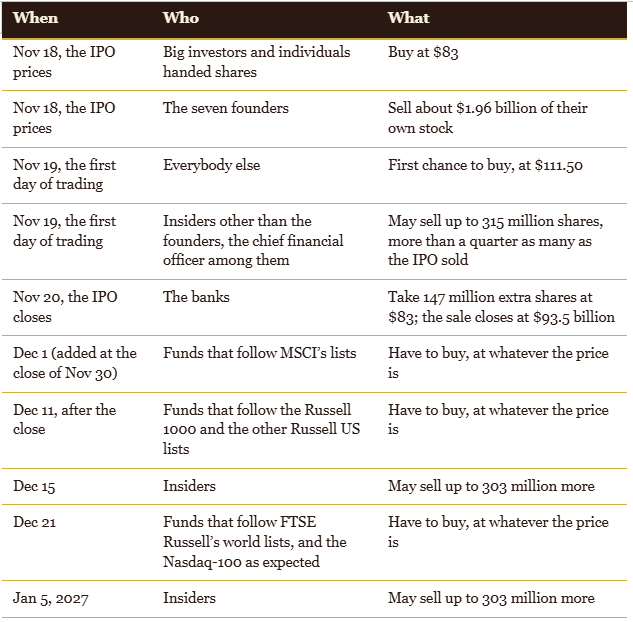
The price tells you who’s left holding it. The $83 price went to big investors and to individuals handed shares in the offering. Everybody else got a first chance on Thursday, November 19, at $111.50. It closed at $97.17. At 9:32 am Eastern on Friday, November 20, a share cost $89.04. Anybody who bought at that first public trade was down about a fifth, and everybody who paid $83 was still ahead. That’s what I mean by dumped on the public.
To me, the insiders are cashing out of a business that free models are already squeezing, and your retirement fund is lined up to buy.
Who Benefits: The Money Map
Weaponizing Patriotism
The formula is problem, reaction, solution. They either create a problem or take one that comes along, the reaction is usually fear, and lo and behold, the solution is already baked, and it increases surveillance and gives them more control. I said it on Redacted about the bank outages, and it fits Nvidia. The problem was a spy story, the reaction was fear, and the solution was a chip rule that makes data centers, chip factories and chip exporters check who owns their customers.
Huang said himself that fear helps sell products. The day after an Anthropic researcher resigned in September 2026, warning that AI’s builders believe “it could kill us all by the end of the decade,” Huang told a Goldman Sachs conference that the cybersecurity talk was there “because the industry is getting ready to launch some products,” and he asked, “what better way to create demand than to create a problem?” They’re trumping up all of this fear to push more and more regulation into place.
Watch that word, SI. The President told 60 Minutes that super intelligence is “a much better name I think, ‘cause it’s not artificial.” By November the Justice Department had a Super Intelligence Task Force to “ensure that America’s leadership in SI is not compromised.” The night the chip rule was filed, the Homeland Security Secretary said of that week’s outages, “I believe that it’s the SI.”
Then came the letter. Fifteen national security and AI policy figures asked Attorney General Todd Blanche on November 17 to investigate what Nvidia knew about its chips being smuggled to China and whether it “deliberately blinded itself to export control violations.” Its pitch is the flag: “The United States has the world’s most advanced SI chip technology, much of it built by Nvidia.”
The group that organized it is Americans for Responsible Innovation, and its president, Brad Carson, signed it. Carson also co-founded Public First Action, a nonprofit and super PAC network that has received $40 million from Anthropic and $1 million from Dario Amodei personally.
There Is No China Versus the US
In Shenzhen, Chinese state media say, Xi told Trump the two countries should “strengthen communication and coordination to guard against artificial intelligence safety risks,” and Trump’s own Treasury Secretary had already said both sides would discuss how to alert each other to AI safety incidents at the APEC talks. After the meeting, Trump said, “And whoever wins SI wins.” There’s coordination globally, and the United States is a leading participant in it, frankly.
The US government also takes its cut of the China trade it warns you about. Lutnick went on CNBC in July 2025 to explain why Nvidia could resume selling its H20 chips to China. “We don’t sell them our best stuff, not our second best stuff, not even our third best,” he said, and “We want to keep having the Chinese use the American technology stack, because they still rely upon it.”
That August a deal gave Washington 15% of Nvidia’s and AMD’s China chip sales, and in December Trump let Nvidia sell H200 chips in China with 25% of the revenue going to the government. Eleven months later Huang was out, in the middle of a China spy story.
When he came back, the President posted that the Attorney General “has confirmed that the U.S. Government does not possess evidence that he has engaged in any unlawful conduct.”
The United States has taken the closed-source road. The closed labs’ censorship is going to obliterate American competitiveness, whether or not their models are more advanced, because you can run open models uncensored and configure them yourself. If you’re a free person in any country, what matters is whether you can hold the model yourself, on your own machine.
The Case for Owning Your Model
In a Wharton survey of more than 800 senior leaders at large US firms, “Three out of four leaders reported positive returns on AI investments, and 88% plan to increase spending in the next year.” Anthropic’s own filing shows 11,900 customers each paying at least $100,000 a year, up from more than 1,500 at the end of 2025. A company doesn’t gain that many six-figure customers in nine months on a tool that returns nothing. I get that return myself.
What I pay Anthropic for its coding tool is one hundred percent worth it. Owning pays faster still. I paid $4,000 for an Nvidia DGX Spark, and I had my money back on the first one in sixty days.
So why rent the thing that makes you money? If these models return more than they cost, the sensible move is to own the model that produces the return. The company renting it to you has that bill to pay. When the rent goes up, and I think it will, a business that owns its model keeps its return.
What I Run on My Own Machines
My rule is to use the big closed models as much as possible while they’re subsidized, and to move each job home when an open model is good enough. A lot has already come home: uncensored pictures, video, my own cloned voice, speech to text and search over my books. Some of my music videos used to cost $100 or $200 just for access to a paid video model, and with an open-weights model one cost me $12 in computing power.
Qwen, an open model from Alibaba in China, does my private drafting, and to me it’s right up there with Anthropic. An uncensored version of it, possible because open weights can be changed, checks the other models’ work. I still rent the rest, coding and the running of my system above all, and what I run at home stays at home.
What I Run
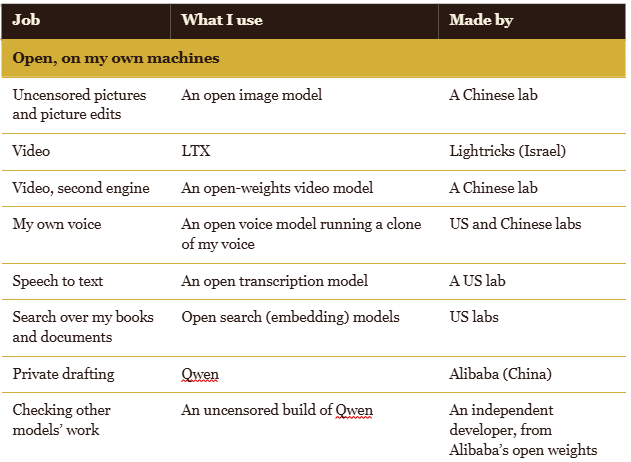
The makers of the open models I run are in China, Israel and the United States, and anyone can download them.
What We Should Do
Download an open model while no government license is required, and keep a copy. You can start small, with a local AI on your phone that doesn’t even need to connect to the internet. Keep your data on your own hardware, so no company that has agreed to report malicious activity to the government ever sees your questions.
When the next China story about AI comes along, treat it as a sales pitch until you know who gets paid, and ask who wrote the rule and who it exempts.
Oppose any law that lets one official switch off a model or demand its weights, whatever flag it flies. Withdraw your consent from the fear.
For years I’ve taught people to leave the dollar, and they walk out of my workshops able to use money they hold themselves. You can get on the list for the first invite to my workshops on leaving the dollar. I’ve been talking about the same discipline for your intelligence since August 2025, when I spoke on my show about “the ability to have a self-custody AI.”
Most people have never run a model on their own computer, and the closed labs are counting on that. So I’m considering running online workshops to show people how to get started with open-source AI. I believe this is one of the most important things we can do. A model on your own machine can’t be switched off by a letter from Washington.
Sources
- CBS News, “Anthropic set for Nasdaq trading debut after completing largest IPO in history,” Nov 19, 2026
- Reuters via Euronext, “Anthropic valued at $1.5 trillion as IPO raises record $81 billion,” Nov 19, 2026
- CNBC, Anthropic IPO live updates, Nov 19, 2026
- Fox News, Anthropic IPO live updates, Nov 19, 2026
- CNN, “Anthropic to seek $1.4 trillion valuation in blockbuster IPO,” Nov 10, 2026
- Yahoo Finance, “Everything you need to know ahead of Anthropic’s IPO,” Nov 3, 2026
- BigGo Finance, “Anthropic Prices Record-Scale IPO as Safety Warnings Collide With $1.4 Trillion Ambition,” Nov 18, 2026
- Leverage Shares, Anthropic IPO tracker
- 24/7 Wall St., on Anthropic’s spending commitments, Nov 3, 2026
- TechCrunch, on Anthropic’s weekly limits for heavy subscribers, July 28, 2025
- Futurism, on Anthropic’s plan limits, July 30, 2025
- Cryptopolitan, on the SemiAnalysis test of the $200 plans, Aug 24, 2026
- Wharton and GBK Collective, survey of senior leaders on returns from AI, Nov 17, 2025
- investingLive, “AI stocks near 45% of S&P 500 weight, Goldman flags rising concentration,” Apr 22, 2026
- Nvidia, “A Message to Our Company,” Nov 8, 2026
- The White House, “President Trump Presents National Medals of Science and National Medals of Technology and Innovation,” Oct 8, 2026
- Nvidia filing with the SEC, “NVIDIA Announces CEO Transition,” Nov 12, 2026
- Axios, on Commerce Secretary Lutnick stalling the crackdown on Nvidia chips diverted to China, Nov 11, 2026
- Reuters via BNN Bloomberg, “Lutnick stalled Trump crackdown on diversion of Nvidia chips to China, Axios reports,” Nov 12, 2026
- Reuters via BusinessDay, “Bessent blames Lutnick’s department over lack of export controls for Nvidia partner Megaspeed,” Nov 13, 2026
- TechCrunch, “The unfolding Jensen Huang scandal: a timeline,” Nov 13, 2026
- The New York Times, Oct 29, 2026
- The New York Times, Nov 6, 2026
- The New York Times, Nov 8, 2026
- CBS News, “Read the full transcript of Ross Douthat’s interview with President Trump,” 60 Minutes, Nov 8, 2026
- CNBC, “Nvidia’s Kress faces a divided workforce as some employees push for Huang’s return,” Nov 18, 2026
- NBC News, “Jensen Huang says he would be ‘honored’ to return as Nvidia’s CEO if he were asked,” Nov 18, 2026
- Fox Business, on Treasury Secretary Bessent’s call for an outside chief at Nvidia, Nov 2026
- MacRumors, on Trump’s post naming Tim Cook, Nov 12, 2026
- Axios, “Nvidia CEO Jensen Huang: AI fears designed to generate cybersecurity business,” Sept 10, 2026
- Axios, “Scoop: Anthropic whistleblower gave up his equity to leave the company,” Sept 9, 2026
- The Next Web, “The AI giants just broke with OpenAI and Anthropic on open weights,” July 24, 2026
- The Next Platform, “Nvidia Expands Its Open Source AI Presence With $12.9 Billion Hugging Face Buy,” Sept 3, 2026
- NBC News, “National security and AI figures urge DOJ to probe what Nvidia knew about chip smuggling,” Nov 18, 2026
- POLITICO via Yahoo News, “Leading AI safety advocate likely to run for president,” Nov 2026
- Bureau of Industry and Security, “BIS Issues Rule Addressing Remote Access to American Super Intelligence Technology,” Nov 16, 2026
- Reuters via Yahoo News, “US removes curbs on Anthropic’s latest Fable and Mythos AI models,” June 30, 2026
- CSIS, analysis of Commerce’s June 12 letter to Anthropic, June 16, 2026
- Mayer Brown, “Commerce Department Extends Export Controls to Advanced AI Models, Authorizes Release to Specific Trusted Partners,” June 30, 2026
- Anthropic, notice on access to Fable 5 and Mythos 5, June 12, 2026
- US Senate hearing record, July 25, 2023 (S. Hrg. 118-108)
- Sen. Marsha Blackburn, TRUMP AMERICA AI Act, draft bill text, March 2026
- Sen. Marsha Blackburn, TRUMP AMERICA AI Act, section-by-section summary
- The White House, “America’s AI Action Plan,” July 23, 2025
- The White House, “Ensuring a National Policy Framework for Artificial Intelligence,” Dec 11, 2025
- Intel, on the US government’s 9.9% stake, Aug 22, 2025
- Reuters via KSL, “Nvidia, AMD to pay 15% of China chip sale revenues to US, official says,” Aug 11, 2025
- CNBC via NBC San Diego, “Commerce Secretary Lutnick says China is only getting Nvidia’s ‘4th best’ AI chip,” July 15, 2025
- Reuters via BusinessWorld, “Chip tensions loom over Trump-Xi summit, as US and China push AI safety steps,” Nov 16, 2026
- Euronews with AFP, “US President Trump rejects global AI regulation as China’s Xi calls for cooperation on safety,” Nov 19, 2026
- CNBC, on the Trump and Xi meeting at APEC, Nov 19, 2026
- Reuters via MarketScreener, on Trump’s remarks after meeting Xi, Nov 18, 2026
- Yahoo Finance, markets live blog, Nov 19, 2026
- MSCI, announcement on the early inclusion of Anthropic in the MSCI Global Standard Indexes, Nov 19, 2026
- sec-api.io, “Anthropic (ANT) IPO: $83.00 a Share, $81.3bn Offering and First Trading Days, SEC Filing Analysis,” Nov 19, 2026
- Anthropic, preliminary prospectus, Nov 17, 2026
- Bloomberg via WealthManagement.com, “Anthropic Founders to Cash Out $1.75B in Blockbuster IPO,” Nov 2026
- Reuters via BNN Bloomberg, “New Nasdaq rules to include ‘fast entry’ for new listings on benchmark index,” Mar 30, 2026
- Reuters via RTÉ, on SpaceX seeking early entry to the Nasdaq-100, Mar 10, 2026
- Nasdaq, Nasdaq-100 Index consultation of February 2026: summary of responses and conclusion
- FTSE Russell, “Faster large-cap entry to the Russell,” May 27, 2026
- FTSE Russell, notice on Anthropic’s fast entry to the FTSE Global Equity Index Series, Nov 19, 2026
- FTSE Russell, notice on Anthropic’s addition to the Russell US Indexes, Nov 19, 2026
- TechTimes, “Anthropic IPO Approved for Nasdaq; Nasdaq-100 Funds on Track to Buy ANT at December 21 Open,” Nov 17, 2026
- Reuters via Khaleej Times, “From SpaceX to Anthropic, markets have a new playbook for mega share debuts,” Nov 12, 2026
- S&P Dow Jones Indices, “Consultation on Treatment of MegaCap Companies – Results,” June 4, 2026
- Business Insider via Yahoo Finance, “Let’s try to unpack Anthropic’s wild share-lockup plan,” Oct 27, 2026
- AP via BNN Bloomberg, on Anthropic’s first day of trading, Nov 19, 2026
- Nasdaq, quote page for Anthropic (ANT)
- Anthropic, “Anthropic announces closing of initial public offering, including full exercise of underwriters’ option to purchase additional shares, and closing of concurrent private placement,” Nov 20, 2026
- Reuters via Devdiscourse, “Anthropic IPO haul rises to $93.5 billion after underwriters exercise greenshoe,” Nov 20, 2026
- Nasdaq, questions and answers on the 2026 changes to the Nasdaq-100
Join the Conversation
Published under a Creative Commons Attribution 4.0 International License
For reprints, please set the canonical link back to the original Brownstone Institute Article and Author.
Author