
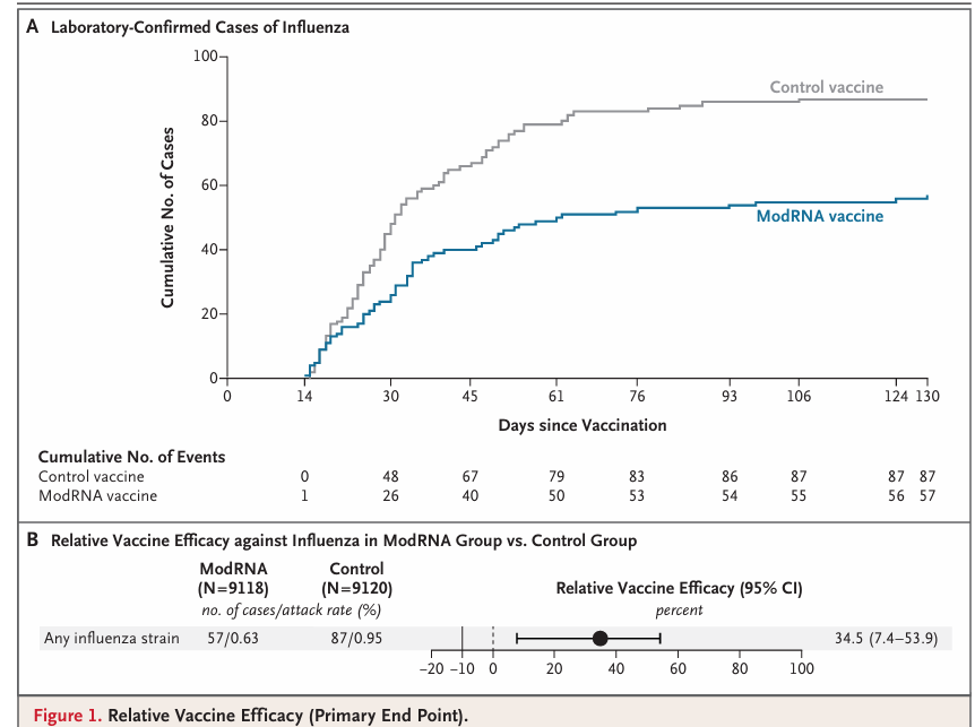
Last year, the New England Journal of Medicine published the results of a randomized trial of an mRNA flu vaccine (manufactured by Pfizer). The study compared the experimental product with a traditional vaccine during the 2022–2023 flu season and concluded that the former was superior. Below is the key finding as reported in the abstract:
“The relative efficacy of the modRNA vaccine as compared with the control vaccine against influenza-like illness was 34.5% (95% confidence interval [CI], 7.4 to 53.9) on the basis of 57 cases in the modRNA group and 87 cases in the control group…”
I offer a critical look at the results of the trial. Better late than never.
To make a long story short, there are findings that suggest non-uniform ascertainment of the endpoint in the two arms, as well as biologically implausible results. The estimated relative vaccine effectiveness (RVE) cannot be trusted, and we cannot infer that the mRNA-based product differed from the traditional vaccine. How effective the latter was in that season will be revealed at the end. (Spoiler: It was not.)
The main results were shown in Figure 1 of the paper (screenshot).
Two points about my analysis below:
- I could not compute risk ratios because exact denominators are not known. However, event-based analysis was similar to rate-based analysis. For example, the estimated RVE based on the number of events is 1–(57/87) = 0.345 or 34.5%, just like the reported RVE.
- I truncated the followup at 76 days after vaccination, a time when 95% of the events have already accumulated: 53 of 57 events in the mRNA arm and 83 of 87 events in the control arm.
Based on the numbers in Figure 1, we can compute the cumulative RVE by successive days after vaccination (Table). We observe a monotonic decline from 46% by day 30 to 36% by day 76.

To better understand the observed decline, I computed interval RVE: the RVE in consecutive two-week periods. (For the first 14 days, we have no data on the primary endpoint.)
It is now clear that the gradual decline reflects much lower effectiveness after the first month, ranging from 17% to 26% (top graph). Since the variation is small, we may combine the last three periods (bottom graph).
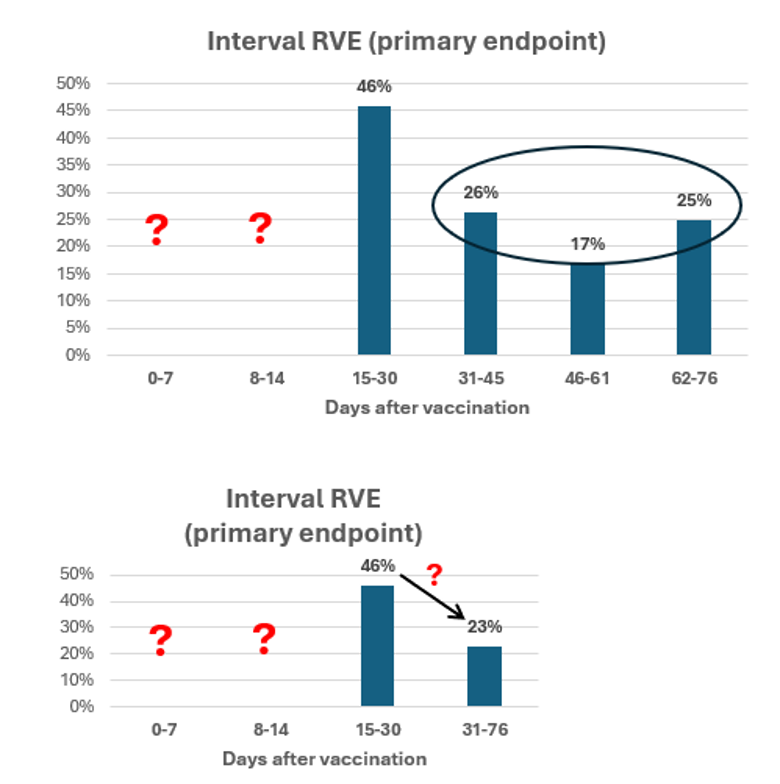
Evidently, the so-called superiority of the mRNA vaccine peaked during a two-week period (days 15–30) and collapsed to half of that peak later on. Why did superiority decline? That does not correspond to the expected effect of a superior vaccine over two months.
The authors provided a supplementary appendix with complete data on another endpoint (Figure S2, screenshot).
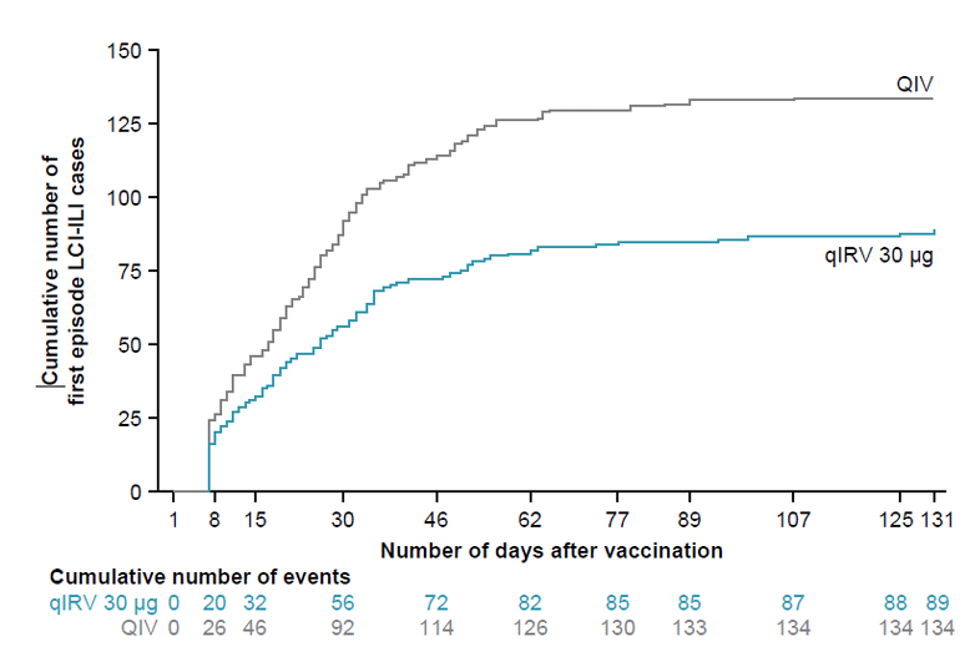
Based on the numbers in Figure S2, we can compute the interval RVE between day 15 and day 77 for this endpoint too:
Number of events in mRNA arm: 85–32=53
Number of events in control arm: 130–46=84
RVE: 1–(53/84) = 0.37 or 37%, which is similar to the estimate for the primary endpoint by day 76 (36%).
For this endpoint, however, we have data on the first two weeks. I will return to this period momentarily.
First, the dramatic decline of RVE after 30 days is seen again (top graph). From a peak of almost 50% on days 16–30 to 17%-27% later on. Combining the last three categories as before, we observe reduction from 48% to 24% (bottom graph). What do immunologists have to say on this observation? Does it make any biological sense? Are these numbers trustworthy?
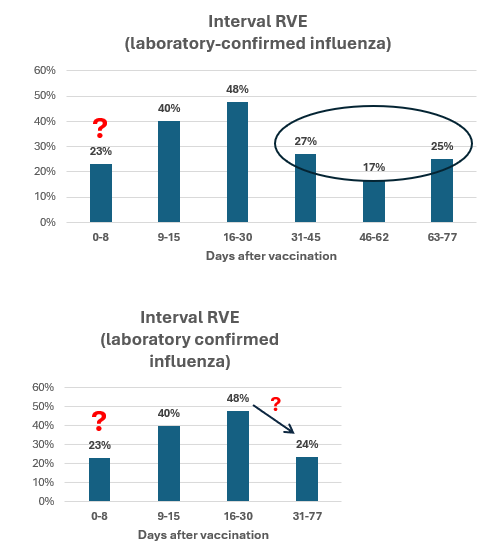
There is more. A new surprising result has been discovered. Within one week after vaccination, the mRNA product already shows superiority (RVE=23%) over the traditional vaccine! How come? Conventional wisdom says that building up immunity — by whatever vaccine — takes time. Studies of both the traditional flu vaccine and the Covid mRNA vaccine have always excluded the first two weeks from the computation. In fact, that’s why the authors excluded the first two weeks in their main analysis. They did not expect any meaningful effect of either vaccine.
That early RVE of 23% is nothing more than bias. The most likely explanation is non-uniform ascertainment of the endpoint in the two arms of the trial, with underdetection in mRNA recipients. If it happened early on, it probably happened throughout the followup. Biases don’t disappear overnight. For sure, the comparable estimate for days 31 to 77 (RVE=24%) is not trustworthy either.
We are left with a questionable jump to 40% in the second week (too early?) and a peak of 48% on days 16–30. How much ascertainment bias is embedded in these estimates?
To summarize, superiority was not demonstrated beyond reasonable doubt. At most, equivalence might be proposed.
All that is left to decide is how effective the traditional flu vaccines were in that season (2022–2023).
I examined the question thoroughly in two previous posts. In one, I concluded that the results from the test-negative design (reference 17 in the NEJM paper) are biased and incoherent. In another, I estimated zero effectiveness against symptomatic infection in a cohort study, using the estimated effectiveness against asymptomatic infection.
What competing conclusions may I offer from my three analyses?
· The conventional flu vaccine in that flu season was about useless.
· The novel mRNA flu vaccine was about the same.
Of course, there was no third arm of placebo recipients in the Pfizer trial to tell us the truth on either vaccine. Why not? Because it might have damaged both public health trust and Big Pharma.
Republished from Medium
Join the Conversation
Published under a Creative Commons Attribution 4.0 International License
For reprints, please set the canonical link back to the original Brownstone Institute Article and Author.
Author