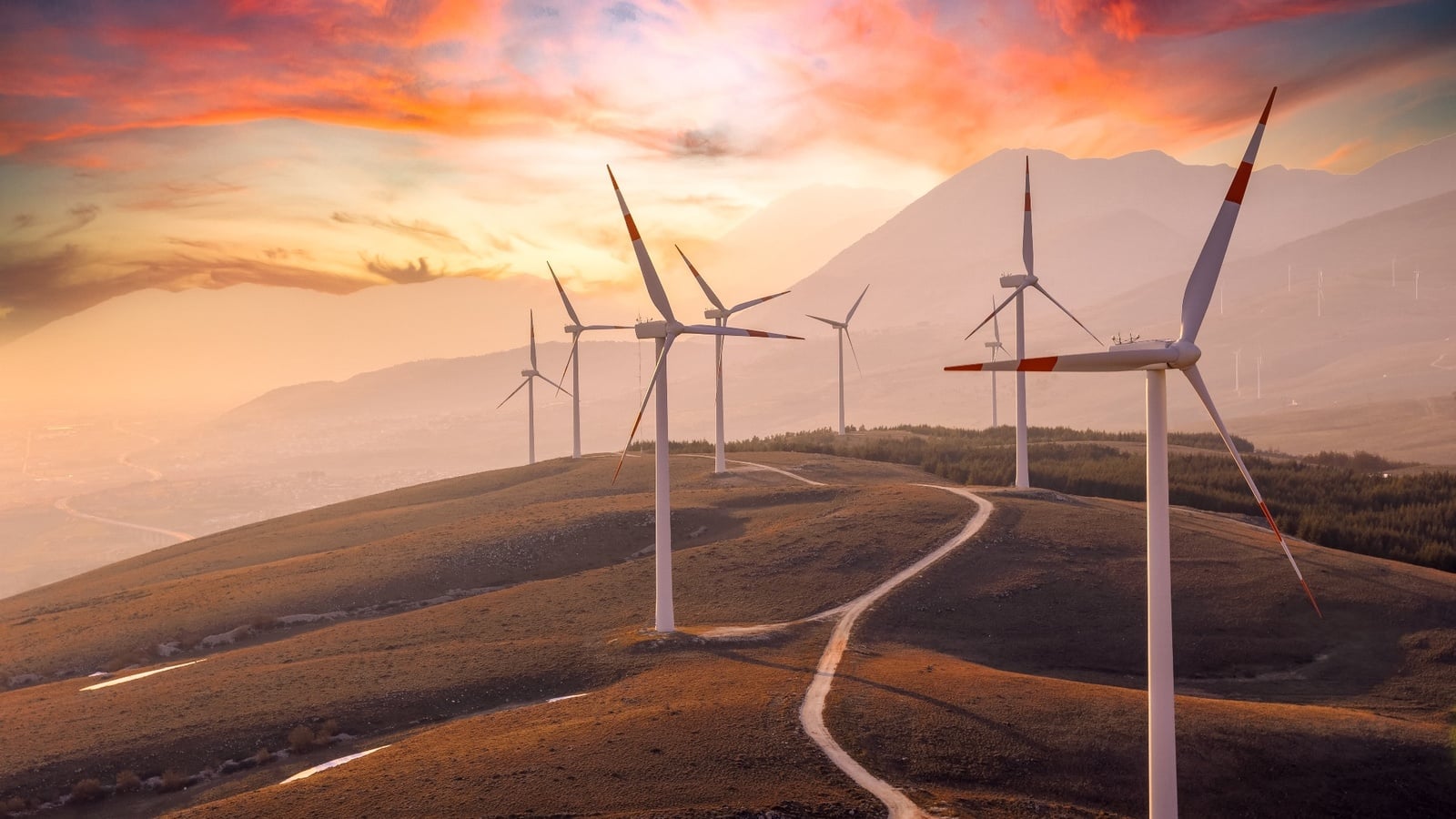

Canary in a Climate World: Climate Realism vs. the Net Zero Myth (2026) is the third book in the Canary in a Covid World/Climate World series. The first was Canary in a Covid World: How Propaganda and Censorship Changed Our (My) World (2023) and the second was Canary in a (Post) Covid World: Money, Fear and Power (2025). As the titles suggest, the three books trace the changed contours of the world under the impact of the twin crises alleged to have confronted humanity with existential threats. Intriguingly, both narratives seem also to be unravelling in tandem.
My own chapter in the final book describes the many parallels in the two official narratives, including the willing co-option of the media to parrot and amplify the narrative. The institutional failure of the media as a safety guardrail against the abuse of entrusted power by political and health authorities is not news to the Brownstone community. After all, many members were themselves targeted by the censorship industrial complex.
Three American and Argentinian researchers looked at the reporting of climate change stories by ten leading US and British media outlets, five left-leaning (BBC, Guardian, Independent, New York Times, Washington Post) and five right-leaning (Daily Mail, Fox News, New York Post, Telegraph, Wall Street Journal). Their study was published by the National Bureau of Economics Research as Working Paper No. 35216 in May 2026. A total of 116,045 full-text articles from the ten media outlets covering all five IPCC Assessment Reports were scrutinised to observe patterns of how reporters, editors, and columnists selected, framed, and presented stories to governments and the public. The study found a consistent bias towards emphasising higher-impact magnitudes within the ranges reported by the IPCC, a validation of the journalistic adage that if it bleeds, it leads.
Geological records show that warming and cooling periods go through extended cycles with no clear pattern to the intensity, severity, and timing of the cycles. Natural disasters have always been with us and climate change is another constant. The relationship between climate and natural disasters is anything but clear. An IPCC assessment found only weak links between human-induced climate change and droughts, wildfires, floods, and hurricanes.
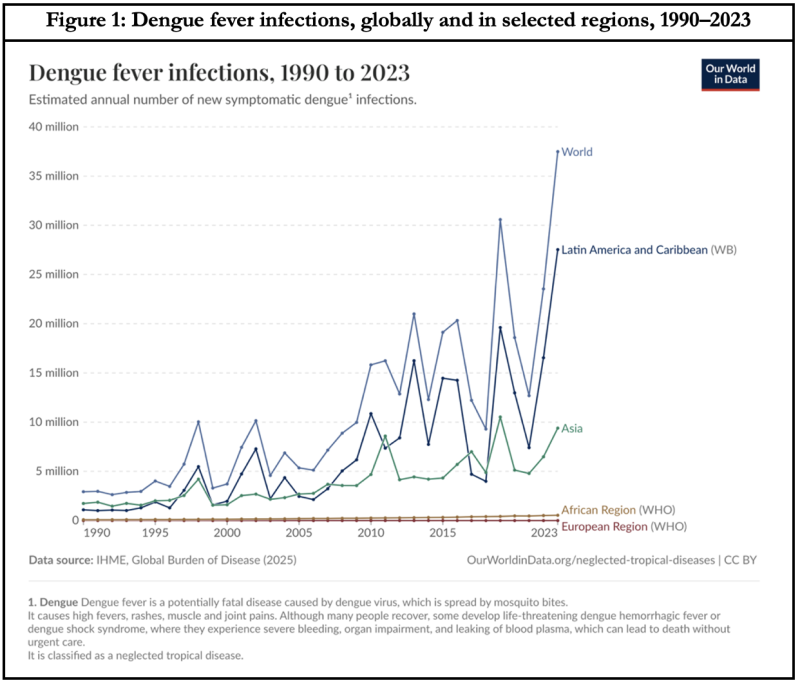
Notwithstanding this, legacy media just cannot seem to help themselves when it comes to shoehorning climate alarmism into disaster stories. On 23 July, writing about the worst dengue fever outbreak in a decade in Sri Lanka, a BBC report by Kelly Ng and Sampath Dissanayake commented that ‘as temperatures rise worldwide, these disease-carrying mosquitos are now moving into new areas, including Europe and the Mediterranean.’ They cited a WHO report that the number of cases had surged globally from around 500,000 in 2000 to 14.4 million in 2024.
I decided to check this out. I am confident you will gasp in shock to learn that the BBC was cherry-picking data to fit the narrative. As Figure 1 shows, the global trajectory is a jagged line with peaks and troughs. The global number of dengue fever infections (not cases) fell from 10 million in 1998 to 3.7 million in 2000, upturned, and stood at 37.5 million in 2023. But the slope of the global rise almost precisely parallels the rise in Latin America and the Caribbean, from 2 million in 2000 to 27.5 million in 2023. Unless the BBC is prepared to inform us ignorant deplorables just why the temperature rise is global but the dengue infections is restricted mainly to this one region, BBC Verify should call them out on this. But don’t hold your breath. Climate change is the narrative that must not be challenged.
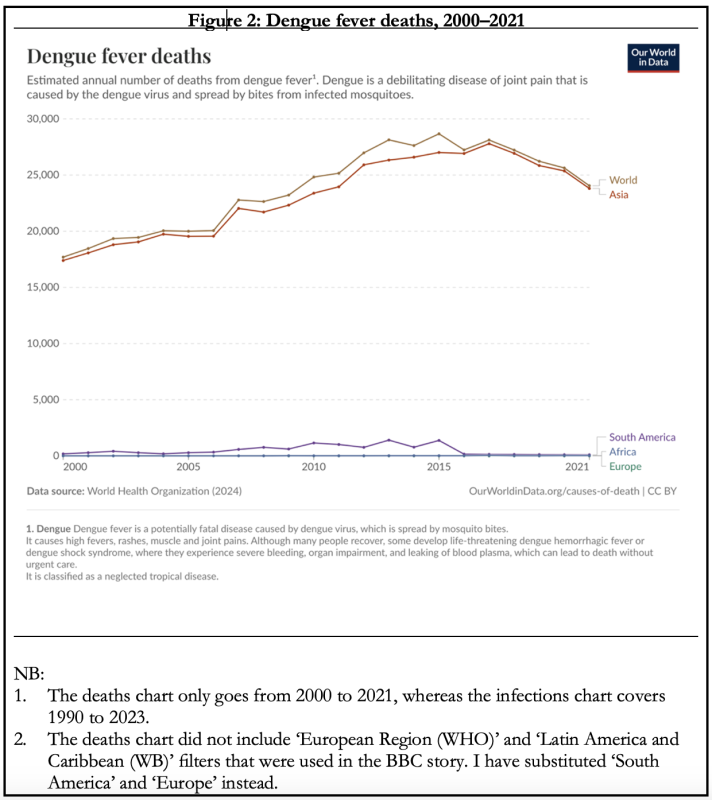
Furthermore, on dengue fever deaths, the global slope broadly follows the Asian curve (Figure 2), suggesting that dengue mortality might correlate more to Asiatic poverty, that energy intensity is the key to alleviating and then eradicating poverty, and that fossil fuel-driven economic growth is critical to this transition from high to low vulnerability to death by infectious diseases.
Consider another example. On 2 November 2025, BBC News published an article with the headline ‘Devastation on repeat: How climate change is worsening Pakistan’s deadly floods.’ Having grown up in a part of India that is subject to annual flooding as the overflowing rivers descend into the plains from the melting snows atop the Himalayan ranges, I am inured to local news reports that every year faithfully described the floods as ‘unprecedented.’ I thus read the BBC report with particular interest. Alas, it brought back the irritable memories of the old media reports. There were graphic before-and-after images to show the damage but not charts to map their long-term frequency, intensity, and variability.
True to form like all reporting of natural disaster events by climate zealots, there was no contextualisation of the history of cycles of droughts and floods, no acknowledgment of the inconvenient facts that these were not the worst floods in the region’s history and that they can affect crop yields for both better and worse, nor investigation of the possibility that the death tolls from flooding might be due to rising population pressures and the resulting increase in human settlements in flood plains. It’s as if before industrialisation, climate had been absolutely invariable.
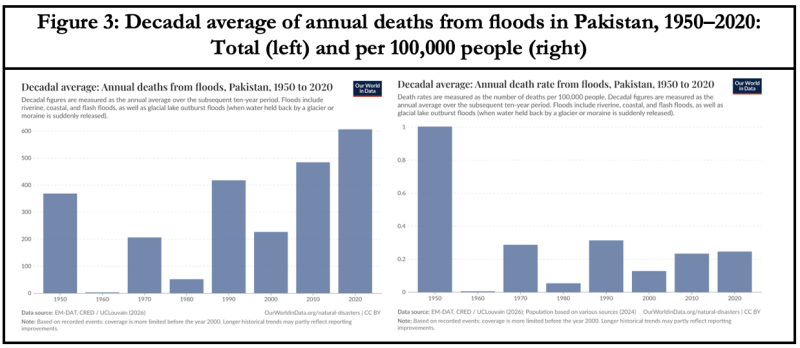
So, once again, I consulted the trusty Our World in Data site. Once again, if you cherry pick the raw numbers, there has been a steady jump in the numbers dying in Pakistan’s flood-related deaths decade-by-decade since the 1950s. But the picture is dramatically different when we chart the number of deaths as a share of the total population (Figure 3), again suggesting that building resilience on the back of economic development as a prerequisite might be rather more helpful in helping the people of Pakistan than obsessing over an alleged climate crisis.
Climate Complexity Makes Attribution Challenging
Complexity of climate systems is due to nonlinear equations involving many different variables on land, sea, air, and time, as well as the interactive linkages among multiple subsystems like the atmosphere, oceans, glacier ice, permafrost, land surface, etc. Non-linear, complex, and multiple subsystems make it notoriously difficult to predict future trajectories and effects. The relative potency of the different drivers of climate change variability—such as CO2 emissions, solar variability, ocean circulation patterns, volcanic eruptions, and Milankovitch cycles of planetary orbital variations—is not known with precision.
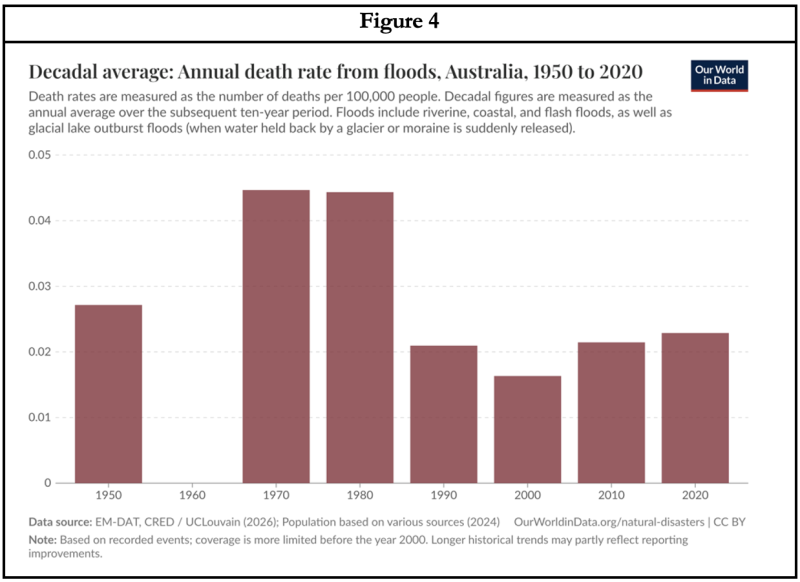
The impact of natural disasters on human life can be measured with respect to frequency, severity, economic costs, physical destruction, and mortality. An IPCC assessment found only weak links between human-induced climate change and droughts, wildfires, floods, and hurricanes. As it happens, I now live in the flood-prone Northern Rivers region of New South Wales and the topic is of more than academic interest. Every flooding produces breathless media coverage with fresh warnings of wake-up calls on the climate emergency. All sense of perspective is abandoned. Yet, compared to the country’s total population, proportionately fewer have died from floods in the last four decades since the 1980s than in the previous four decades (Figure 4).
Before moving to the Northern Rivers, I lived in Canberra. In the summer of 2019–20, there were raging bushfires all around us and we could see some of the flames from our house. This too produced many dire warnings of the dangers of the all-too visible evidence of the climate emergency that poses an existential threat. Yet, according to the review of the scientific literature by Matthew Jones and his co-authors for the UK Met Office, man-made climate change will not begin to impact Australia’s fire weather extremes and fire season length until the 2040s.
The debate over whether or how much wildfire emergencies are caused by climate change is a good example of the inherent scientific uncertainty involving future modelling-based projected impacts versus present weather-related events, global versus national action to decelerate climate change, and the many different variables determining the start, severity, and duration of bushfires.
An undated article by Tom Hultquist on the website of the US National Oceanic and Atmospheric Administration notes that from 8 to 10 October 1871, ‘wildfires claimed thousands of lives and consumed three million acres across the Upper Midwest’ (Chicago, Michigan, Wisconsin). Fires in and around Peshtigo, Wisconsin alone claimed between 1,200 to 2,400 lives and up to 1.5 million acres. Just as a reminder, this was essentially in the pre-Industrial age.
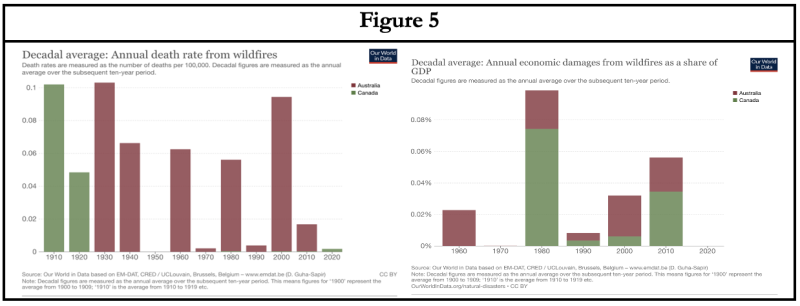
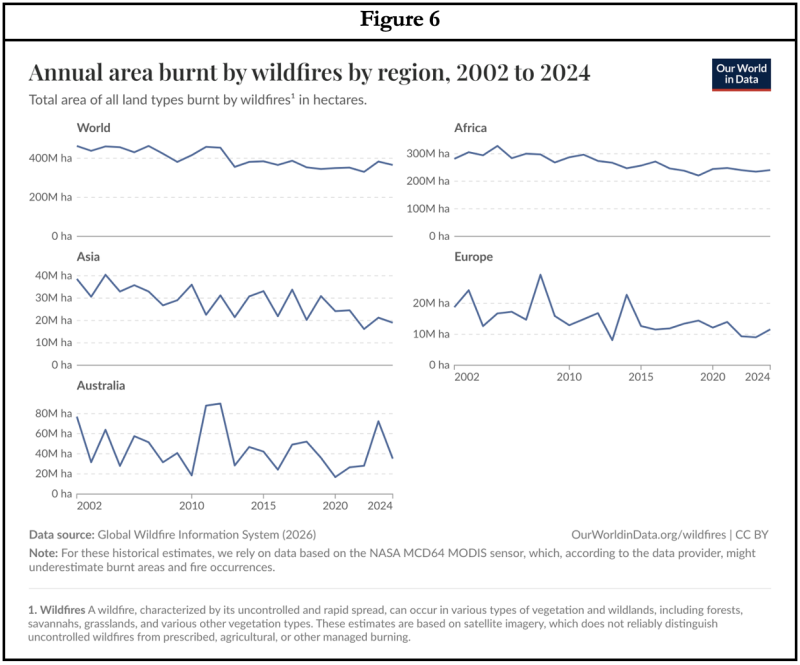
The trendline evidence on wildfires is more reassuring than alarming on the decadal average of annual death rates and economic damage (Figure 5), as well as on the area burnt by wildfires in this century thus far (Figure 6).
Replace Excitable Exclamation Marks with Sceptical Question Marks
The eight charts in this article help to explain why the instinctive sceptic’s response to excitable exclamation points should be to replace them with question marks. There is legitimate scientific disagreement over how dominant human activity is as cause of global warming relative to natural variability, the rise in temperature that will mark a point of no return for the stability of the earth’s environment, and the ‘tipping points’ that will push the ecosystem into a self-exacerbating cycle of rapid collapse.
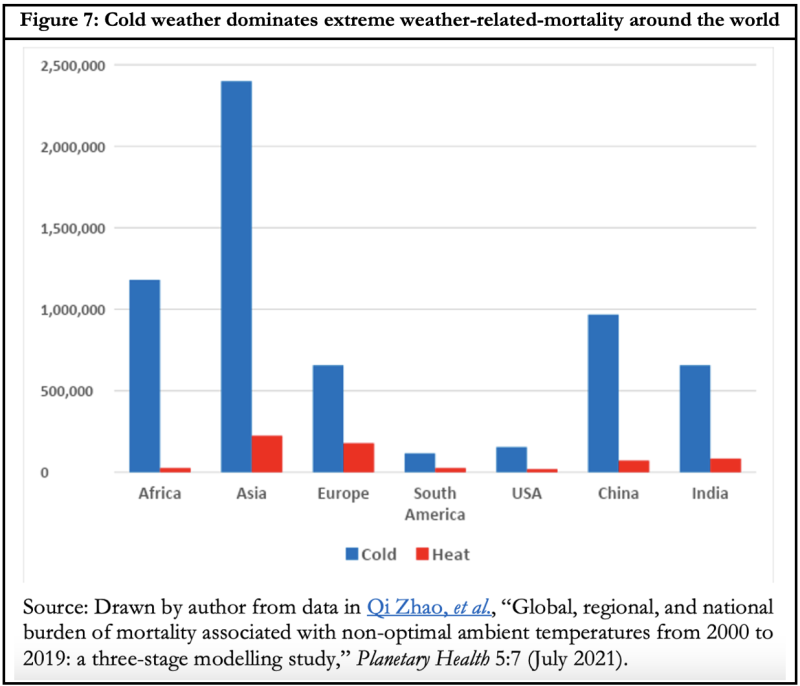
Climate alarmists refuse to acknowledge the rise in global food security thanks to the increased greening of the Earth from higher CO2 levels and the reduction in global mortality with increased state capacity to mitigate peoples’ vulnerability to diseases and natural disasters through fossil fuel-driven economic development. Focusing only on the life-threatening risks of higher temperatures, they also ignore the substantially greater reduction of extreme-weather-related mortality from very cold temperatures (Figure 7).
Observational data can also be at variance with climate model predictions. In an article in the History of Geo- and Space Sciences in May 2021 (but see also the author’s reply which will seem eerily familiar to all Covid-era sceptics), Pascal Richet looked for evidence of the influence of greenhouse gases on climate over long periods. He found that variations in the concentration of carbon dioxide and methane emissions in the Vostok ice cores in Antarctica ‘exerted, at most, a minor feedback on temperature.’ His overall conclusion was that changes in the emissions could not account for the glacial-interglacial transitions since the early 19th century, and therefore the existing climate change models cannot be validated by this set of observational data.
A reconstruction for the Southeast Greenland Shelf showed that temperatures had risen and fallen between 1796 and 2013. If rising CO2 concentrations are a driver of Arctic warming, the 19th and 20th centuries should have been noticeably colder than today. Instead, the study found that there were warming and cooling episodes throughout 1796–2013, decadal periods in the 1800s were occasionally warmer than 2013, and there was more sustained warming in the 1920s and 1940s than during the 21st century. Some analysts also tend to conflate threats to the environment from greenhouse gas (GHG) emissions and those from other causes including population growth and the resulting rapid expansion in food, housing, and water requirements. These tendencies are referred to as the ‘uncertainty monster’ in climate science.
The Political Cost-Benefit Equation Doesn’t Compute, for Rich or Poor Countries
The domestic politics of persuading citizens, in rich and poor countries alike, to cut existing or aspirational living standards and the global politics of financial and technology transfers are extremely challenging. Because the sacrifices demanded are real, immediate, and individual, but the gains are projected, future, generalised, and diffused, the logic of individual costs and benefits clashes with the logic of collective action, for citizens and for countries. The political costs will have to be borne upfront by today’s politicians, but the major rewards will be delivered decades into the future. Political payoffs are typically calculated for the ‘long run’ of just the next election cycle; in the present-vs-future tussle, no political party is going to win majority support in India, for example, by promising to prioritise the slowing of climate change over poverty alleviation.
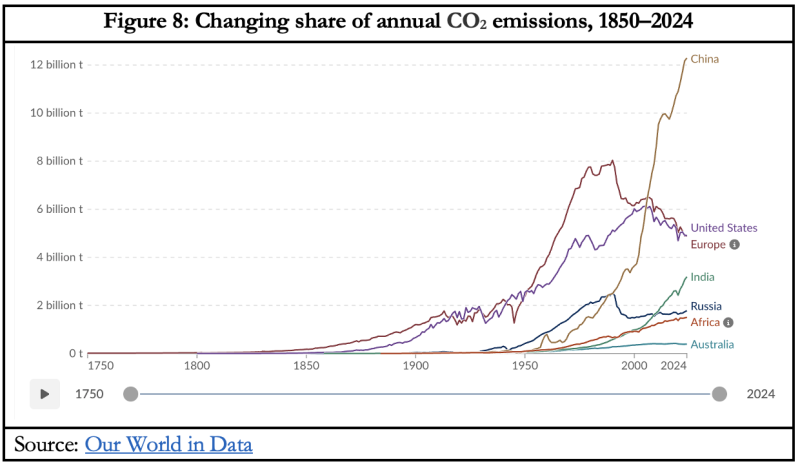
No net advance in climate action goals for the world is possible unless all major economies meet their national commitments. But aside from the four big emitters (China 33.1 percent of global emissions, the US 11.7 percent, India 8 percent, Russia 5.1 percent), the net difference to global emission reductions from any one country’s efforts range from modest to negligible. What if effective action means job losses and a major drop in living standards for Australians, when the current big net CO2 emitters are China, US, India, and Russia, and Australian action proportionate to its share of emissions will make only a miniscule contribution to reducing the risk of climate catastrophe?
Reducing emissions on the scale demanded would require poor countries to remain mired in poverty (and in extreme cases, to stop breeding) and sizable numbers of working and middle class people in rich countries to risk falling into poverty. Neither equation computes in the real world of politics. This reality—and not the ignorance or venality of political leaders—is a major explanation for the lack of effective action. Disruptive protests and haranguing slogans are no substitute for policy action. For many Africans and Asians, climbing out of debilitating and deadly poverty now is critical and urgent. Elevating climate change to the topmost priority can wait until after they have climbed the income ladder. But equally, Western leaders will face political extinction if they commit to a drastic drop in living standards for their citizens.
For Western countries, Net Zero dogma is too high a price to pay for the death of industrial economies by suicide. Yet their self-harm will have no discernible effect on the global climate which requires substantial halt to growing carbonisation by the likes of China, India, the US, and Russia (Figure 8). Part of their net emissions is the result of displaced manufacturing activity from the rich countries to jurisdictions with more lax environmental controls. But for the latter countries, rapid Net Zero will condemn billions to forever poverty: fossil fuel-powered industrialisation was the key to lifting the masses from poverty in the Western countries and dramatically improving their living standards and health and educational outcomes.
The ‘Climate Consensus’ Is Fraying
International treaties establish the norms and legal obligations of states parties. They are based in the state of scientific knowledge at the time. But science is never static. Rather, it is constantly evolving and it does so by questioning and testing the existing knowledge. Yet, treaty negotiations are usually protracted and lengthy processes. It is possible that some of the scientific tenets informing a treaty might already be under critical challenge when the treaty is adopted. In addition, the shared understandings, evidence base, and accepted theories in the scientific foundations of a particular treaty can undergo substantial revisions over time and thus overtake the static treaty obligations.
This appears to be happening with the climate change agenda. The World Climate Declaration, signed by more than 2,000 experts from 60 countries, boldly declares that ‘there is no climate emergency.’ Warming has been ‘far slower than predicted’ and global warming has not increased natural disasters. The declaration calls for climate science to be less political and climate policy to be more scientific.
The US Department of Energy issued a significant report last year that rejects the core tenets of climate alarmism, notes that US policies will ‘have undetectably small direct impacts on the global climate,’ and insists that the dominant energy systems deserve to be celebrated for their role in ‘the rise of human flourishing over the past two centuries.’ Accordingly, the US has revoked many restrictive climate regulations in the push for continued global energy dominance.
Former Prime Minister Tony Blair conceded in April 2025 that cutting fossil fuel production and energy consumption is ‘doomed to fail’ and the UK needs a major rethink of Net Zero policies. The Microsoft multibillionaire-cum-liberal philanthropist Bill Gates, a longstanding proponent of the catastrophist view that global warming is an existential threat that screams for urgent political action, has also had an epiphany.
Last October, noting that emissions have been trending down, he acknowledged that innovation can continue to drive down emissions such that humanity’s demise and the end of civilisation are not inevitable with a changing climate. Rather, ‘The biggest problems are poverty and disease, just as they always have been’ and the obsession with ‘Climate Action Now!’ is ‘diverting resources from the most effective things we should be doing to improve life in a warming world.’ Even the Democratic Party has quietly acknowledged that its aggressive advocacy of stringent climate action has pushed its working class base away and that attracting the base back requires a quiet retreat from apocalyptic messaging.
RCP8.5 ‘Implausible’
RCP8.5, first used in the IPCC Fifth Assessment Report in 2014, was immensely influential in shaping scientific research (over 100,000 peer-reviewed studies), media coverage, and public policy (national climate assessments, insurance risk analyses, banking regulations, estimates of the social cost of carbon) because of the conflation of structured hypothetical futures so scientists could explore the long-term consequences of different assumptions on greenhouse gas concentrations (RCP is an abbreviation of Representative Concentration Pathways), into a plausible baseline scenario that represented a realistic future development under business-as-usual energy policies. One of the crucial but incorrect assumptions behind RCP8.5 was an eightfold increase in the worldwide consumption of coal. It also underestimated technological advances in energy efficiency.
The costs of inaction or insufficiently stringent and urgent action were inflated and the costs of stringent and accelerated action to reduce emissions were understated. On 3 December 2025, Nature retracted an article published on 17 April 2024 that had argued that the annual economic cost of unmitigated climate change would amount to $38 trillion (in 2005 dollars) by 2049. The authors conceded that the errors in their calculations were ‘too substantial’ for corrections. The paper had been widely cited, not the least, one suspects, for its alarmist findings.
On 7 April 2026, the European Geosciences Union’s Geoscientific Model Development published a hugely consequential 30-page article summarising the findings of a high-level collaborative project. Detlef P. Van Vuuren et al. abandoned the longstanding RCP8.5 scenario because, ‘based on trends in the costs of renewables, the emergence of climate policy and recent emission trends,’ RCP8.5’s ‘high emission levels have become implausible.’ While some climate change believers argued that the change simply reflects the success of climate policy (falling fossil fuel use, rising share of renewables, etc) in bending the global emissions curve over the last few decades, others insist that rather, this is an overdue correction of implausible assumptions that had (mis)informed RCP8.5 right from the start.
Net Zero Is Not Energy Policy, Just a Slogan
Thus, like every public policy, climate action too requires a careful calculation of cost-benefit trade-offs between investment in and return from public resources. The goal of taxing the CO2 emissions of fossil fuel power, while continually expanding subsidies for the renewables industry, is to raise costs on fossil fuel plants and make them less competitive in wholesale markets against wind and solar power. This will cause many fossil fuel plants to shut down. Climate activists will cheer, but the result will be a less reliable electric grid, blackouts, and soaring utility bills. As argued by Richard Dearlove, a former head of MI6 (the British Secret Intelligence Service), with specific reference to the UK, the ideological pursuit of Net Zero policy is also a national security threat in the way in which it deindustrialises and impoverishes the West, enriches China, and creates Western dependency on Chinese supply chains.
After 25 years of the most expensive industrial policy in history in the new millennium, with several ‘last chance’ climate summits and numerous tipping points, the share of global primary energy supplied by fossil fuels (oil, coal, natural gas) fell from 88 percent in 2000—to 86 percent in 2025. The share of renewables was 6 percent. As the 2026 edition of the Statistical Review of World Energy comments: ‘After 35 years of international conferences, promises to almost completely eliminate fossil fuel energy sources and the expenditure of many trillions of dollars in public funds…the percentage of global energy supply met by fossil fuels is actually increasing!’ (p. 5). GHG emissions increased by 1.1 percent over the year, despite the $14 trillion (and counting) spent on emission-reduction measures and technologies.
Just like Net Zero, ‘renewables are cheaper’ is an electorally powerful slogan that allows voters to indulge cost-free feelings of virtue while disdaining the climate deniers who oppose it. But this too is disconnected from the physical world. Slogans do not build systems. Backup is not optional and the transmission infrastructure to compensate for intermittency is not free. The higher the share of intermittent generation in the grid the size of which grows voraciously to deliver the same output of baseload power, the more expensive and infrastructure-heavy the system becomes. The road to the renewables nirvana is land-hungry and capital-intensive. With rising power prices for consumers and businesses and plummeting public support because unlike politicians, people prioritise affordable and reliable power over renewables at any cost, and even Tony Blair and Bill Gates have seen the light.
Net Zero is neither energy, economic, nor even public policy; it’s simply a slogan. As national policy, it is environmentally irrelevant at the global level, physically impossible to achieve, economically ruinous, and politically performative: an unserious approach to governance. It’s not a plan but a slogan, one that undermines sensible policy discussion. But it does allow politicians to shift the blame, from their own failures to adopt sensible precautionary measures against the certainty and ravages of natural disasters, to the all-encompassing ‘climate emergency’—and to mock and demonise critics.
Covid policy errors underlined how the resilience of the public health infrastructure is ultimately dependent on economic security. More broadly, the above analysis includes several examples of the reality that energy security is a prerequisite of economic security, and economic security is a necessary precondition of social and national security.
The facts have changed while the zealotry is frozen in time. The gap between the stringent actions demanded by climate change warriors, the commitments made, and the actual record thus far is used to create panic. The notion that we are already doomed promotes a culture of hopelessness and despair best epitomised by Greta Thunberg’s anguished cry: ‘How dare you?‘ In turn this instils despair in many youths, on the one hand, and encourages demonisation of any dissent from the orthodoxy being pushed, on the other.
A shorter version of this was published in The Daily Sceptic on 5 August.
Join the Conversation
Published under a Creative Commons Attribution 4.0 International License
For reprints, please set the canonical link back to the original Brownstone Institute Article and Author.