

In 2020, governments around the world panicked in response to the declaration of a pandemic and imposed drastic interventions to impede the spread of Covid-19, interventions which crushed human rights on an unprecedented scale and without sufficient justification. Yet this was widely accepted, even by human rights organisations. How could this happen? And how could we amend human rights protections to ensure that it does not happen again?
In the aftermath of the Second World War, there was recognition that rights should be codified, leading to the United Nations’ Universal Declaration of Human Rights. These rights are taken to be universal and inalienable.
The Declaration includes declaration of the rights to ‘life, liberty and security of person,’ freedom from torture, equality before the law, freedom of movement, including ‘the right to leave any country including his own, and return to his country,’ freedom to own property, freedom of thought, opinion and expression, freedom of assembly, and the right to education.
These are a mix of fundamental rights and other categories. Fundamental rights are everyone’s birthrights originating in fundamental capabilities or states of being which we all have unless we are actively prevented from exercising them by others.
We do not need to apply for permission to exercise this type of right. The classic case of a fundamental right is freedom of expression. We all have this capability as soon as we can speak (or sign), and no one should take it away from us.
Freedom from torture is fundamental to health and well-being and again is the natural state of being unless torture is inflicted on us.
Freedom of education is in a different category, as education by its nature needs to be provided by someone, a government, or a private organisation, which costs money. There is no fundamental right to have education provided without contributing to the cost of it through fees or taxes, but where it is provided it should be accessible to all on an equal basis. So, this right is really about equity.
Commendably, the Declaration does not include any qualifications to fundamental rights, although it is understood elsewhere that:
They should not be taken away, except in specific situations and according to due process. For example, the right to liberty may be restricted if a person is found guilty of a crime by a court of law.
No one would dispute this exception: even the most libertarian of countries puts people in jail if they break the law (but authoritarian countries have laws that put people in jail for reasons that would never be acceptable in truly democratic counties, for example, insulting the President). Once the possibility of wider exceptions is recognised, however, abuses become possible.
The best justification for exceptions is where someone exercises their own right by contravening someone else’s right. Even in the case of free speech, one of the most fundamental of all rights, it is universally accepted that it is not permissible to advocate for or incite violence, especially against an ethnic or religious group. The most notorious examples of this over the last hundred years have been the Nazi campaign of vilification against the Jews, which led directly to their killing around six million Jewish people in the Holocaust, and the Hutu government incitement of the population against the Tutsi (‘cockroaches’), which led to at least 800,000 deaths. In these cases, a direct line can be drawn between incitement and genocide. In other cases, incitement is more coded and difficult to prove.
The International Covenant on Civil and Political Rights expands on some of the rights in the Declaration and adds others. It also adds a critical loophole, expressed as (#4.1):
In time of public emergency which threatens the life of the nation and the existence of which is officially proclaimed, the States Parties to the present Covenant may take measures derogating from their obligations under the present Covenant to the extent strictly required by the exigencies of the situation, provided that such measures are not inconsistent with their other obligations under international law and do not involve discrimination solely on the ground of race, colour, sex, language, religion or social origin.
Freedom of movement and the freedom to leave or return to your own country (#12) is specifically qualified along the same lines:
The above-mentioned rights shall not be subject to any restrictions except those which are provided by law, are necessary to protect national security, public order (ordre public), public health or morals or the rights and freedoms of others, and are consistent with the other rights recognized in the present Covenant.
What on earth did they mean by allowing restriction of movement on the grounds of morals?
These types of qualifications introduce fatal weaknesses into the codification of human rights, which governments can drive a proverbial truck through.
They effectively mean that governments can take all our rights away by declaring a state of emergency due to national security or public health.
In 2020 and 2021 governments across the world suspended liberty of movement and placed their entire populations in home detention. Governments in my home state of Victoria and other jurisdictions suspended these liberties without the permission of Parliament, and the Australian Human Right Commission and almost all human rights organisations around the world raised no objections. Even healthy individuals overseas were prevented from returning to their country.
The underlying ethical theory on which they were implicitly relying is consequentialism, which holds that actions are justifiable solely on the grounds that they produce the best outcomes.
To justify suppressing human rights on this basis, a minimum requirement would be that a robust evidence-based case can be made that the intervention will result in better outcomes. When extreme measures are imposed, the highest level of proof is required. At the time when the population of the world was put in detention, there was literally no proof at all that this would be effective.
There was only the notorious Report 9 of the Imperial College London which concluded that drastic measures were necessary, because of a combination of computer modelling of (a) the prediction that tens of millions of people would otherwise be killed by the ’novel’ virus (which was not that novel, being a common coronavirus) and (b) more modelling of the outcomes of the proposed interventions.
Modelling is not evidence and is not a sufficient basis for suppressing the fundamental rights of entire populations. It does not appear in the evidence-based medicine pyramid at all. The extreme nature of the intervention was weighed against the supposedly extreme nature of the threat but should also have been weighed against the strength of the available evidence that outcomes would be decisively improved.
Many attempts have been made to retrospectively show that the outcomes were, in fact, improved, but again, these do not rely on the highest levels of evidence and are not sufficiently robust enough.
Extraordinary and incompatible claims are made that: (a) tens of millions of deaths were directly caused by Covid-19 and (b) tens of millions of deaths were saved by vaccination. So many lives were lost, and so many were saved? On both sides of the balance sheet these were hypothetical lives.
Political leaders and the public health establishment at the time led us to believe that the grand strategy of imposing lockdowns until a vaccine could be found would defer and then prevent excess deaths, but excess deaths continued over three years at diminishing but elevated levels.
Many observational studies have sought to demonstrate that the interventions were successful, but these are not classified at the highest levels of that evidence-based medicine pyramid because they are easily distorted by a range of manipulations including:
- Trial populations not representative of the wider population
- Vaccine side effects underreported
- Case-counting window bias or immortal time bias
- Selective adjustments of results (only those favourable to the interventions)
- Selective interpretation of results
- Conclusions that contradict the findings.
There is ample substantiation of these limitations in the articles listed here, and elsewhere in Brownstone Institute papers and beyond.
The UK Office for National Statistics stopped publishing its figures for mortality rates after they started showing higher rates in the vaccinated, but after adjusting for demographic, prior health, and other factors their report, released in March 2023, found:
Vaccine effectiveness against COVID-19 mortality was 58.7% (confidence interval: 52.7% to 63.9%) for a first dose, 88.6% (confidence interval: 87.5% to 89.5%) for a second dose, and 93.2% (confidence interval: 92.9% to 93.5%) for a third dose of the vaccine. Vaccine effectiveness decreases with time after the second and third doses.
They were right to go on to control for the effect of higher non-Covid-19 mortality rates in the vaccinated, which indicates the likelihood of misallocation, but they report no data on this, only an editorial comment:
However, even when including all adjustments for confounding factors, we observe a reduction in risk of non-COVID-19 death for vaccinated groups compared with the unvaccinated population. The risk of non-COVID-19 death is lower for all vaccinated groups compared with unvaccinated groups except the “over three months after the first dose” group. This indicates the presence of residual confounding, despite taking into account recent socio-demographic factors and different sources of health data.
So, they found residual confounding but did not adjust their vaccine effectiveness figures for it. These figures are the ones that get reported and influence policy; the residual confounding remains invisible.
There are so many variables that can be adjusted to bring about a desired result, and the potential for misallocation and ‘healthy vaccinee bias’ renders the apparently conclusive figures on vaccine effectiveness nugatory. Worse, they give the illusion of objectivity to biased and misleading findings.
The precautionary principle has been distorted such that extreme measures have been imposed that rest on a foundation of extreme uncertainty. A true precautionary approach would have been to recognise that lockdowns would indisputably cause harms, and that the benefits of vaccination were unknown.
Taylor et al conducted a comprehensive review that assessed the impact of US lockdowns and school closures on health-related outcomes excluding Covid-19 transmission and mortality, concluding:
Findings from this review indicate that both lockdowns and school closures were frequently associated with detrimental effects across multiple categories of health outcomes, including measures of mental health, obesity, and health-related social needs (ie, child development/education, employment, food access, and economic/financial stability).
Worse, the World Bank estimates that 70 million people were pushed into extreme poverty in 2020. As usual this is attributed to the pandemic, but the main shock to the world economy was brought about by the lockdowns and the closure of borders, leading to a decline in global trade of nearly 9%. A World Bank Policy Research Working Paper leads with its conclusion:
The COVID-19 pandemic has generated the deepest and most synchronized decline in economic growth rates across countries in the world since World War II.
It was misguided government interventions that caused this devastation, not the virus, and it was bound to lead to profound adverse health effects.
A 2022 Australian survey by the CSIRO found that over 28% of respondents had missed or delayed access to GPs or specialists, and it is likely that this resulted in missed diagnoses and care resulting in increases in the burden of disease.
The suppression of rights is enabled by a legal infrastructure of public health legislation that imposes almost no restraint on government suppression of rights.
Victoria represents an exemplary case study since Melbourne, the capital city, had one of the longest and strictest series of lockdowns in the world, totalling 262 days in aggregate. Victoria’s Health and Wellbeing Act is representative. It is based on the paradigm that government interventions can prevent the spread of infectious diseases.
Ironically, a key principle at the top of the Act is that public health interventions should ‘be based on evidence available in the circumstances that is relevant and reliable.’ In imposing the world’s longest lockdowns, the Victorian Government did not base their decisions on reliable evidence, only modelling, as described admiringly by Scott et al.
Modelling can be indicative, but Ioannidis et al conclusively showed that Forecasting for COVID-19 has failed. A response to his article draws the conventional lesson that ‘decisive actions must be taken as early as possible once a pandemic has been confirmed.’ But lockdowns became widespread within a few weeks of the declaration of a global pandemic by the World Health Organisation on 11 March 2020.
The point of Ioannidis’ paper is that modelling was too unreliable to predict the future course of the disease. If lockdowns were imposed within days of a declaration, there would be an elevated risk of false positives – lockdowns for pandemics that resulted in low mortality like MERS. The risk of frequent imposition of ‘decisive actions’ (with all their adverse effects) outweighs the risk of waiting for clear patterns to emerge from evidence.
The Victorian Act also proclaims that decisions made ‘should be proportionate to the public health risk sought to be prevented, minimised or controlled.’ There is no evidence that the Government considered the proportionality of the extreme measures it took. Proportionality should refer not only to the extent of the risk being targeted but also the risks of adverse effects. The principle of necessity is not only about how great the risk is and therefore how necessary some form of action is, but also the extent to which it is necessary to go to higher levels of coercion to achieve the desired outcomes, and the robustness of the evidence for that.
Indeed, the Act proclaims that ‘in minimising the risk that a person poses to public health, the measure which is the least restrictive of the rights of the person should be chosen.’ There is no evidence that the Government seriously considered (except through unreliable modelling) how less restrictive measures might still have led to acceptable outcomes, or what the marginal benefit was of imposing more restrictive measures. There is no evidence at all that it considered the balance of benefits and costs (both financial costs and the illness burden of adverse effects), but by the end of 2021 Pak et al advocated that this was essential in the light of the ‘futility’ of the government’s ‘zero-covid’ strategy.
At first sight, the Act includes the basis for lockdowns where individuals have an infectious disease, giving that the Chief Health Officer has the power to make an individual ‘reside at a specified place of residence at all or during specified times.’ However, this applies only to individuals who are infected with the infectious disease or ‘have been exposed to the infectious disease in circumstances where a person is likely to contract the infectious disease.’ It is a legal stretch to impose this quite specific restriction on everyone without regard to their circumstances, merely on the expectation that everyone ‘is likely to contract the infectious disease’ during an epidemic.
US states have similar legislation, as summarised here.
Nowhere does the Victorian Act authorize the Chief Health Officer or the government to coerce healthy individuals to undergo an intrusive health intervention (vaccination) designed to prevent the spread of an infectious disease, especially since it was not in the event successful. But the Victorian Government proclaimed that essential workers would lose their jobs if they were not vaccinated and designated most categories of workers as essential.
So, based on an unspoken assumption that an extreme threat requires extreme measure, the chain of decision-making appeared to go as follows.
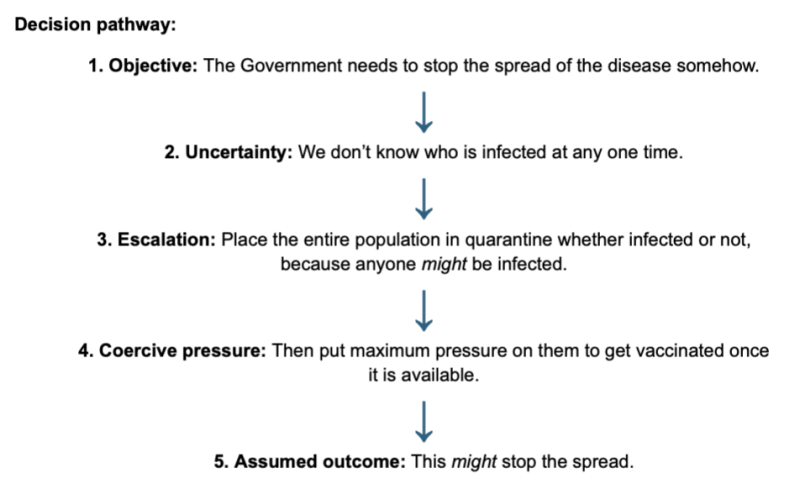
None of these steps were evidence-based. The decision path rests on a chain of compounding suppositions and hypotheses.
Did this in fact stop the spread of Covid-19 in Victoria? In February 2023, the Australian COVID-19 Serosurveillance Network reported that 70% of the population had been infected, and a paper by Giles and Flanagan of the Australian Technical Advisory Group on Immunisation concluded: ‘This demonstrates that high rates of vaccination have not been able to prevent subsequent SARS-CoV-2 infections from occurring.’
The only ethical justification for coerced vaccination on consequentialist grounds would be to prevent the spread of an infection. Governments can only override rights, remember, to prevent the rights of others from being infringed (including supposedly their right to health and well-being). But the interventions demonstrably failed to achieve this objective. Is mass suppression of human rights justifiable to slow the spread? Catastrophic outcomes from rapid spread were nowhere evident and remain hypothetical.
Coerced vaccination is a violation of the right to bodily integrity. Where does this right feature in the codification of human rights? A general right to bodily integrity is not spelled out in the Declaration or the Covenant, although it is implied or indirectly addressed as explained by Christoph Bublick:
The human right to physical integrity reflects the exalted status of the body. Although not explicitly enumerated in the Universal Declaration of Human Rights (UDHR), it is entailed by the guarantee of the security of the person, Art. 3 UDHR, as well as Art. 9 of the Convention [in fact Covenant] on Civil and Political Rights. It is codified in Art. 5.1 of the American Convention on Human Rights and subsequent instruments, eg Art. 17 CRPD and Art. 3.1 ECFR. It is well established in the jurisprudence of the ECtHR on Art. 8 ECHR, many domestic constitutions, and counts as a cornerstone of common law.
‘Security of person’ however is too general and affords little protection against coercing individuals to have chemicals injected into the body against their will. Some commentators try and get around this by arguing that no one was forced to be vaccinated; however, exerting the threat of losing your job or not being able to enroll your child in kindergarten or school is coercion.
These decisions should be left entirely to the individual and not taken away from them by governments. Governments assume that vaccination will protect third parties, but if the evidence does not clearly support this, governments should not make these decisions for individuals. When decisions are made centrally by governments to breach human rights on a mass scale without consent, there is the risk of errors or abuses being inflicted on entire populations or peoples (for example China’s Great Leap Forward and the Holocaust).
Governments should not take the claims of their public health advisors at face value and should critically appraise the reasoning and evidence behind it, as they do with all other areas. Extreme claims need to be substantiated with the highest level of evidence and met with scepticism if they are not.
The risk entailed in giving coercive powers to governments for the protection of public health outweighs the possible benefits, which are generally exaggerated. As shown here, the trajectory of polio and measles in the 20th century is not correlated with the introduction of vaccination. Covid-19 vaccination increases the risk of cardiac events and mortality as I maintained here and here, and as discussed in a BMJ paper that was recently retracted because the findings contradicted establishment opinion, which agreed that:
Excess mortality has remained high in the Western World for three consecutive years, despite the implementation of containment measures and COVID-19 vaccines. This raises serious concerns. Government leaders and policymakers need to thoroughly investigate underlying causes of persistent excess mortality.
These findings are unexceptionable. Contrarian views should not be suppressed especially when they undermine the justification for suppressing human rights. The pathway to truth does not lead through suppression, but through open debate especially of tenable and evidence-based views. The history of this unjustifiable retraction is outlined here.
Public health legislation that gives authoritarian power to governments even temporarily should be simply dismantled.
Any decision to override the fundamental rights of populations should be resisted and at a minimum must be robust and defensible by the highest level of evidence of effectiveness. It should not rest on the basis of opinion, especially opinion that can be controverted. Only universally accepted principles and evidence should be used to advocate breaching universal human rights. The existence of many contrarian papers published by Brownstone Institute and others demonstrates that this condition has not been met in the case of the Covid-19 pandemic.
Human rights declarations and protections should be amended to explicitly include the right to bodily integrity, one of the most fundamental rights it is possible to imagine.
And the ultimate way to safeguard for protecting human rights is not to allow them to be breached at all through loopholes – strike them out!
Join the Conversation
Published under a Creative Commons Attribution 4.0 International License
For reprints, please set the canonical link back to the original Brownstone Institute Article and Author.