

Few individuals can relate as personally as I do to the experience of having peer-reviewed research retracted after it revealed potential safety signals in the VAERS database.
Neil Miller recently had his peer-reviewed published work “removed” from the journal Toxicology Reports. It has been published for 5 years: since June 2021.
Five years! What’s that now? The smell of a Pubpeer rat? Could be.
The title of the paper is Vaccines and sudden infant death: An analysis of the VAERS database 1990-2019 and review of the medical literature, and you can find the abstract on PubMed.
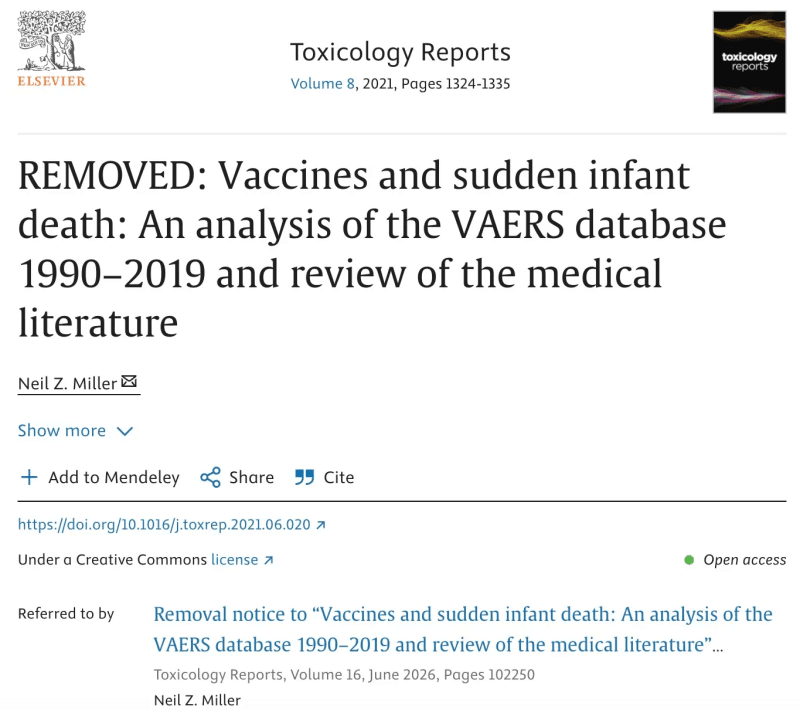
The reason for the “removal” was that there were claimed “serious methodological flaws” according to the Editor-in-Chief of the journal. What were these methodological flaws, you ask? Well according to the excuse written on the journal’s site where the paper was once readable, these “flaws” revolved around the inability to “infer correlation” – NOT CAUSATION – between vaccination and sudden infant death syndrome (SIDS).
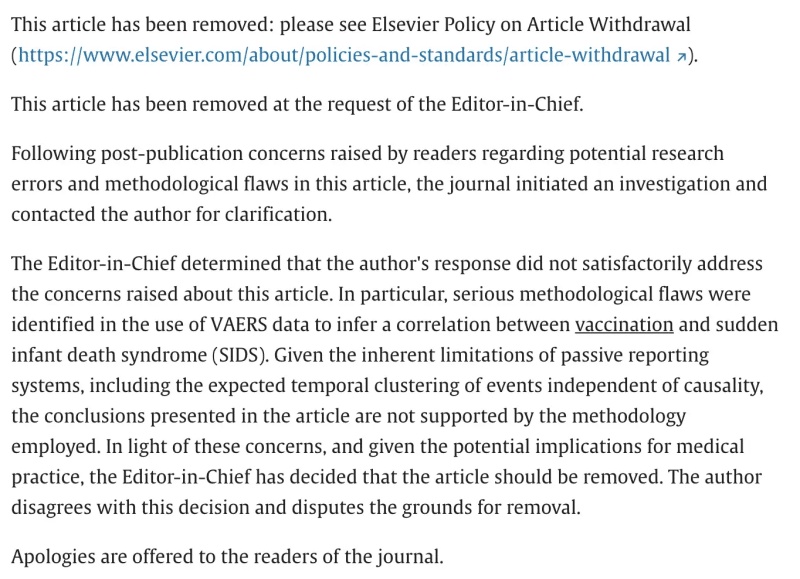
Hold the horses, now. This is not a viable reason to claim a methodological flaw. I’m going to do what has been done to me for years – just for using VAERS to demonstrate safety signal emergence – by quoting the VAERS website to call BS on this claim.
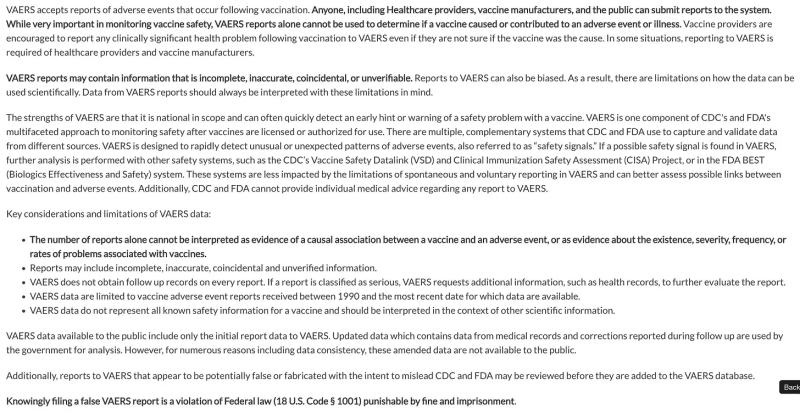
Two points stick out:
- VAERS reports alone cannot be used to determine if a vaccine caused an adverse event
- The number of reports alone cannot be interpreted as evidence of a causal association between a vaccine and an adverse event.
Fair enough. Both of these points (one written in bold!) indicate an inability to use VAERS data alone to prove causality. We know that already. This is why we use the PRR, Bayesian analyses and/or the Bradford Hill Criteria for causality as follow-up to verify not only safety signals, but causal relationships between a particular vaccine and a particular adverse event. And if FDA employee Ana Szarfman hadn’t been brushed aside like dandruff, we would have also had a Regression-Adjusted GPS Algorithm in our hands that incidentally, revealed much more in terms of adverse events as safety signals than the PRR alone.
If you read the removal reason carefully, you’ll have noticed that they removed Neil’s paper on the basis that he cannot use VAERS data to draw a correlation between a safety signal (for SIDS) and vaccines. This does not align with what HHS dictate that you cannot use VAERS for. Correlations are very easy to demonstrate using very simple statistics like regression analyses, and can certainly be demonstrated with VAERS data. A strong correlation (whether from simple linear regression, Pearson’s r, or more advanced models) can show that two variables move together. It’s true that it says nothing about whether one actually causes the other, whether a third variable is driving both, or whether the relationship is spurious, but, this is not the point. Once a correlation is demonstrated, it is necessary to follow up to prove or disprove causation using the above-mentioned techniques as per proper pharmacovigilance.
So I would claim that the reasons for the removal were not valid.
It bears repeating that my own paper with Kevin McKernan and David Speicher published in Autoimmunity is also on the investigation cutting block for unjustified reasons – likely because of the same perpetrators. I’m lookin’ at you, Pubpeer.
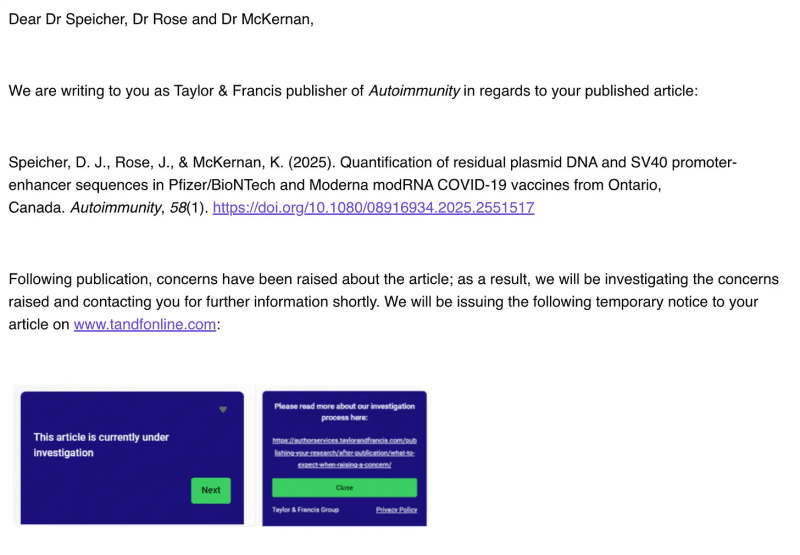
N.B. Aaron Siri has written a great summary regarding unjustified targeting of published papers for retraction as well, that includes Neil’s paper and ours.
The claim in the case of Neil’s paper is that his answers to their investigational questions were not good enough for them to keep it published. His answers were likely more than satisfactory, but my point herein is that it doesn’t matter. The decision was likely already made ahead of time.
Why else would a paper published for 5 years go to the cutting block so suddenly?
And unfortunately, even though our answers (me, Kevin, and David’s) to the barrage of unwarranted investigational questions were more than sufficient in our case (it’s all public, by the way, as much as it can be), our paper might face the same fate for the same unjustified reasons.
Time will tell.
It is at this point that I must ask the following question of everyone involved in censorship of peer-reviewed literature that involves VAERS data in particular:
Q1:What is your motivation?
The strengths of VAERS are that it is national in scope and can often quickly detect an early hint or warning of a safety problem with a vaccine.1
The above quote (and the one below) are directly from HHS’s VAERS website. VAERS is a strong pharmacovigilance tool – owned and operated by a US government agency – because it can detect early warning signals with regard to adverse events linked to specific vaccines. If a safety is detected, then the proper course of action is to determine whether or not beyond correlation, there is a causal link, also stated on the VAERS website.
If a possible safety signal is found in VAERS, further analysis is performed with other safety systems. [1]
Q2: If a safety signal is detected, and further analysis is warranted and performed, then why are these analyses being censored?
It also bears repeating that Neil’s paper is about SIDS – babies dying is bad. Babies dying – potentially due to vaccines – is really bad. That word “potentially” is extremely important. If there is even a minor suspicion that a vaccine could be a driver toward infant death (or cause), it must be thoroughly investigated. And unless it is proven that the culprit vaccine is not the cause, that potential remains.
So I elaborate on my above question:
Q3: Why does it seem like certain agencies, journal editors, and people are against basic due diligence with it comes to pharmacovigilance, especially when infants’ lives are at stake?
The whole point of VAERS (or any pharmacovigilance database) is to prevent harms, injuries, and deaths from vaccines. It’s actually all we – as the public – have. No one wants babies to die, do they? So why is VAERS not being used in the way that it should be used as described by HHS? Why is it actually being either unused or abused? Where are the follow-up causality assessments proving no cause?
Where are the studies of non-vaccinated babies compared to vaccinated babies in the context of SIDS?
Let’s relive my own deep dive into VAERS with regard to SIDS reports and vaccine administration.
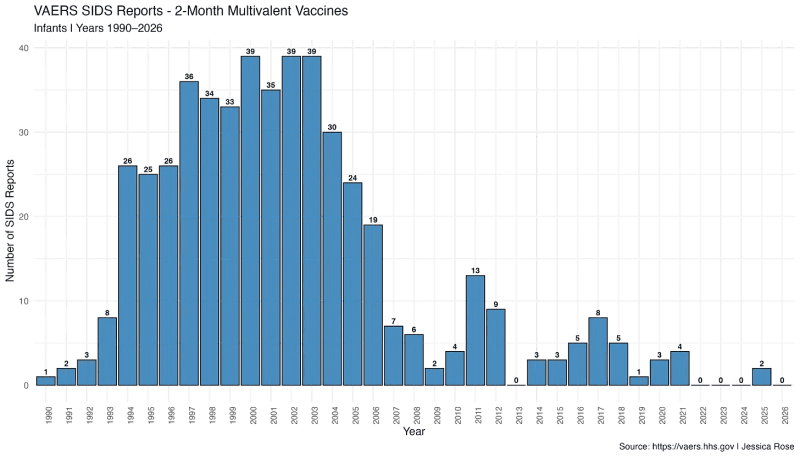
When you only query the multivalent, polyantigen vaccines provided to newborns at only 2 months old (multivalent_vax_types <- c(”DTAP”, “DTAPIPV”, “DTAPIPVHIB”, “DTAPHEPBIPV”, “HIB”, “PNC13”, “PNC20”, “RV”, “HEP B”, “DTAPHEPBIPVHIB”) using MedDRA codes ”SIDS|sudden infant death syndrome|cot death|crib death”), you get the following plots.
The blue barred plot represents absolute counts from 1990 through 2026.
The red barred plot represents rates per total adverse events reports per year from 1990 through 2026.
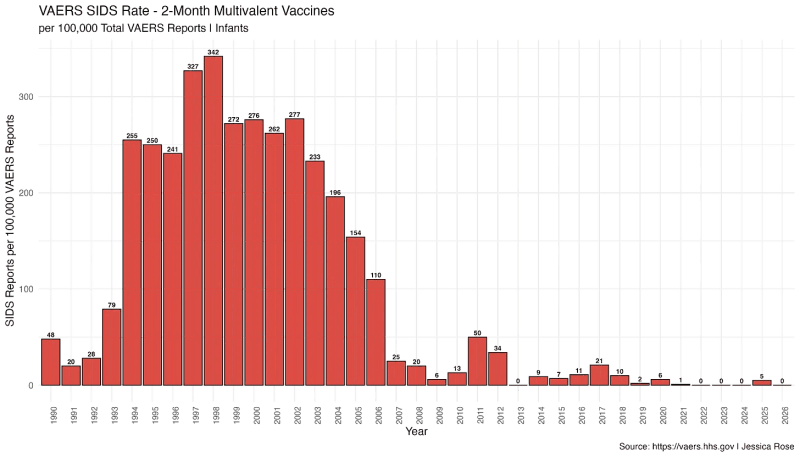
This is quite striking, no? I mean, strictly from a layman’s point of view it appears from VAERS reports that there are 2 distinct “species” of curve revealed by simply plotting the number of reports, split at ~2008. Between 1990 and 2008, there’s a humpity hump – quite perfectly normal actually – and from 2009 and 2026, there’s no humpity hump.
So, what explains this? Have the vaccines become more “safe?” Has the reporting been noosed? By the way, I bet my buddy Liz from OpenVAERS has the answer.
Diagnostic coding changes and overall SIDS decline could be explained by the fact that many SIDS cases were reclassified as “accidental suffocation” or “unknown,” as per the CDCs admission.2 And yes, changing MedDRA coding is done all the time to distribute signals or make them disappear (see: Addressing Signal Loss: The Impact of MedDRA Dispersion in my paper), and this might be exactly what happened. That’s bad. And unfortunately, there’s no way to know if an infant died from SIDS if “Unknown” is the ascribed MedDRA code as per a VAERS report. See the problem?
Neil approached his analysis from the point of view of time to death.
Of 2605 infant deaths reported to VAERS from 1990 through 2019, 58% clustered within 3 days post-vaccination and 78.3% occurred within 7 days post-vaccination, confirming that infant deaths tend to occur in temporal proximity to vaccine administration. The excess of deaths during these early post-vaccination periods was statistically significant (p < 0.00001).3
That’s not what the data I am presenting here exposes. The way I am presenting the data – as mere counts and rates – exposes another question in dire need of a genuine response:
Q4: What explains this obvious distinct disappearance of SIDS reporting to VAERS around 2008?
The Editor-in-Chief of Toxicology Reports can argue all he wants that “the inherent limitations of passive reporting systems, including the expected temporal clustering of events independent of causality [renders] the conclusions presented in the article not supported by the methodology employed,” but I am simply asking a question about a notable pattern (you might even call it a signal) emergent from VAERS in a very specific context (infant vaccines and SIDS). It almost makes you wonder if Neil wasn’t into something, hmm?
Importantly, the reason Neil used temporality as a focus for his study is precisely because temporality serves as a mandatory gatekeeper for causal links – no before and after: no causal effect – as I point out in my new paper published in the Journal of Independent Medicine.
In addition to my presentation of the SIDS data above, you might also be interested to know that when I reproduce the data query as per his paper – 1990-2016/SIDS with the childhood vaccines listed above, I get the same result as Neil. (VAERS Domestic data: Total SIDS reports: 945; SIDS reports after 2-month multivalent vaccine filter: 494; SIDS reports after AGE_YRS available data filter: 443).
N.B. The counts presented are based on narrow, pre-specified search criteria designed to reduce false positives and reporting bias. As a result, they likely represent an underestimate of the total number of potentially relevant reports.
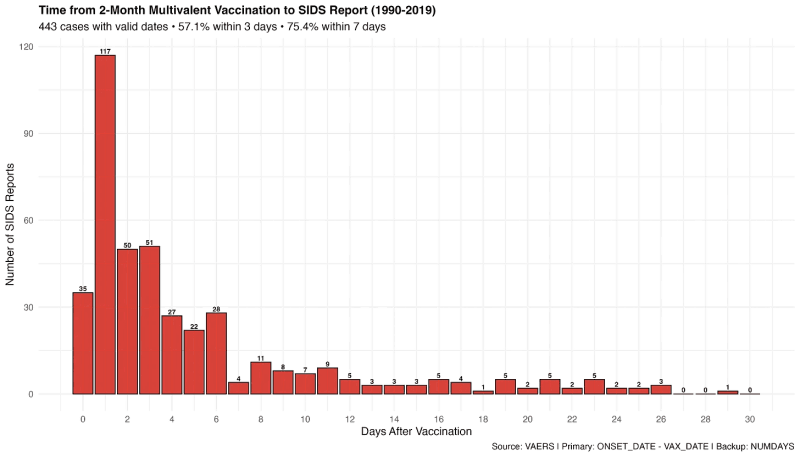
The trend is the same. Even though my absolute count is lower (443 cases with my strict criteria and valid date data), the percentages are exactly the same with regard to the 3 and 7-day window percentages.
There’s a temporal signal, so causality is definitely on the table. No matter what the Editor-in-Chief thinks, this is precisely indicative of a temporal association between specific vaccines and SIDS. It’s literally what VAERS is for. Two independent analysts on different sides of the world came to the same conclusion – a little something called reproducibility. Fine. Me and Neil both see clustering in VAERS as claimed to be expected in passive data, so to put our minds at ease for the sake of the infants, just do a comparative study with to non-vaccinated infants.
And again, according to the excuse for removal, the “flaws” revolved around a so-called inability to “to infer a correlation between vaccination and sudden infant death syndrome (SIDS).” Neil didn’t do this. His exact words were:
While the findings in this paper are not proof of an association between infant vaccines and infant deaths, they are highly suggestive of a causal relationship.
Yes. They are. So perhaps what the Editor-in-Chief should have written as his excuse was something along the lines of “serious methodological flaws were identified in the use of VAERS data to suggest a causal relationship between vaccination and sudden infant death syndrome (SIDS).” But even this would be lame, in my opinion.
Perhaps the legitimate question that I posed here pertaining to exactly why SIDS reports drop (does this drop fully match diagnostic shifts?) could encourage those who are insistent that vaccines do not cause SIDS, to look again.
Think about what you protecting, and who you are not protecting.
For the love of God.
Infants’ lives are at stake.
References
- https://vaers.hhs.gov/data.html
- https://www.cdc.gov/sudden-infant-death/data-research/data/sids-deaths-by-cause.html
- Miller NZ. Vaccines and sudden infant death: An analysis of the VAERS database 1990-2019 and review of the medical literature. Toxicol Rep. 2021 Jun 24;8:1324-1335. doi: 10.1016/j.toxrep.2021.06.020. PMID: 34258234; PMCID: PMC8255173
Republished from the author’s Substack
Join the Conversation
Published under a Creative Commons Attribution 4.0 International License
For reprints, please set the canonical link back to the original Brownstone Institute Article and Author.