React19 reviewed free-text entries submitted to the CDC’s V-safe vaccine safety monitoring program to document reports in which participants asked for help, described suicidal thoughts, reported that they were dying or nearly died, or reported a death, and to document what participants said about the response they received.
CDC V-safe free-text survey responses were produced under FOIA request 24-01322 and published by the Informed Consent Action Network (ICAN) at icandecide.org/v-safe-data. The CDC released the data in twelve interim and final tranches. This audit uses ICAN’s updated files, which add the survey type, response ID, and response date to each entry. All twelve tranches: the 1st through 12th, were released from December 14, 2020 to December 31, 2022. These contain 7,554,929 responses from 3,489,888 unique participants.
Each entry was searched for words and phrases indicating a plea for help or contact, suicidal thoughts, dying, or death. Death, suicidal, and dying entries were reviewed individually; cries for help were filtered by rule. Because V-safe check-ins are tied to vaccine doses, entries were treated as post-vaccination reports unless the writer named another cause. Entries attributing illness to Covid-19 infection were excluded. All entries from each identified participant are grouped under their V-safe user ID, in date order, across tranches.
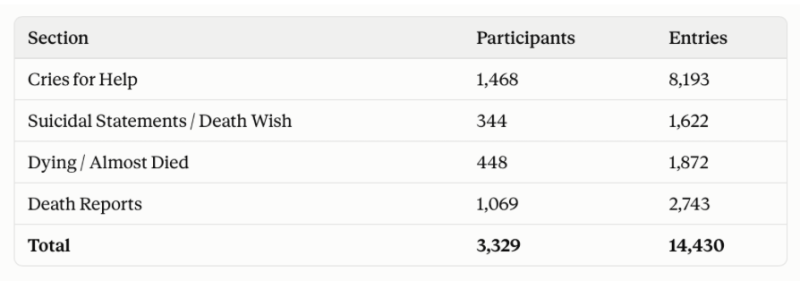
Conclusion: 3,329 participants met the criteria and submitted 14,430 related entries. About 1 in every 1,048 participants in the tranches wrote a plea for help, or reported a death. Many wrote in repeatedly. Several reported that promised callbacks never came, and some asked directly whether anyone was reading their reports.
V-safe was built to hear from people after vaccination, and these participants used it for that purpose. In their own words, 3,329 people reported serious harm, suicidal thoughts, near-death events, or the death of someone they loved. Many kept writing for weeks or months. Their entries describe promised callbacks that never came, pleas for help with no reply, and repeated questions about whether anyone was reading at all. This audit cannot determine what the CDC did with these reports. It can document what participants experienced: a system that asked them to report and, as they describe it, did not respond.
There are limitations. Entries are self-reported; this audit does not assess whether the vaccine caused any reported event. Counts are a floor: participants who described serious events without using the search terms are not included. The CDC’s redactions appear as (b)(6). Names, phone numbers, and email addresses the CDC left unredacted have been replaced with [name], [phone], and [email].
How to read this report. Each block is one participant: the header shows the V-safe user ID and number of entries. Entries in bold with a red date matched the search; the rest are the same participant’s other entries. The companion spreadsheet lists the CDC response ID and tranche for every entry. The Top Cries for Help list follows on the next page, then the 30 notable cases and the full audit entries.
React19 exists so that people injured after vaccination are heard, believed, and cared for. These entries show why that work matters. They also show where the public health system’s own tools fell short of it.
Typeset book for downloading and distributing widely. No copyright restrictions.
You can purchase a physical copy, a Kindle edition, or the audio at Amazon.
Join the Conversation
Published under a Creative Commons Attribution 4.0 International License
For reprints, please set the canonical link back to the original Brownstone Institute Article and Author.