

We’re now rapidly approaching the six-year anniversary of “15 Days to Slow the Spread.”
That policy has to have been one of the most disastrous in world history, created by “experts” who took all established pre-pandemic planning documents and tossed them out the window at the first opportunity.
It was a policy based on inaccurate reports out of China, which claimed that their lockdowns effectively stamped out transmission of Covid-19 within a matter of days.
It was a policy that ignored solid research – from established epidemiologists like Dr. Jay Bhattacharya – which found that the coronavirus had already spread much more widely than previously realized.
It must be noted forever that lockdowns and the associated mask mandates, vaccine passports, and school closures continued in some places for several years. The ramifications of those wretched policies will be quite literally endless. It’s not an exaggeration to say that lockdowns, our policies, and responses have quite literally changed the course of world history.
One would think that there would definitely be a concerted effort to understand whether such policies were effective or not. Whether approaching respiratory viruses with authoritarian crackdowns on businesses and schools was necessary to save lives.
Yet six years later, there’s unfortunately very little interest in examining those questions. And when you understand the data from Sweden, you will see exactly why.
Study on Swedish Approach to Covid Shows Lockdowns Didn’t Work
A study published in PubMed examined the Swedish approach to Covid policy, relative to its European counterparts, primarily because Sweden did not rely on lockdowns in response to the pandemic, but instead used “voluntary and sustainable mitigation recommendations,” the study says.
Despite a “majority of Swedes” supporting those policies, “this approach faced rapid and continuous criticism.”
That criticism came primarily from public health figures such as, surprise, surprise, Dr. Anthony Fauci, who criticized Sweden repeatedly for going against the herd.
“You’ve compared us to Sweden, and there are a lot of differences,” he said during a Senate Committee hearing in September 2020. “But compare Sweden’s death rate to other comparable Scandinavian countries. It’s worse. So I don’t think it’s appropriate to compare Sweden with us.”
“If you look at Sweden, they are in some trouble,” Fauci claimed on Good Morning America in late 2020. “They are starting to see that their death rate is much higher than the surrounding countries of Norway, Denmark, and Finland…They’re starting to see now that they’re having to rethink some of the things they did.”
This was, of course, not true. They did not “rethink” their strategy of light touch recommendations over lockdowns. And comparing Sweden exclusively to its neighbors is an absurd misdirection that no other country was subjected to. But Fauci, obviously never one for honesty or intellectual integrity, represented many public health figures who were anxious to see Sweden fail.
Yet as this research shows, reality was precisely the opposite.
The study explains that Sweden received criticism for “not legally enforcing mask-wearing in public spaces,” as well as keeping schools open and “being too permissive” with its policies. All the things that we were told were necessary to stop Covid and save lives. The researchers tested these statements using excess mortality data and stringency indices to compare Sweden across the whole of Europe, not just its neighbors.
They chose excess mortality because, unlike Covid specific measurements, it’s less subject to bias, differences in testing, and counting, and individual definitions of Covid-caused outcomes. It also accounts for deaths that “could potentially be indirectly attributed to the negative effects of strict lockdown measures and the overall strain on healthcare systems, leading to reduced access to healthcare for other diseases, among other factors.”
Turns out that what they discovered was that Sweden vastly outperformed the rest of Europe from 2020-2022, with outcomes that were remarkably similar to the other Nordic countries.
“Among 42 European countries, the cumulative excess all-cause mortality from January 2020 to December 2022 ranged from 46 (Luxembourg) to 1,080 (Bulgaria) deaths per 100,000 inhabitants, with a median of 351/100,000,” they write. “In Sweden, the excess mortality rate of 158/100,000 was among the lowest, ranked 37th among 42 countries, and not very different from other Nordic countries: Norway (129), Denmark (97), and Finland (228).”
So why did Sweden underperform in 2020 relative to their neighbors? Likely due, as the study explains, to “mortality displacement due to low all-cause mortality in 2019,” as well as “poorly organized older adult care structures.”
What does this mean? Essentially, there were significantly fewer deaths from all causes in Sweden in 2019, meaning there were more extremely elderly people alive in 2020 that were susceptible to severe outcomes from Covid. This is reflected in the massive age gradient with Covid-associated deaths. In Sweden, “~40% of the COVID-19-associated deaths were among patients in nursing homes,” the study says, “and 67% of all COVID-19 deaths were among individuals above 80 years of age, representing 10% of all deaths in that age group.”
For younger age groups, Covid was mostly a non-issue. “COVID-19 deaths below 50 years of age represented only 1.2% of all COVID deaths, including 21 individuals below 20 years of age, mostly with underlying co-morbidities, representing 1% of all deaths in that age group.”
Effectively, Covid ravaged extremely elderly people, while those under 50, despite the lack of mask mandates and lockdowns, saw very limited impact.
Sweden’s Lack of Lockdowns Led to Better Outcomes
Equally important, they examined the “stringency index” for countries across Europe, then made a data table comparing that stringency to excess mortality from 2020-2022. Effectively, how strict were a country’s policies, and how much did that matter to reducing excess mortality?
Turns out, there’s a definitive, resounding answer which this chart demonstrates perfectly. Countries are plotted based on their stringency index, the x-axis, and excess mortality, the y-axis. The line demonstrates the trend in mortality rates, and there’s virtually no relationship between the severity of policy and preventing excess mortality.
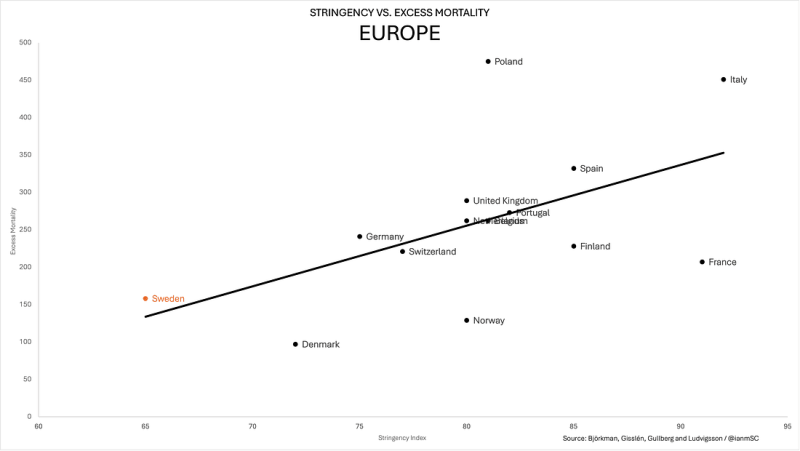
The R-squared, effectively the relationship between stringency index and excess mortality, is just 0.14. The closer to 1, the more related stringency is to outcomes. This is 0.14.
Countries like Italy and Spain were some of the strictest when it came to lockdowns and mandates, yet ranked near the top in excess mortality rates. The UK, Portugal, the Netherlands and others were significantly more stringent and also had demonstrably worse outcomes. Denmark was the second least strict country and had the best outcomes, at least in this examination.
What does this tell us? Well, put simply, Fauci was wrong. Sweden did not underperform relative to its neighbors. It did significantly better than the rest of Europe, and of course, the United States. Lockdowns and stringency were not related, whatsoever, to reducing excess mortality. They never mandated masks, one of his chief policy recommendations, and outperformed other countries like Germany which imposed N95-level mandates for months on end.
This is a clear repudiation of the lockdown model. Which is precisely why Sweden’s example is deliberately being ignored today.
Because learning the actual results of these historically bad policies requires humility, accountability, and honesty, all qualities that many in public health are truly incapable of possessing.
Republished from the author’s Substack
Join the Conversation
Published under a Creative Commons Attribution 4.0 International License
For reprints, please set the canonical link back to the original Brownstone Institute Article and Author.