
The Cochrane Collaboration is a grassroots organisation founded in 1993. It publishes systematic reviews of healthcare interventions and was highly successful until British journalist Mark Wilson became CEO in 2012. A major medical journal expressed concern that someone with no health care experience was leading one of the foremost organisations dedicated to ensuring good clinical decisions.1 Wilson made the organisation highly ineffective and bureaucratic, and his actions harmed Cochrane’s mission about ensuring high scientific standards.2-4
The problems mounted, and in April 2021, Wilson suddenly left his job, a week before Cochrane’s largest funder, the National Institute of Health Research (NIHR) in the UK, announced a major budget cut.5 The funder criticised the poor scientific quality of Cochrane reviews, “a point raised by people in the Collaboration to ensure that garbage does not go into the reviews; otherwise, your reviews will be garbage.”2 Only four months later, the NIHR declared that the funding would stop in March 2023. When that happened, Cochrane was in big disarray, but the huge bureaucracy and the poor scientific standard continued nonetheless.2
Wilson left abruptly “after eight years of outstanding service,”6 as Cochrane leaders called his destruction of the organisation. Cochrane’s Editor-in-Chief, Karla Soares-Weiser, became acting CEO for a month until MBA Judith Brodie took over as interim CEO for a year.7
In July 2022, Catherine Spencer became CEO. The “full bio” on Cochrane’s homepage does not reveal her education,8 and I couldn’t find that out, as there are, for example, a historian and a rugby player with the same name.
When Spencer left in March 2025, Soares-Weiser became acting CEO. Six months later, she became the CEO,9 and the chair of the Cochrane Governing Board, Susan Phillips, said that she “has the vision, experience and passion to lead Cochrane to a bright new future.”
I shall give my reasons why I don’t think the Cochrane Titanic with Soares-Weiser as captain has a “bright new future” but is more likely to sink, which some people predicted would happen when I, one of the founding fathers, was expelled in 2018 because I had become a threat to Wilson’s firm grip on power. I had been elected to the Governing Board because I wanted to save Cochrane from him.2,10,11
I shall discuss 11 cases that stem from my personal experiences and those of Tom Jefferson, one of my previous employees, starting in 2015 when Soares-Weiser became Deputy Editor-in-Chief and got a substantial say about the standard of Cochrane reviews (she became Editor-in-Chief in 2019).12 But first, I shall describe a stunning affair in 2013.
2013, Cochrane Review of Influenza Vaccines
After Tom Jefferson had not found any effect of influenza vaccines on mortality in elderly people, a group of researchers “rearranged” the data “after invitation from Cochrane”13 and reported that the vaccines reduced deaths14 – an amazing statistical stunt considering that the risk ratio was 1.02 and only four people died. This misconduct foreboded later events.
2015, Cochrane Review of Chlorpromazine for Schizophrenia
I submitted a comment to the Cochrane Library about this review.15 The authors included Soares-Weiser who is a psychiatrist. They mentioned in the abstract, without any reservation, that akathisia didn’t occur more often on drug than on placebo, and that the largest trial even found significantly less akathisia in the active group than in the placebo group. I noted that, “Since we know that antipsychotics cause akathisia and that placebo cannot cause akathisia, this result speaks volumes about how flawed trials in schizophrenia generally are. What was seen in the placebo group were cold turkey symptoms caused by withdrawal of the antipsychotics the patients had received before randomisation.”
Cochrane replied that akathisia symptoms “are well recognised to also occur in people who have never been on medication. Even a cursory search of the literature highlights study after study illustrating this odd fact.”15
Well, even a cursory search on the Internet reveals that scientists don’t believe akathisia can occur in unmedicated people and none of Cochrane’s three references demonstrated that. Having no counterarguments, Cochrane changed the subject and accused me of “attempting to discredit all psychiatry drugs” in “my statements to the press where I advertised my book.”15,16
2019, The DTP Vaccines
Three affairs in 2019 illustrated that the moral and scientific decline in Cochrane had been major.
When Professor Peter Aaby had found in several studies that the diphtheria, tetanus, and pertussis (DTP) vaccine increases overall mortality in low-income countries, the WHO asked key Cochrane people to assess the evidence.13,17 They were not allowed to do any meta-analyses, likely because the WHO didn’t want to run a risk of receiving a review that confirmed Aaby’s findings.
The Cochrane authors complied with this unacceptable interference with their research and produced a report that included vote counting – how many studies are for and how many against? – which is a method recommended against in the Cochrane Handbook.18 One of the authors of the WHO’s review was statistician Julian Higgins, editor of the Handbook, and another was Soares-Weiser.
Lawyer Aaron Siri in New York asked me to assess the evidence. I found that Aaby’s findings were reliable whereas there were serious flaws and inconsistencies in the Cochrane report.19-22 The DTP vaccine doubled mortality even though all the biases Aaby documented favoured the vaccinated group.
2019, The Cochrane Review of the HPV Vaccines
Tom Jefferson and I warned Cochrane several times. I told Cochrane’s Editor-in-Chief, David Tovey, that they “must be very, very careful with this review” and that we also did a review, using clinical study reports we had obtained from the European Medicines Agency, which are far more reliable than the published trial reports.”17
As our advice was ignored, we published a criticism of the Cochrane review noting that many studies and patients were missing and that the harms of the vaccines had been underestimated.23 We hit a very sore spot. A week later, we were heavily attacked by Tovey and Soares-Weiser in a 30-page (!) comment on the Cochrane website.24 They opined that public confidence may be undermined if scientific debates take place in public and accused us of having made unwarranted allegations in an inaccurate and sensationalised report.
They lamented that we had not contacted the Cochrane authors before we went public although Tovey knew it wasn’t our fault and that I had intended to inform them in advance.2 They spread their misinformation to everyone in Cochrane using general email lists and attacked the peer review and editorial work in the journal where we published our criticism.23 The editors became upset and asked Tovey and Soares-Weiser to be concrete and publish their criticism in the journal. They didn’t and we couldn’t reject their arguments, as we were not allowed to write on Cochrane’s website.
The review authors did not defend themselves. This is how the drug industry operates. It was warfare with dirty methods, protecting the Cochrane flag by appealing to authority rather than reason and stifling debate.25
The Cochrane editor who published the review, Jo Morrison, accused us of risking “the lives of millions of women world-wide by affecting vaccine uptake rates.”10 In my book about mammography screening, I call this the “You are killing my patients” argument.26
People shun uncertainty and Cochrane’s criticism of us was interpreted as the final word in the debate even though they failed to address our criticism. After we had done further detective work, we published an even stronger criticism showing that over 25,000 patients were missing in the Cochrane review.27
We are likely the only ones to have read 60,000 pages of study reports, corresponding to 250 books. The Cochrane review didn’t find an increase in serious neurological harms but we did.28 Tovey and Soares-Weiser were confident that the Cochrane authors didn’t have relevant conflicts of interest, but we gave many examples of such conflicts.
Like when a drug company announces its new blockbuster,20 Cochrane’s PR was shameless, using the Science Media Centre, which has a very bad reputation.29 It promotes corporate views and gets funding from industry whose products it often defends. Cochrane also had a conflict of interest as it received a grant of $1.15 million from the Bill & Melinda Gates Foundation in 2016.20 One of Bill Gates’s major projects was to propagate HPV vaccines.
My criticism of the Cochrane HPV vaccine review played a major role in my unjustified expulsion from Cochrane in 2018.2 Many comments raised by Governing Board members during the secret show trial against me implied that scientists cannot be board members, and that Cochrane should prioritise protecting its reputation over having an open public debate about the science.2 In the drug industry, it is the same. Its employees must protect drug sales and cannot criticise the company’s research publicly.
2019, Cochrane’s Conflicts of Interest Policy
I fought for 17 years to get industry money out of Cochrane, which earned me many enemies.
My closest ally was Drummond Rennie,30 Deputy Editor at JAMA and co-director of the San Francisco branch of the US Cochrane Center.2 In 2002, we published an article about inappropriate authorship.31 Half of the Cochrane reviews had honorary or ghost authors who had not contributed meaningfully or had contributed without being named. I also held a workshop for Cochrane editors in Copenhagen.30 Drummond strongly condemned two Cochrane reviews on drugs for migraines that had been funded by Pfizer, the manufacturer of Eletriptan, and I asked the Cochrane Steering Group to ensure that industry funding of Cochrane was prohibited.
But, as Drummond had predicted, there was an outcry from the Cochrane leadership, with poor arguments for their inaction.30
In 2005, we had an exhausting battle with our fellow Cochrane centre directors. A few centres got financial support from drug companies. We didn’t buy any of the silly arguments and I said that if centres couldn’t survive without industry support, they shouldn’t survive.
When I was elected to the Cochrane Governing Board in 2017, I suggested changing our policy so that no one with financial conflicts of interest related to a drug company could be an author of a Cochrane review about that company’s product. We agreed that I should rewrite our highly ambiguous and inconsistent policy, which I did in an afternoon.2
But co-chair Martin Burton, undoubtedly instructed by his boss, Mark Wilson, to do so, sabotaged my work. He immediately prevented everyone from writing to other board members that they liked my proposal and claimed we had only agreed on proposing a process for the policy change, which wasn’t correct.
Twenty months later, a progress report was circulated.2,32 It said that Cochrane could not implement a policy that eliminated conflicts of interest, but that everyone “should be confident that our policy is robust and in-line with industry best practice..we must find a way to continue to allow people from diverse academic, clinical, and cultural backgrounds to contribute to the production of Cochrane reviews.”
This pompous beating about the bush means: “We still want the industry money.” And in line with industry best practice? Industry does its best to corrupt influential doctors!33
Over two years passed before the world saw the result of Cochrane’s elaborate processes. To get there, Cochrane had examined conflict-of-interest policies from 33 healthcare-related organisations; had conducted a survey with contributions from nearly 1,000 Cochrane members; and had interviewed 16 internal and external stakeholders.34 This was inefficiency in the extreme.
Soares-Weiser announced Cochrane’s “new, more rigorous ‘conflict of interest’ policy”34 16 years after I had pointed out at a plenary meeting in Barcelona that a better commercial sponsorship policy was needed.2 Cochrane’s groundbreaking new policy said that “The proportion of conflict free authors in a team will increase from a simple majority to a proportion of 66% or more.”34
The HealthWatch Newsletter was not impressed and quoted me:35 “Semmelweis never told doctors to wash one hand only. Wash both…Cochrane’s ‘strengthened’ commercial sponsorship policy is like eating the cake and still having it. It is like going from declaring to your spouse that you are unfaithful half of the days in a month to ‘improving’ by declaring that from now on you will only be unfaithful one third of the days.”
2023, Cochrane Review of Safe Withdrawal of Antidepressants
In March 2023, I complained to Soares-Weiser about editorial misconduct in the Cochrane Common Mental Disorders group, which she forwarded to Cochrane’s CEO, Catherine Spencer.36,37
Editorial misconduct is a serious matter, but they refused to answer my simple questions and didn’t submit my complaint to due process. Spencer replied that they had noted my concerns, which is executive parlance for: “We don’t give a damn; we are beyond reproach.” I have described the affair in an article38 and a freely available book,39 and shall only summarise the issues here.
Cochrane sent us on a mission that was impossible to accomplish, with increasingly absurd demands of protocol changes that contradicted the science. We couldn’t comply with this without making complete fools of ourselves, jeopardising our scientific reputations, but we tried hard and explained carefully, with references to the science, when the comments were wrong and that we could therefore not comply with them.
Our project was very simple: to review the randomised trials of various methods of drug withdrawal. But it took nine months before we got the first feedback, and our protocol was rejected two years and four months after we submitted the first version.
When we appealed to Soares-Weiser, she said she had looked carefully at everything and claimed we had not addressed the peer-review comments, which was blatantly false.
The final peer review, 1,830 words, which finished us off, is the worst I have ever seen. The anonymous hangman protected the interests of the psychiatric guild and the drug industry by denying a long array of scientific facts and by using strawman arguments accusing us of things we had never claimed.38,39
The reviewer believed in the discarded myth40 that depression is caused by a chemical imbalance and wanted us to say so; asked us to start praising the drugs, as if we were writing an ad for a drug company; and claimed falsely that we conflated disease reappearance with withdrawal symptoms, and that most people who had taken antidepressants for extended periods could stop safely without any withdrawal symptoms.
An editor assessing one of our appeals wrote that our stance on the harms and benefits of psychiatric drugs did not “fully reflect the current international consensus and could cause alarm among review users who rely on Cochrane’s impartiality.” We replied that Cochrane is not about consensus but about getting the science right and that our protocol didn’t offer any “stance” about the merits of the drugs.
In the meantime, against key Cochrane principles, Cochrane had secretly let other researchers go ahead with a similar review, which they published.41 It was 23 times as long as the review we published in a medical journal.42
The Cochrane review is highly embarrassing for Cochrane. It didn’t include trials comparing different withdrawal strategies, whereas it included many flawed studies comparing abrupt discontinuation (cold turkey) with continuation, which are irrelevant. The Background section was longer than most scientific papers (4,239 words) and was full of irrelevant and untruthful marketing messages about how good the drugs are.36
Even though one of the main drivers for establishing the Cochrane Collaboration was to assist patients in their decision-making, the whole Background section is about what doctors think. The tone in the review is highly paternalistic and there is no mention that many patients didn’t like the drugs and wanted to come off them, which should have been the primary reason for the authors to do the review.
The Cochrane authors didn’t conclude anything apart from saying that future studies should report key outcomes such as the successful discontinuation rate. The irony couldn’t be bigger. Our only primary outcome in our 2017 protocol was exactly that! We found a median success rate of 50% and showed that a long tapering period was highly predictive for success (P = 0.00001).42
The Cochrane review is totally unbalanced. There are precise but misleading estimates of the number needed to treat to benefit one person but no estimates for the most serious harms and it doesn’t say that depression drugs double the suicide risk.43
2023, Cochrane Review of Face Masks
In early 2020, in the beginning of the Covid-19 pandemic, Tom Jefferson submitted an update of his Cochrane review about physical interventions to reduce the spread of respiratory viruses.44 Face masks don’t work,45 but Cochrane held the review back for 7 months while many countries mandated people to dress as bank robbers,46 and other Cochrane researchers published substandard research that gave the answer the politicians wanted.13,47
This censorship was of the worst kind. The Cochrane leaders knew perfectly well how important this high-quality Cochrane review was. It became the most downloaded review in Cochrane’s history.48
When Tom updated his review again, in 2023,49 Cochrane committed editorial misconduct again. An influencer who didn’t know much about masks or science50 claimed in the New York Times that masks worked, and that the Cochrane review had misled the public.13 Her article was full of errors,50 but Soares-Weiser apologised the same day on Cochrane’s website for the wording in the review summary,51 even though there was nothing to apologise for.45
Soares-Weiser violated Cochrane’s rules for post-publication criticism, which should have been published alongside Tom’s review, with his reply, and she didn’t even tell him what she would write before she went public.50,52 She also violated the guidelines from the Committee of Publication Ethics (COPE), even though Cochrane is a member of COPE.
Three weeks earlier, Tom’s review was attacked by Facebook’s fact-checker Health Feed-back with “absurd results.”53 Facebook claimed that face masks worked, but all eight claims in the summary were void: Four were plainly false, one was logically invalid, one was misleading, and two were not supported by any evidence.
Soares-Weiser claimed that the review could not address whether mask-wearing reduces the risk of contracting or spreading respiratory viruses, but the review addressed exactly this.
Tom said she made a colossal mistake by signalling that Cochrane can be pressured to undermine their own reviews,52 and he wondered, “given the speed and highly unprofessional nature of the reaction,” if what spooked the Editor-in-Chief was one of Cochrane’s big funders?54
Cochrane’s statement was widely interpreted as an apology coming from the authors, and former CDC director Rochelle Walensky falsely told the US Congress that the review was retracted.55
Vinay Prasad, who currently holds a top job at the FDA, wrote in the article, “The Cochrane mask fiasco,” that Soares-Weiser should be fired because it is bad leadership to throw an author under the bus, “especially when the author was factually correct.”56
Investigative journalist Paul D. Thacker wrote that, faced with an ongoing crisis caused by multiple missteps, Soares-Weiser hired the pricey consulting firm Envoy to address scientists’ concerns about her lack of transparency, leadership, and communication skills.57 When he asked how Cochrane had handled his request for comment and answers in relation to the scandal, he received heavy redacted documents:
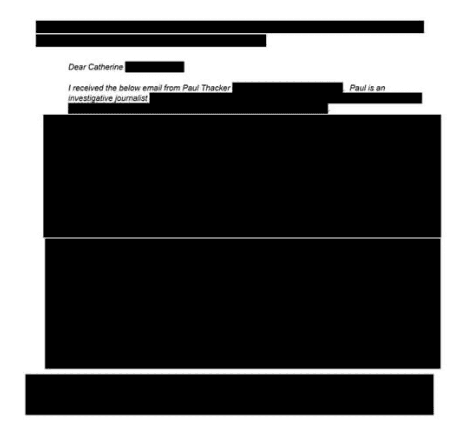
In his article: “Cochrane: world’s preeminent medical information resource goes into tailspin,”57 Paul said that his questions about how much Soares-Weiser paid Envoy remained unanswered. He noted that co-chair of the Cochrane Governing Board, Catherine Marshall, had helped her draft the statement undermining the Cochrane mask review, and that Marshall, in her Cochrane conflict of interest declaration, had failed to disclose her Covid consulting gigs with the New Zealand government, which ignored the Cochrane review and implemented a stringent mask policy.
When Tom requested his personal data from Cochrane under Article 15 of the European Union’s General Data Protection Regulation, he received “nearly 300 pages of nothing” with “all the important email exchanges” fully redacted.58
It is hard to believe that “transparent communication” is a key Cochrane principle.59
2023, Editorial Misconduct in the Cochrane Schizophrenia Group
The abstract in a Cochrane review of acute psychosis noted that, “compared with haloperidol, there was no observed effect for benzodiazepines for sedation.”60 This was totally misleading as benzodiazepines had the same effect as haloperidol. Another Cochrane review showed that the desired sedation was obtained significantly quicker with a benzodiazepine than with an antipsychotic.61
I contacted Cochrane about this in 2018 but it took five years and a lot of persistence on my part before they changed the text.62
I asked the primary author, Hadar Zaman, to correct the abstract, which he didn’t. He sent my comments to the Cochrane Schizophrenia Group, noting they would come back with guidance, which they didn’t.
I interpreted the lack of response and the renunciation of an author’s accountability for what he had published as Cochrane censorship. As noted above, Cochrane was obsessed with publishing messages that helped the drug firms in their marketing.
I wrote to Zaman again, copying the Managing Editor of the Cochrane group, Claire Irving, and submitted my criticism via the Comments function in the Cochrane Library. Irving replied that the group would respond “as soon as possible” but three years later, I had still not heard from them.
I resubmitted my comment, repeating that I wondered why the authors had not quoted the Cochrane review that showed that benzodiazepines worked better than antipsychotics.61
When over a year had passed, with no reply, I sent a complaint to Cochrane’s Editor-in-Chief, psychiatrist Karla Soares-Weiser, who replied she would let me know when my comment had been published.
She didn’t. Three months later, I found out that my comment was published. But there was no reply to it in the review, and as nothing had been changed in the seriously misleading abstract, Soares-Weiser had failed to live up to her responsibility as Cochrane’s Editor-in-Chief. I considered this editorial misconduct.
In March 2023, I contacted her again noting that “The whole idea of post-publication criticism of Cochrane reviews has always been that this would help make the reviews better and less biased. ‘Trusted evidence’ is Cochrane’s motto but this abstract…is far from being trusted evidence.”62
Two months later, John Hilton, with the impressive title, Head of Content Publication and Policies, Cochrane Central Executive, wrote to me that the review had been amended, now saying there was no difference between haloperidol and benzodiazepines, and a response was published. But not by the authors, even though this was their duty, which confirmed my suspicion that censorship is part of Cochrane’s modus operandi.
The response from the “Editorial base” was pathetic. Cochrane downgraded its error by saying, “sometimes the phrase can be misinterpreted.” Wrong. The sentence “there was no observed effect for benzodiazepines for sedation” cannot be misinterpreted.
The editors didn’t find it relevant to mention the Cochrane review that found faster sedation with benzodiazepines, arguing that it only assessed the acute effect. This was also plain nonsense. The review I criticised was about psychosis-induced aggression or agitation, which are acute conditions.
My comment is now part of the Cochrane review,63 but, unfortunately, the PubMed abstract is still the old misleading one.
Antipsychotics are far more dangerous than benzodiazepines,16,39 and patients have always told me when I lecture that they prefer the latter.
This affair illustrates that Cochrane is willing to sacrifice scientific honesty and the patients to protect their guild and financial interests.
2023, Our Cochrane Review of Mammography Screening
The first big moral and scientific scandal in Cochrane’s history occurred in 2001, when my co-author and I submitted our review of mammography screening to the Australian-based Cochrane Breast Cancer Group – which had a financial conflict of interest, as it was funded by the centre that offered breast screening in Australia. They refused to publish our data on the most important harms of cancer screening, overdiagnosis, and overtreatment.64
We published the full review, with the harms, in the Lancet. It took me five years of hard work and many complaints to Cochrane authorities to get the harms into the Cochrane review.26,64
When I and my current co-author, the Danish Cochrane director, updated the review in 2023 for the fourth time, with more mortality data, Cochrane refused to publish it in an act of horrific censorship.64 It took six months before we got any feedback, and the peer reviews – 8 from Cochrane, 3 from other people, – had 91 separate points over 21 pages.
Later, we received 34 pages, and when we had done our utmost to meet all the unwarranted demands, we received 62 pages of comments, which we were told were not exhaustive – for a simple update of a review published four times before, most recently in 2013.65 Some of the peer-reviewers didn’t understand the basics of cancer screening or review methodology, but they were undeterred in demanding ludicrous changes to our review.
The editors required, with reference to the Cochrane Handbook, that we should write that screening “may show little or no difference in terms of a reduction in breast cancer mortality.” This is silly, as it is subjective whether a difference is small or not.
We were not allowed to call overdiagnosis overdiagnosis, even though we had done that in the existing review; Cochrane reviews of other cancer screenings did it; Cochrane’s Editor-in-Chief Karla Soares-Weiser had done it; the major guideline groups had done it; and it was an official Medical Subject Heading in the research database PubMed.
Adding insult to injury, the Methods Reviewer required that the authors of the original trials should have used the term “overdiagnosis” if we were to use it. This is not a Cochrane requirement and some of the original trial authors had in fact used the term.64
Even more absurd, we needed to “identify individual women who have been overdiagnosed.” This is impossible. Everyone knows that overdiagnosis is a statistical concept that is documented by comparing screened with unscreened women.
Cochrane showed its true face when the appeals editor, Jordi Pardo, told us that a 2024 review of breast screening, which he called the David Moher review after the last author, was a useful example of how we could have addressed the concerns about our review. It was a politically expedient, poor-quality review.66 The authors didn’t even accept overdiagnosis as a reality. They wrote that overdiagnosis can be associated with breast cancer screening. It is an inevitable consequence of screening, and it is caused by screening.
Very conveniently, the authors considered the two Canadian screening trials, some of the best ever performed, at high risk of bias. Screening enthusiasts hate these trials because they didn’t find an effect of screening on breast cancer mortality. The poor-quality review gave five references to justify their decision, which were to articles written by staunch screening advocates. I have documented that some of these advocates have published highly misleading, and in some cases fraudulent, papers about the alleged benefits of mammography screening.26
Amusingly, it doesn’t matter what one thinks about the Canadian trials. We documented already in 2001 that breast cancer mortality is a biased outcome that favours screening. We therefore need to look at cancer mortality, including breast cancer mortality, and total mortality. The poor-quality review didn’t alert their readers to this bias and didn’t report on total cancer mortality, which is inexcusable.
The authors claimed that screening reduces all-cause mortality and gave estimates for the number of deaths saved per 1,000 in various age groups.66 This is fraud because screening doesn’t reduce all-cause mortality.65
Cochrane didn’t hide their brutal censorship. The ”Sign-Off Editor” noted that our review might create a potentially damaging firestorm of misinformation. Well, it is the most unbiased and comprehensive review that exists and it has been available since 2001.
Based on our Cochrane review, I wrote a leaflet for women in 2012 to help them decide if they should go to screening. It was so popular that volunteers translated it into 16 languages, including Chinese, Arabic, Russian, and Urdu.67 And BMJ’s editor called our paper about the misleading UK leaflet68 one of her top 20 articles in the last 20 years.69
Isn’t this what Cochrane should be all about? Helping people make wise decisions about healthcare interventions?
The Sign-Off Editor opined that we had pre-conceived ideas about screening, “rather than considering it may actually have benefit not detected.”64 It is shameful that Cochrane argues like healers do, which we call wishful thinking. We had no pre-conceived ideas about the effect when we did the first Cochrane review, and why should we conclude that a benefit might have been overlooked after 600,000 women had participated in trials that showed no effect on cancer mortality or total mortality (risk ratios of 1.00 and 1.01, respectively)?70,71
This saga took two years. In June 2025, Cochrane Central Editorial Service rejected our appeal. As it was a high-profile case, about an intervention considered highly controversial, I have no doubt that Soares-Weiser, now Cochrane’s CEO, knew what was going on. She could and should have intervened but didn’t.
Cochrane doesn’t learn from its huge mistakes, or from Greek mythology that tells us that after hubris comes nemesis. There is no hope for a Cochrane that tortures the data until they confess72 or kill them and refuses to publish high-quality reviews that contradict popular beliefs. This is why I called my detailed article about the two Cochrane mammography screening scandals, where there are links to all the foolish peer reviews with our responses, “Cochrane on a suicide mission.”64
2023, Cochrane Review of the Covid-19 Vaccines
This Cochrane review is a politically expedient garbage-in, garbage-out exercise. It ignored the serious harms of the vaccines,13,73 saying there was little or no difference in serious adverse events compared to placebo.74 Peter Doshi and colleagues criticised this review.74 When they used regulatory data, they found that one serious adverse event occurred for every 800 vaccinated people in the pivotal mRNA trials and that the harm was considerably larger than the benefit – avoiding hospitalisation.75
Maryanne Demasi and I also found serious, sometimes deadly, harms of the vaccines in our systematic review.76
Cochrane used misleading industry jargon in the review title: “Efficacy and safety of COVID-19 vaccines,”74 which suggests that the vaccines can only be good for you, but no drug is safe. There is always a risk that a drug will harm some people.77
The misleading review title is a sign of Cochrane’s moral decline. I convinced Cochrane 20 years ago that we should talk about benefits and harms, in agreement with the CONSORT guidelines for good reporting of harms in trials, which I co-authored.78
2025, Two New Cochrane Reviews of the HPV Vaccines
In November 2025, Cochrane published a dishonest press release: “Two new Cochrane reviews show strong and consistent evidence that HPV vaccines are effective in preventing cervical cancer.”79 The BMJ also hyped the HPV vaccines in the extreme in a news piece, claiming that girls vaccinated before the age of 16 were 80% less likely to develop cervical cancer.80,81
One of the Cochrane reviews was a network meta-analysis of the randomised trials.82 As there were no cancers and no data on pre-cancer outcomes for girls under 15, the broad claim of 80% effect referring to both reviews was plain false.
The other review included observational studies,83 which the Cochrane authors deemed at “high risk of bias,” but they nonetheless concluded about an 80% effect.
It is very well known that studies such as those Cochrane included are heavily biased because of the healthy volunteer effect: Those who decide to get vaccinated are generally healthier than others and they are also more likely to get screened for HPV infection. No amount of statistical adjustment can remove this bias.84
The Cochrane review found that, in the cohort studies, the odds of getting screened were twice as high for the vaccinated as for the unvaccinated people.83 Since cervical cancer grows so slowly that regular screening is highly effective in reducing mortality from cervical cancer,85 this bias invalidates the Cochrane review totally, but the authors didn’t mention this issue in their discussion or abstract. They didn’t even include the healthy volunteer effect in a list of six confounders although it is the most important one.
The authors told the BMJ that “they wanted to share high quality data to counter misinformation spread on social media, which has had a massive impact on vaccination rates.”86 To call seriously flawed observational data “high quality” is as bad as it gets. Whitewashing dirty data, Cochrane showcased as the vaccine industry’s useful idiot, and the BMJ joined the party.
The Cochrane authors quoted several observational studies that didn’t find serious neurological harms. I was an expert witness in a lawsuit against Merck, which sells the HPV vaccine Gardasil, and during my deposition, Merck’s lawyer counted on some of the same studies, which I showed were highly flawed.87
Based on the confidential clinical study reports of the trials, my research group found in 2020 that the HPV vaccines cause serious neurological harms,28 but under the obligatory Cochrane heading, “Agreements and disagreements with other studies or reviews,” the Cochrane authors only mentioned our review this way:83 “The evaluation of specific adverse events that are commonly discussed on social media has been more limited than vaccine effectiveness outcomes. These events are rare and often not evaluated in clinical trials (Jørgensen 2020).” Ignoring what we found comes close to scientific misconduct.
Cochrane has also become nauseatingly “politically correct.” Both reviews talked about “people with a uterine cervix,”82,83 which the rest of us call females.
Cochrane routinely uses the drug industry’s playbook, which is to scare people with big numbers for the prevalence of a disease and its death toll, and to offer a solution, with inflated numbers for the effect, while ignoring the harms and omitting any mention of the financial cost. Both reviews mentioned that cervical cancer is the fourth leading cause of death from cancer amongst females worldwide, with 311,000 deaths in 2018. Instead of scaring women, Cochrane could have reassured them that their risk of dying from cervical cancer is miniscule. In the UK, cervical cancer deaths constitute only 0.5% of all cancer deaths and only 0.1% of all deaths, and most of those who die are older women.88
2025, Cochrane Admitted Guilt but Won’t Apologise for Defamation and Malicious Lies
I have published a separate article about this.89 Briefly, I found out in February 2025, seven years after I was expelled from Cochrane in a show trial, that journalists still referred to two defamatory and mendacious messages Cochrane published on its website in 2018.
I asked Cochrane’s CEO to ensure that the messages were corrected or removed, noting that victims of abuse always appreciate getting an apology, which could also be helpful for Cochrane if it wanted to try to recoup some of the good reputation it had before 2018.
The CEO didn’t respond. “Cochrane Complaints” replied that there were no issues to address but took down one of the defamatory statements. After my second letter, Cochrane took down a far more defamatory statement and a YouTube video of Cochrane’s Annual General Meeting, where they tried to explain why I had been expelled.
Any reasonable observer would interpret Cochrane’s actions as an admission of guilt. Cochrane was in deep trouble as its statements and strong insinuations could not be substantiated, and they ran a risk of getting sued for defamation and my loss of income.
In a third letter, I did my utmost to wake Cochrane up to the gravity of the situation they had created for themselves. I got nowhere even though I pointed out that even today, top researchers all over the world, including Jay Bhattacharya, the Director of the US National Institutes of Health, said in my interview with him90 that they have lost the respect they had for Cochrane before 2018. I also noted:
Tens of thousands of people wondered why I was expelled from Cochrane, and they will now wonder why the defamatory statements have been removed. Cochrane, which has transparent communication and decision-making among its key principles, owes the public an explanation. If Cochrane does not admit that I was subjected to gross injustice, this would tell the world that the Cochrane moral meltdown in 2018 still characterises Cochrane, which is therefore beyond repair.
But just like in 2018, Cochrane chose the worst possible option. They didn’t respond. “Cochrane Complaints” merely repeated their earlier letters.
I asked again if my letters had been seen by the CEO and the Governing Board, as I had requested, but Cochrane never told me if that was the case. While all this took place, Soares-Weiser was Cochrane’s CEO. By not apologising, she demonstrated once again her poor leadership.
Conclusions
Karla Soares-Weiser had many opportunities to prevent the Cochrane Titanic from hitting the iceberg, but she failed every time. A CEO who accepts that guild and financial interests are more important than getting the science right and allows publication of politically expedient but seriously misleading Cochrane reviews and press releases while preventing high-quality, unbiased reviews from being published, or undermining them publicly without even consulting the authors, cannot save the sinking ship.
If it was not possible for Cochrane to find a better CEO, it illustrates how deep Cochrane has sunk, morally and scientifically, and if there were better candidates than Soares-Weiser, it shows how profound the clubbiness in Cochrane is. The secret show trial revealed that the dominating Governing Board members perceived Cochrane’s clubbiness as something positive, but I saw it more as a mafia and noted in my first book about Cochrane that,3
To feel that you belong to a social club or a large family has its advantages, but it can be ruinous for a scientific organisation. You should not bring shame onto your family, but you should also do the right thing. In science, there can be no compromises when these loyalties clash, even if members of the club may feel you don’t respect them or their authority.
References
1 Chanchlani N. New CEO transforming the Cochrane Collaboration. CMAJ 2013;185:1123.
2 Gøtzsche PC. The decline and fall of the Cochrane empire. Copenhagen: Institute for Scientific Freedom; 2022 (freely available).
3 Gøtzsche PC. Death of a whistleblower and Cochrane’s moral collapse. Copenhagen: People’s Press; 2019.
4 Timimi S. Death of a whistleblower and Cochrane’s moral collapse. Psychosis 2020;12:99-100 (freely available here).
5 Gøtzsche PC. Cochrane: a sinking supertanker? Funding of UK Cochrane groups in jeopardy. Institute for Scientific Freedom 2021; May 15.
6 A message from Cochrane’s Governing Board. Cochrane 2021; April 20.
7 Judith Brodie is our new interim Chief Executive Officer! Cochrane 2025 (undated).
8 This week Catherine Spencer starts as Cochrane’s new Chief Executive Officer. Cochrane 2022; July 12.
9 Cochrane appoints Dr Karla Soares-Weiser as new Chief Executive Officer. Cochrane 2025; Sept 26.
10 Demasi M. Cochrane – A sinking ship? BMJ blog 2018; Sept 16.
11 Bijl D, Fernandez LCS, Font M, et al. Cochrane’s sinking ship and conflicts of interest. BMJ 2018; Sept 18.
12 Introducing Karla Soares-Weiser, Editor in Chief of the Cochrane Library. Cochrane 2019; Nov 1.
13 Gøtzsche PC. Requiem for the Cochrane Collaboration. Brownstone Journal 2025; July 18.
14 Beyer WE, McElhaney J, Smith DJ, et al. Cochrane re-arranged: support for policies to vaccinate elderly people against influenza. Vaccine 2013;31:6030-3.
15 Adams CE, Awad GA, Rathbone J, Thornley B, Soares-Weiser K. Chlorpromazine versus placebo for schizophrenia. Cochrane Database Syst Rev 2014;2014:CD000284.
16 Gøtzsche PC. Deadly psychiatry and organised denial. Copenhagen: People’s Press; 2015.
17 Gøtzsche PC. Whistleblower in healthcare (autobiography). Copenhagen: Institute for Scientific Freedom; 2025 (freely available).
18 Higgins JPT, Green S (editors). Cochrane Handbook for Systematic Reviews of Interventions Version 5.1.0 [updated March 2011]. The Cochrane Collaboration 2011.
19 Gøtzsche PC. Effect of DTP vaccines on mortality in children in low-income countries. Expert Report 2019; June 19.
20 Gøtzsche PC. Vaccines: truth, lies, and controversy. New York: Skyhorse; 2021.
21 Gøtzsche PC. The Chinese virus: Killed millions and scientific freedom. Copenhagen: Institute for Scientific Freedom; 2022 (freely available).
22 Gøtzsche PC. How CDC and FDA Defrauded the American Public about Serious Vaccine Harms. Brownstone Journal 2025; Nov 21.
23 Jørgensen L, Gøtzsche PC, Jefferson T. The Cochrane HPV vaccine review was incomplete and ignored important evidence of bias. BMJ Evidence-Based Medicine 2018; July 27.
24 Tovey D, Soares-Weiser K. Cochrane’s Editor in Chief responds to BMJ EBM article criticizing HPV review. Cochrane 2018; Sept 3.
25 Schopenhauer A. The Art of Always Being Right. London: Gibson Square; 2009.
26 Gøtzsche PC. Mammography screening: truth, lies and controversy. London: Radcliffe Publishing; 2012.
27 Jørgensen L, Gøtzsche PC, Jefferson T. The Cochrane HPV vaccine review was incomplete and ignored important evidence of bias: Response to the Cochrane editors. BMJ Evid Based Med 2018; Sept 17.
28 Jørgensen L, Gøtzsche PC, Jefferson T. Benefits and harms of the human papillomavirus (HPV) vaccines: systematic review with meta-analyses of trial data from clinical study reports. Syst Rev 2020;9:43.
29 Malkan S. Science Media Centre promotes corporate views of science. US Right to Know 2023; Nov 2.
30 Gøtzsche PC. A Giant in Medicine: Tribute to Drummond Rennie. Brownstone Journal 2025; Oct 2.
31 Mowatt G, Shirran L, Grimshaw JM, Rennie D, Flanagin A, Yank V, MacLennan G, Gøtzsche PC, Bero LA. Prevalence of honorary and ghost authorship in Cochrane reviews. JAMA 2002;287:2769-71.
32 Conflict of Interest Revision Project – Progress Report, May 2019. Cochrane 2019; May 10. No longer available; the link is to Web.archive.com.
33 Gøtzsche PC. Deadly medicines and organised crime: How big pharma has corrupted health care. London: Radcliffe Publishing; 2013.
34 Karla Soares-Weiser: Cochrane announces a new, more rigorous “conflict of interest” policy. BMJ blog 2019;Dec 3.
35 Cochrane policy change raises eyebrows. HealthWatch Newsletter Winter 2019–
2020;111:2.
36 Gøtzsche PC. Complaint about Cochrane editors committing editorial misconduct. Copenhagen: Institute for Scientific Freedom 2023; March 29.
37 Gøtzsche PC. Cochrane doesn’t take editorial misconduct seriously. Copenhagen: Institute for Scientific Freedom 2023; Aug 31.
38 Gøtzsche PC, Sørensen A. The review on antidepressant withdrawal that Cochrane won’t publish. Mad in America 2020; Feb 11.
39 Gøtzsche PC. Is psychiatry a crime against humanity? Copenhagen: Institute for Scientific Freedom; 2024 (freely available).
40 Moncrieff J, Cooper RE, Stockmann T, et al. The serotonin theory of depression: a systematic umbrella review of the evidence. Mol Psychiatry 2023;28:3243-56.
41 Van Leeuwen E, van Driel ML, Horowitz MA, et al. Approaches for discontinuation versus continuation of long-term antidepressant use for depressive and anxiety disorders in adults. Cochrane Database Syst Rev 2021;4:CD013495.
42 Gøtzsche PC, Demasi M. Interventions to help patients withdraw from depression drugs: A systematic review. Int J Risk Saf Med 2024;35:103-16.
43 Gøtzsche PC. Observational studies confirm trial results that antidepressants double suicides. Mad in America 2025; Feb 8.
44 Jefferson T, Del Mar CB, Dooley L, et al. Physical interventions to interrupt or reduce the spread of respiratory viruses. Cochrane Database Syst Rev 2020;11:CD006207.
45 Gøtzsche PC. False propaganda about face masks and Cochrane editorial misconduct. Copenhagen: Institute for Scientific Freedom 2023; Sept 11.
46 Demasi M. EXCLUSIVE: Lead author of new Cochrane review speaks out. Substack 2023; Feb 5.
47 Demasi M. EXCLUSIVE: Lead author of Cochrane mask review responds to Fauci’s dismissal of evidence. Substack 2023; Sept 5.
48 https://cochrane.altmetric.com/details/141934282.
49 Jefferson T, Dooley L, Ferroni E, et al. Physical interventions to interrupt or reduce the spread of respiratory viruses. Cochrane Database Syst Rev 2023;1:CD006207.
50 Thacker P. Zeynep Tufekci’s unseemly collusion with Cochrane officials to attack scientists is falling apart. The Disinformation Chronicle 2023; Sept 8.
51 Soares-Weiser K. Statement on ‘Physical interventions to interrupt or reduce the spread of respiratory viruses’ review. Cochrane 2023; March 10.
52 Demasi M. BREAKING: Did Cochrane sacrifice its researchers to appease critics? Substack 2023; March 15.
53 Siglauggson T. Cochrane fact-checked with absurd results. Brownstone Journal 2023; March 13.
54 Jefferson T, Heneghan C. The latest in the war on science. Brownstone Journal 2023; March 23.
55 Demasi M. CDC director gives misleading testimony to Congress. Substack 2023; April 20.
56 Prasad V. The Cochrane mask fiasco. Sensible Medicine 2023; March 15.
57 Thacker P. Cochrane: World’s preeminent medical information resource goes into tailspin. The Disinformation Chronicle 2023; Aug 28.
58 Piper G. NIH-funded research collaborative redacts emails on why it disavowed ‘gold standard’ mask study. Just the News 2023; Sept 1.
59 Principles of Collaboration: Working Together for Cochrane.2019; Oct 22.
60 Zaman H, Sampson SJ, Beck AL, et al. Benzodiazepines for psychosis-induced aggression or agitation. Cochrane Database Syst Rev 2017;12:CD003079.
61 Dold M, Li C, Tardy M, et al. Benzodiazepines for schizophrenia. Cochrane Database Syst Rev 2012;11:CD006391.
62 Gøtzsche PC. Cochrane’s demise: misleading denigration of benzodiazepines for acute psychosis. Mad in America 2023; June 3.
63 Gøtzsche PC. Misleading denigration of benzodiazepines when compared to antipsychotics. In: Cochrane Database Syst Rev 2023;CD003079:Jan 3.
64 Gøtzsche PC. Cochrane on a suicide mission. Brownstone Journal 2025; June 20.
65 Gøtzsche PC, Jørgensen KJ. Screening for breast cancer with mammography. Cochrane Database Sys Rev 2013;6:CD001877.
66 Bennett A, Shaver N, Vyas N, et al. Screening for breast cancer: a systematic review update to inform the Canadian Task Force on Preventive Health Care guideline. Syst Rev 2024;13:304.
67 Gøtzsche PC, Hartling OJ, Nielsen M, Brodersen J. Screening for breast cancer with mammography. Information leaflet from 2012 in 17 languages.
68 Gøtzsche P, Hartling OJ, Nielsen M, et al. Breast screening: the facts – or maybe not. BMJ 2009;338:b86.
69 Godlee F. Content is king. BMJ 2015;351:h3720.
70 Gøtzsche PC. Screening for breast cancer with mammography. Copenhagen: Institute for Scientific Freedom 2023; May 3.
71 Gøtzsche PC, Jørgensen KJ. Screening for breast cancer with mammography. Updated Cochrane review 2024; June 6:medRxiv preprint.
72 Mills JL. Data torturing. N Engl J Med 1993;329:1196-9.
73 Demasi M. Cochrane review of covid-19 vaccines under the microscope. Substack 2023; Nov 1.
74 Graña C, Ghosn L, Evrenoglou T, et al. Efficacy and safety of COVID-19 vaccines. Cochrane Database Syst Rev 2022;12:CD015477.
75 Fraiman J, Erviti J, Jones M, et al. Serious adverse events of special interest following mRNA COVID-19 vaccination in randomized trials in adults. Vaccine 2022;40:5798-5805.
76 Gøtzsche PC, Demasi M. Serious harms of the COVID-19 vaccines: a systematic review. Copenhagen: Institute for Scientific Freedom 2023;March 22.
77 Gøtzsche PC. The terminology we use about medical drugs can be misleading. BMJ 2023;380:p601.
78 Ioannidis JPA, Evans SJW, Gøtzsche PC, et al. Better reporting of harms in randomized trials: An extension of the CONSORT statement. Ann Intern Med 2004;141:781-8 and Junqueira DR, Zorzela L, Golder S, et al. CONSORT Harms 2022 statement, explanation, and elaboration: updated guideline for the reporting of harms in randomised trials. BMJ 2023;381:e073725.
79 New research confirms HPV vaccination prevents cervical cancer. Cochrane 2025; Nov 24.
80 Gøtzsche PC. BMJ and Cochrane Hype the HPV Vaccines in the Extreme. Brownstone Journal 2025; Dec 8.
81 Gøtzsche PC. BMJ’s hype about the Cochrane HPV vaccine reviews. BMJ 2025; Dec 9.
82 Bergman H, Henschke N, Arevalo-Rodriguez I, et al. Human papillomavirus (HPV) vaccination for the prevention of cervical cancer and other HPV-related diseases: a network meta-analysis. Cochrane Database Syst Rev 2025;11:CD015364.
83 Henschke N, Bergman H, Buckley BS, et al. Effects of human papillomavirus (HPV) vaccination programmes on community rates of HPV-related disease and harms from vaccination. Cochrane Database Syst Rev 2025;11:CD015363.
84 Obel N, Fox MP, Tetens MM, et al. Confounding and Negative Control Methods in Observational Study of SARS-CoV-2 Vaccine Effectiveness: A Nationwide, Population-Based Danish Health Registry Study. Clin Epidemiol 2024;16:501-12.
85 Simms KT, Keane A, Nguyen DTN, et al. Benefits, harms and cost-effectiveness of cervical screening, triage and treatment strategies for women in the general population. Nat Med 2023;29:3050-8.
86 Wise J. HPV vaccine safe and reduces risk of cervical cancer, anti-misinformation review finds. BMJ 2025;391:r2479.
87 Gøtzsche PC. How Merck and drug regulators hid serious harms of the HPV vaccines. New York: Skyhorse 2025.
88 Cancer mortality statistics. Cancer Research UK and Cancer Registration Statistics, England, 2021 – Full release.
89 Gøtzsche PC. Cochrane Admitted Guilt for Defamation. Brownstone Journal 2025; Dec 27.
90 Visions for the new director of the US National Institutes of Health. Interview with Jay Bhattacharya. Broken Medical Science 2025; Dec 19.
Join the conversation:

Published under a Creative Commons Attribution 4.0 International License
For reprints, please set the canonical link back to the original Brownstone Institute Article and Author.