The polarised debate on the World Health Organization (WHO) has been based more on mud-slinging and all-or-nothing dogma than scientific evidence and empirical data. However, with trust plummeting in public health and the WHO’s funding rapidly falling as it scrambles for more to fund what it claims are ever-increasing threats, change is needed.
The International Health Reform Project (IHRP) formed with the intent of returning this debate to a rational framework. It did not begin as an anti-institutional campaign but as a professional reckoning. Its origins lie in a shared unease among physicians, public health practitioners, economists, and former senior international officials who watched the Covid-19 response unfold with growing alarm. Their concern was not with public health itself, but with the direction it appeared to be taking. The two of us, long engaged in global health policy and governance respectively, are co-chairs of a diverse group of ten experts who have spent the past 18 months thinking through this problem from evidence and orthodoxy rather than soundbites. The project delivered its first reports in March.
For decades, the post-war health architecture led by the WHO rested on principles such as proportionality, transparency, subsidiarity, and the primacy of human welfare. Covid exposed strains in that architecture. Emergency powers expanded, dissent narrowed, and policy debate became increasingly constrained. Measures once shunned for their inevitable harms and ethical concerns—lockdowns, prolonged school closures, border restrictions, universal mask and vaccine mandates—became normalised across very different societies with little regard for age-specific risk or local context. Balancing costs and benefits of interventions—the basis of public health policy development—became anathema in professional discourse.
Several IHRP members with long experience in low- and middle-income countries were particularly sensitive to the harmful consequences of the Covid public health response. Disruptions to agriculture and food distribution increased hunger and malnutrition. Routine immunisation programmes were set back. Extended school closures affected tens of millions of children, locking in intergenerational poverty and exposing millions of children to added risks of child labour, child marriage, and trafficking. Poverty reduction efforts suffered reversals and economic losses and national debt will stymie future healthcare programmes.
Those raising such concerns were often dismissed as reckless or ideological. Yet, the questions were rooted in core public health principles: What are the costs as well as the benefits of intervention? What trade-offs are justified? Who decides, on what evidence, and with what accountability? Why were these basic principles of public health abandoned?
During this period, Brownstone Institute emerged as a forum for open debate, building on discussions associated with the Great Barrington Declaration, which called for focused protection of the vulnerable rather than broad society-wide shutdowns. At the same time, the UK-based initiative Action on World Health was exploring the need for a systematic review of the performance of the WHO and the wider international health architecture. Conversations among participants in these efforts helped shape the idea of an independent expert panel to examine global health governance more broadly.
From the outset, IHRP sought to offer constructive reform rather than reactive protest. Its founders were clinicians, economists, and former multilateral officials committed to public health and international cooperation. Their aim was and remains to ensure that future health crises are addressed effectively and with proportionality, transparency, and respect for human dignity.
In this sense, IHRP arose not from hostility to public health, but from fidelity to its core principles.
Rebuilding International Health Governance on Ethics, Evidence, and Sovereign Responsibility
Thus the IHRP is a response to a growing crisis of confidence in international public health governance. Although this crisis became highly visible during Covid-19, its roots predate 2020 and reflect deeper structural and ethical problems within the WHO and the broader global health architecture.
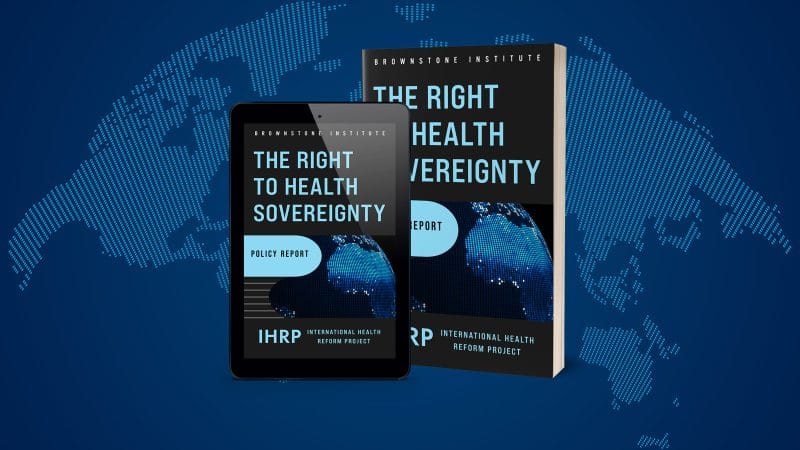
The IHRP panel has developed two linked outputs, The Right to Health Sovereignty, published last month. The Policy Report distils these findings into principles and reform pathways for policymakers. The Technical Report provides the analytical foundation, examining ethics, institutional history, disease burden, financing, governance structures, and legal frameworks.
International cooperation in health is both necessary and valuable. Cross-border surveillance, data sharing, and technical assistance have contributed to dramatic gains in life expectancy, particularly in low- and middle-income countries. Early WHO programmes demonstrated what focused, technically grounded cooperation can achieve.
Over time, however, global health governance has drifted from those foundations. The IHRP identifies several interrelated trends:
- Expansion beyond core public health functions (“mission creep”).
- Centralisation of authority justified by emergency framing.
- Growing dependence on earmarked and non-State donor funding.
- Preference for technological interventions over foundational determinants of health.
- Treaty-based rigidity that locks in policy regardless of evidences.
- Weak accountability to Member States and affected populations.
These developments have not merely reduced efficiency; they have also eroded trust and legitimacy. For healthcare is not value-neutral. Its legitimacy rests on four foundational ethical principles embedded in medical tradition and international human rights law:
- Beneficence
- Non-maleficence
- Confidentiality
- Voluntary informed consent
These principles impose constraints even during emergencies. They require individuals and the communities and states that represent them to be at the centre of health decision-making. This—the sovereignty of individuals and States—is the basis of modern human rights and underlies the Charter of the United Nations. We argue that recent practice has too often subordinated them to abstract notions of collective security, insufficiently weighing human dignity, proportionality, and long-term harm.
The Policy Report advances a conception of health sovereignty that is grounded in responsibility, not isolationism. States bear primary responsibility for protecting their populations’ health. International organisations exist to support states—not to replace or override them. International cooperation derives legitimacy from voluntary state participation. When authority drifts towards centralised technocratic bodies detached from domestic accountability, legitimacy weakens. Intentions being benign or otherwise is neither here nor there.
We identify subsidiarity as the missing organising principle. Decisions should be taken at the lowest level capable of acting effectively:
- Individuals retain autonomy in medical decisions.
- National governments lead policy.
- Regional bodies coordinate where necessary.
- Global institutions provide normative guidance on health standards; data, for example on disease surveillance; and technical support such as acceptable laboratory testing standards.
The Technical Report also demonstrates that pandemics account for a small share of long-term global mortality compared to endemic infectious diseases and non-communicable diseases. Historically, life expectancy gains have primarily come from resilience built through sanitation, nutrition, antibiotics, and primary care—not emergency architectures. Proportionality must guide future investment and intervention decisions.
Institutional Reform
The Right to Health Sovereignty proposes principles for a transformative reform of the WHO—or, if necessary, establishing a successor International Health Organisation (IHO):
- Decentralised authority.
- Proportionate emergency policy focus within a more people-centred public health approach.
- Financial independence through assessed contributions.
- Strict and enforceable conflict-of-interest rules.
- Limited, clearly defined mandates.
- Time-bound interventions that build national capacity.
- Success measured by redundancy, not expansion.
The goal is not institutional destruction, but restoration of legitimacy through clarity of purpose, funding, and accountability.
Why This Matters Now
The exit of the United States, reduced funding prospects, and the pending election of a new WHO Director-General in July 2027 present a critical moment. Leadership transitions create space for institutional reassessment. Member States will have an opportunity to debate not only personalities, but also mandate, structure, financing, and scope.
IHRP is intended to inform that debate. It promotes cooperation, coordinated response, and science-based decision-making. It argues that effective cooperation requires legitimacy—and legitimacy is built on ethics, evidence, proportionality and respect for sovereign responsibility. At its core, this project is about rebuilding trust in international health governance before further drift renders reform politically impossible.
Join the conversation:

Published under a Creative Commons Attribution 4.0 International License
For reprints, please set the canonical link back to the original Brownstone Institute Article and Author.