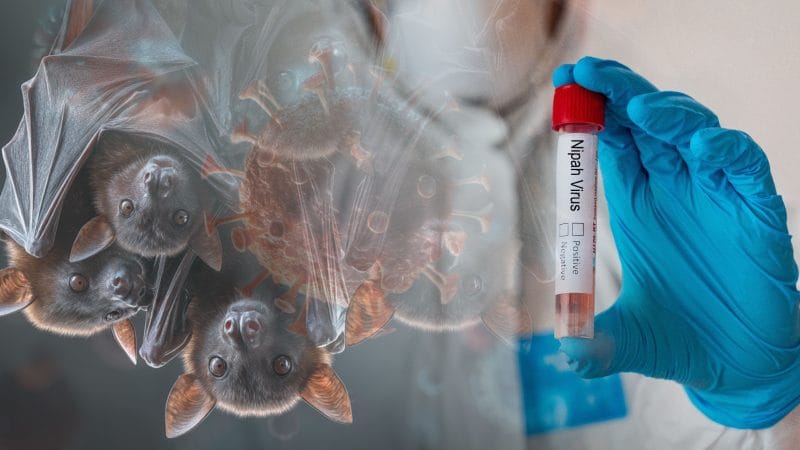

A large outbreak of hysteria occurred in the media over the past week, regarding a small Nipah virus outbreak in eastern India. ‘Hysteria’ is the correct word in terms of proportionality. It is not, unfortunately, the right word in terms of intent. Ten years ago this episode of Nipah virus disease would barely have rated a mention internationally, and certainly not stimulated airport screening and travel warnings – there have been many larger outbreaks of Nipah virus than this one, which did not.
The change over recent years is not that people have lost their minds. It relates to the adoption of the fear-panic-profit model that has entrenched itself in international public health. Tens of billions in annual funding are on the table, and they depend – with the thousands of salaries and exorbitant Pharma profits tied to the pandemic industry – on the maintenance of a constant sense of imminent threat.
The World Health Organization reports two cases from this Nipah outbreak, which is less than usual. As is common, they involve health service personnel who are often infected by the virus before the diagnosis is clear in the patients they care for. Nipah virus infection historically has a high mortality rate among those infected, and each death is a tragedy, especially in those who are infected through caring for others. The deliberate hysteria and fear-mongering these cases are being used to promote will kill lots more, because it diverts resources from programs aimed at far worse health problems. But using small recurrent outbreaks to promote fear is a business case that is too attractive to too many. This Nipah outbreak is simply its latest iteration.
What Is Nipah Virus Disease?
An outbreak of encephalitis (brain inflammation) occurred in a semi-rural area of Malaysia in 1998. It was quite severe, with almost half of the early cases dying. Initially assumed to be an outbreak of Japanese encephalitis (a more common mosquito-borne disease), it was noted that early cases were associated with illness in nearby pigs. The initial outbreak was on a farm where pigs and an orchard were in close proximity.
Unusual characteristics noted in this 1998 outbreak raised questions as to whether this was a new disease. There is an unofficial back story regarding what happened next, including a vial of blood from an infected case carried through customs and ending up at the CDC in the United States. With the help of (what were then) new techniques for distinguishing genetic sequences, it was established that a previously undetected virus was involved.
This outbreak became the first recorded outbreak of Nipah virus, named after Sungai Nipah (the Nipah river) in peninsular Malaysia. The virus is now known to be endemic in various bat species that range across much of Asia and Africa. In the case of the Malaysian outbreak, it spread from fruit bats attracted to an orchard, to the pigs that were kept alongside the fruit trees they fed on, to the humans who looked after the pigs. This remains one of the worst recorded outbreaks in history, with 105 deaths from 265 recorded cases by May 1999. Malaysia took various steps after this, initially killing a lot of pigs, but also changing farming practices. There has not been an outbreak recorded there since.
Why New Viruses Are Not Necessarily New
Since the Malaysian episode, recurrent outbreaks have been recorded, particularly in the Northeast and Southwest of the Indian subcontinent. These have been small outbreaks, less than 110 deaths in the worst, with well under 1,000 people recorded ever dying from Nipah virus globally. However, it is important to realize that this number will not reflect true Nipah virus mortality. The difference between now and the years before 1998 is almost certainly not that a new virus has emerged, but that we have simply developed the means to detect it. We simply could not distinguish Nipah virus outbreaks from other causes of encephalitis. New testing technologies emerged, rather than new viruses. Back in 1900 we knew of no human viruses, identifying the first – Yellow fever virus, in 1901. But it was the invention of PCR in the 1980s and gene sequencing since then that really allowed the new virus idea to take off.
Nipah virus outbreaks on the Indian subcontinent, distant from the first Malaysian outbreak, presumably recur due to local characteristics regarding human-bat interactions or dealings with an intermediate animal host. Evidence of the virus in fruit bats across Asia and Africa means that it has almost certainly been around for a very long time, perhaps many thousands of years. We would still be ignorant of Nipah virus disease if someone had not been clever enough to figure out how to detect and sequence the genetic material that characterizes it.
Avoiding Irritations Like Reality
None of the above stops Nipah virus from being portrayed as a new and emerging threat, because when it comes to the money to be made from the pandemic industry, reality is but a minor impediment to progress. This ”emerging infection” label is common in the infectious disease and pandemic industries. We pretend, as public health professionals, that the thing that changes when we learn how to detect a disease, and start reporting it, is the prevalence of that disease. We completely ignore the fact that there was no way to detect and report it before someone gave us the necessary tools.
By insisting that threats are emerging rather than having always been there, public health is much more exciting and we are far more likely to get funding for further work. This narrative helps drive an entire industry based on the idea that these ‘rapidly emerging diseases’ constitute an existential threat to humanity. That is no exaggeration – “existential threat” is the exact language used at intergovernmental forums like the G20.
Forty billion dollars a year in funding proposed for the pandemic and One Health agendas is based on this premise. This money, about half intended as new money taken from hapless taxpayers globally, is to support thousands of salaries and very large potential profits for multinational corporations. It all depends on maintaining a narrative of exponentially increasing risk. It is silly, readily refutable, but repeated so often that even our governments are widely taken in.
The Pandemic Industry Has a Business to Run
It can be hard to grasp what has happened in international public health, because this whole misrepresentation of reality, this huge fairy tale, is so vast. When the World Bank, the World Health Organization, the Secretary General of the United Nations, and the G20 all parrot the same rhetoric about rapidly emerging infections, increasing deaths from acute outbreaks, and a new era of pandemics, it is hard for people to believe that this is essentially just made up. International agencies of such stature are assumed to be reliable. This is the advantage of the fairytale tellers, and why truth is so hard to accept, however obviously illogical the fairytales may be.
The narrative works because medical journals are owned by large publishing houses that need to please advertisers, media need pharmaceutical advertising, and a multinational pharmaceutical industry that made hundreds of billions in profit during Covid-19 must, in a suitably amoral world, keep this train rolling. The business case is ultimately vaccines for rare diseases – difficult in a rational world but unbeatable in a world fearing every new outbreak may be our last.
The same industry also kills vast numbers of people by impoverishing them and diverting funds from more useful endeavors and higher burden diseases like malaria, tuberculosis, or malnutrition. Wrecking education during Covid, entrenching intergenerational poverty, and condemning millions of additional girls to suffer child marriage was considered an acceptable sacrifice. Pharma does not participate in international public-private health partnerships out of altruism. It is driven by hard commercial realities, and in a capitalist free-for-all it can buy the influence needed to ensure markets are shaped to its desires.
The Depressing Recurrence of Stupidity
Covid-19 has run its course and few people now get vaccinated, Avian flu never really took off despite media effort and gain-of-function research, and the recent Mpox outbreaks never really scared people in wealthy countries. Thus, we have Nipah virus as the next event to stoke the fear machine. We must always believe tht we face an imminent threat so that those who would benefit from saving us are allowed to do so.
We are not in an age of enlightenment. We are not cleverer than we used to be. We have not moved beyond superstition and ignorance in our Information Age. There was a time when international public health was relatively free to focus on interventions that prolong life and well-being. It had more integrity and was more reliable in the information it provided. Almost everyone who works in the field knows that most people will die not from occasional acute outbreaks like Nipah virus disease but from those that offer poorer financial return on investment. But we in public health, and a sycophantic media, tow the line our industry’s sponsors require. It is depressing that we seem too purchasable or unprincipled to rise above it. But it just keeps happening. We could, surely, serve the public better.
Join the conversation:

Published under a Creative Commons Attribution 4.0 International License
For reprints, please set the canonical link back to the original Brownstone Institute Article and Author.