
In a single week in January 2026, new managers of public health in the Trump administration – backed by a vigorous citizens’ movement of highly informed writers and researchers – have made some dramatic decisions to disrupt the status quo of decades. Within the ranks of the institutional gatekeepers, there is a sense of shock and awe. May this be just the beginning.
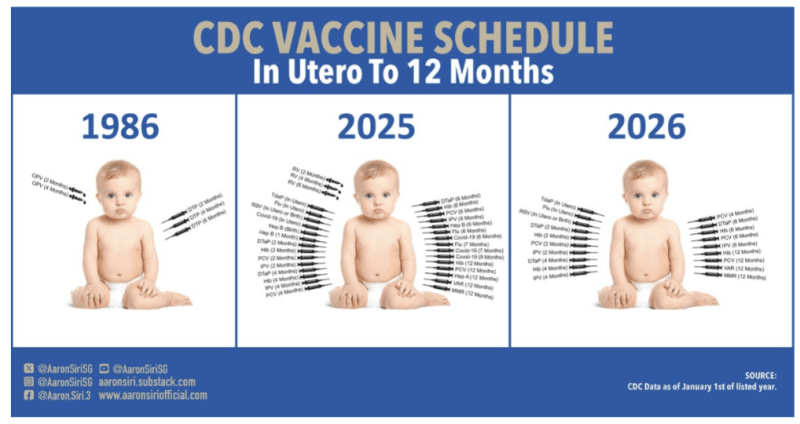
First, the childhood vaccine schedule has been entirely reformulated to fit with the better science and practices of other nations. The schedule had ballooned out of control since the industry received a liability shield in 1986, from a few diseases to 17, from a few shots to a possible 82 doses.
The indemnification rewarded a cynical raid of the childhood schedule to earn huge profits without risk. The industry push clearly came at the expense of kids because the added shots had weak or nonexistent safety profiles, plus the cocktail mix in total has completely evaded serious study. It’s not unreasonable to speculate that the schedule contributed to documented increases in suffering and crisis.
The correction had already begun with the meetings of the Advisory Committee on Immunization Practices (ACIP). The role of this committee in the past was to provide a scientific veneer to industrial and agency priorities. The conflicts on the old committee – patent holders, grant receivers, industry shills – were palpable. The new independent committee, appointed by new leadership, started looking under the hood and asking the right questions. The three meetings of 2025 were grueling and frustrating, not to mention slow going.
This is where the Department of Health and Human Services swung into action, together with CDC Acting Director Jim O’Neill. In early January, HHS released an eye-popping report on the childhood schedule. It is signed not by some anonymous committee but by two top experts in the field. They are Tracy Beth Høeg, MD, Ph.D., Acting Director for the Center for Drug Evaluation and Research and Martin Kulldorff, Ph.D., Chief Science and Data Officer for the Assistant Secretary for Planning and Evaluation and among the most published and cited authors on vaccines in the world.
Signing off on this document is a bold move. It reveals honesty, transparency, and tremendous confidence in the conclusions of their work. After all, the usual academic strategy is to sign a study with as many names as possible so that no one is responsible. When trouble comes, they throw each other under the bus. Similarly, the usual bureaucratic strategy on documents like this is to have only the whole committee sign but not with names. When the trouble begins, and committee members are called, they invariably claim to have been the outlier on the committee and otherwise pressured.
The authors of this study boldly stood up and said: these are our findings. If you disagree, fine, but at least you know who is to blame. This kind of academic courage is too rare these days, especially when dealing with such a dicey topic as this.
The report pushes four core principles of a successful childhood vaccination program: 1) scientific honesty about vaccines, including what is known and not known; 2) informed consent, not coercion; 3) a vaccine approval process using evidence-based science and thorough post-licensure evaluation of vaccine safety and risks; and 4) recommendations that take account of the experience of peer nations.
The CDC under O’Neill accepted the document and ordered the changes. The initial results born of moral courage have stunned industry watchers, while greeted with universal praise from parents and the burgeoning movement that is fed up with shot proliferation without accountability.
Still, this is just a beginning. Much more needs to be done. The vaccine industry needs to be normalized as a conventional market product: no indemnifications, no mandates, no subsidies, no patent-sharing scams, no censorship, no fake science, no fake studies, no compromised media smears of doubters, no quid pro quos with advisory committees, no revolving doors, no captured journals, no buried data of injury and death, no bought-and-paid-for politicians and scientists, no well-heeled shills.
There is a long way to go. Aaron Siri summed it up in a single graphic.
Second, a 50-year tyranny of bad dietary recommendations from the federal government is at an end. The problems began in the early 1970s when policy priorities shifted from penurious food production to output maximalism. That result was a vast subsidy for corporate agriculture, with a special emphasis on grains; wheat, corn, and soy, aided by patented chemical companies and their fertilizers and pesticides.
Farms got bigger and bigger and surpluses of cheap grain started appearing and getting ever worse. There was so much corn coming out that new uses for the stuff, much of it inedible, had to be invented: it became the most common animal feed, a cheap source of sugar, and finally fuel to be added to gasoline. It was also true with soy and wheat: every effort was made to find markets for the overabundance.
The dietary recommendations of the government fit exactly with big-industry profitability priorities. An entire generation became convinced that anything from nature needed to be replaced by some industrial product. On the hit list was fatty meat, eggs, butter, and cream, all conveniently replaced by soy, corn products, fake eggs, artificial this and that. Perhaps all this nonsense made sense to a generation that also believed that natural-fiber clothing would eventually be replaced with polyester.
It became rather obvious in the course of experience that the new dietary recommendations were a disaster for American health. And yet, fully 50 years have gone by in which no agency head was willing to stick his neck out and tell the truth, even given the worsening health crisis. This changed under the leadership of Robert F. Kennedy, Jr., in combination with the FDA’s Marty Makary and NIH’s Jay Bhattacharya.
Here again, we see a demonstration of the power of moral courage combined with dramatic action. Everyone said that it could not be done until suddenly it was done. This should be a model for the future.
Finally, it appears that Brownstone Institute’s own proposed Senate Resolution on Covid has gained some traction in the halls of power. If all goes well, there will be hearings and some action on this over the course of the next year. The idea is not to bring perfect justice and accountability; that is wholly out of reach. The point is simply to bring honesty and some measure of reckoning, a clear statement that what happened was epidemiologically and morally wrong, plus a pledge never to do something like this again.
There we have it: three gigantic wins in a short period of time. There is so much more to secure a future of freedom. We’ve learned over five years that the threats to our lives come from strange and often unexpected sources. They can only be defeated with expertise, integrity, and bold action from those who are willing to take risks to their reputations and careers. This is the model that works.
Join the conversation:

Published under a Creative Commons Attribution 4.0 International License
For reprints, please set the canonical link back to the original Brownstone Institute Article and Author.