The Scientific Advisory Group for the Origins of Novel Pathogens (SAGO) was commissioned by the World Health Organization (WHO) to discover the origin of SARS-CoV-2. Unsurprisingly, a recent paper from members of SAGO concluded: “We did not find evidence to suggest that SARS CoV2 (sic) resulting from experimental manipulation was a more likely scenario than it emerging from naturally occurring mutations or recombination events.”
This conclusion is unsurprising because the WHO was clearly taking marching orders from China; right from the beginning of the pandemic, they were parroting bizarre talking points from China, such as SARS-CoV-2 was not airborne. Furthermore, a WHO team sent to investigate the pandemic origin included Peter Daszak, the head of EcoHealth Alliance and a prime suspect in the lab-leak scenario.
In fact, SARS-CoV-2, with its human-adapted furin cleavage site (FCS), is so evolutionarily out of place that when Dr. Fauci’s crack team of evolutionary virologists studied its genome, they “privately” concluded, “It’s so friggin’ likely” the virus came from a lab.
With some basic virology knowledge (and an awareness of the overwhelming non-science circumstantial evidence), it becomes crystal clear that SARS-CoV-2 is not a natural virus. Arguments from people with everything to lose from a “lab-leak” scenario are little more than stratified layers of improbabilities, teetering on a foundation of desperation. The desperation stemmed from a desire by obedient researchers to avoid angering people in charge of awarding grants. Unfortunately, now they are “locked in the punch” and unable to get out.
It’s possible that this chimeric coronavirus exploded out of the one market out of tens of thousands in China that happens to be near the lab that makes chimeric coronaviruses. It’s possible that SARS-CoV-2 RNA found at the market where raccoon dogs were sold (a few weeks after the start of the pandemic and thousands of shoppers had trudged through) suggests that these animals were the source of the virus. It’s also possible that the origin of SARS-CoV-2 is either “aquatic animals” or vegetables, because virus RNA was also found where those items were sold. Similarly, it’s possible the scientist that somehow managed to develop a patentable SARS-CoV-2 vaccine in February 2020 (less than 2 months after the first reported cases) accidentally fell off the roof of the coronavirus lab.
For that matter, it’s possible that I could become a billionaire by playing Powerball; there are examples of people that have become billionaires this way, so why not?
Conversely, the lab-origin hypothesis for SARS-CoV-2 is Occamesque and easily wins the argument in a trial by jury.
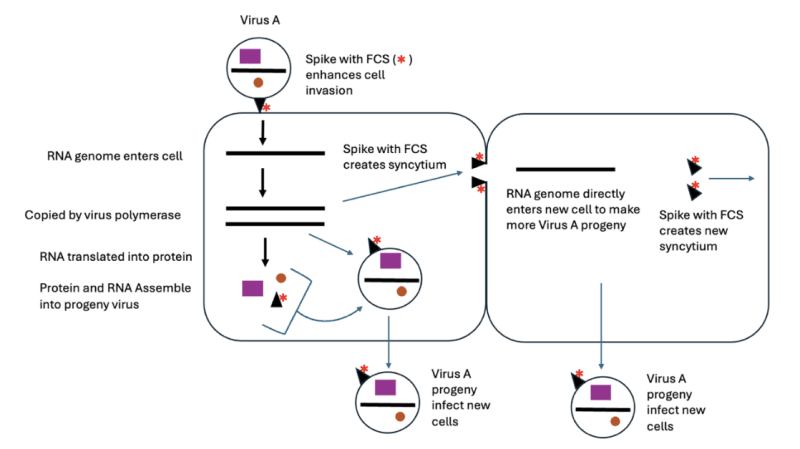
SARS-CoV-2 stands out as a unicorn among coronaviruses, even among its supposed closest relatives in its sub-genus (Sarbecovirus). Frankly, there is nothing even close to a proximal ancestor of this virus.The FCS in the spike protein of SARS-CoV-2 allows the spike to be efficiently processed by human furin protease. This significantly enhances cell invasion, spread to adjacent cells, and eventually to other hosts. Furin processing promotes virus RNA passaging directly between cells by syncytium formation (Fig 1). This “stealth” mechanism enhances virus spread while minimizing alerting the immune response. If I wanted to enhance a coronavirus with increased infectivity for humans, I would add a human adapted furin cleavage site to its spike protein.
Loss of the “PRRA” FCS amino acid sequence in the SARS-CoV-2 spike significantly reduces virulence in laboratory tests. Thus, anyone that argues the SARS-CoV-2 FCS was not deliberately inserted because it is not optimally designed is being disingenuous. Comparing pandemics caused by SARS-CoV (lacking an FCS; Fig. 2) and SARS-CoV-2, which was “factory equipped” with a human adapted FCS, provides a glaring example of just how well-designed its FCS is.
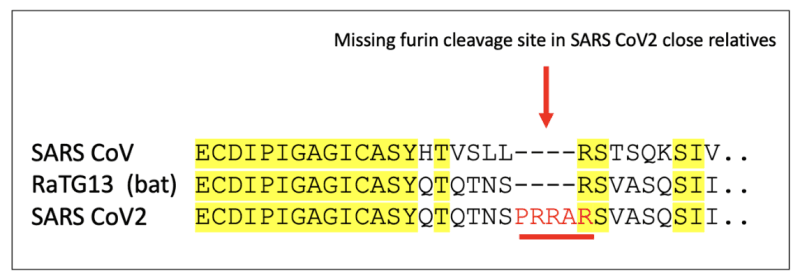
Both SARS pandemics began in China and spread internationally well before the first local cases were made public. However, SARS-CoV resulted in about 8,000 confirmed cases and about 800 deaths worldwide, while SARS-CoV-2 infections are estimated to be 800 million with 8 million associated deaths. The few known coronaviruses with some version of FCS in the S1/S2 junction of the spike protein are many decades of evolutionary distance from SARS-CoV-2. As even SAGO points out, “these elements are not genetic homologues and might have been acquired independently.” None of its closest known relatives have this vital sequence, much less a highly human adapted version like SARS-CoV-2. People with everything to lose from a lab-leak scenario attempt to muddy the debate with examples of a few remotely related coronaviruses with a version of FCS. However, this is like a human with a prominent anterior horn emerging from the forest, and scientists brushing it off as natural because there are examples of horned mammals.
So, where did the SARS-CoV-2 FCS come from if not from these sparse distant relatives?
Natural Mechanisms of Coronavirus Evolution
Replication error. To minimize accumulation of detrimental errors during genome replication, SARS-CoV-2 RNA polymerase complex contains an error proofing component. SARS-CoV-2 has a large single-stranded RNA genome of ∼30,000 nucleotides. Because of this error proofing mechanism, SARS-CoV-2 RNA replication is fairly accurate by RNA virus standards; it is approximately 24 times more accurate than influenza virus. Thus, for replication errors to account for the de novo synthesis of the novel FCS, the progenitor SARS-CoV-2 polymerase (with error proofing) would have had to make 12 mistaken insertions in a row precisely at the S1/S2 spike junction encoding region resulting in a highly human adapted FCS not found in any of its closest known relatives.
This becomes exponentially more complicated by the doublet of cgg codons that make up two of the four vital FCS-encoding codons. That less than 4% of all codons in the SARS-CoV-2 genome are cgg is not random; selective pressure acts on genomes to optimize “language” (i.e., codon usage). Aside from SARS-CoV-2, a cgg-cgg doublet has only been found in a few barely related coronavirus genomes among the thousands that are known, but never in another FCS-encoding region. Genomes evolve “languages” through intense selection. “Genomic language” can be used to infer evolutionary origin in the same conceptual way one could use writing style to detect plagiarism. If you find a few sentences in a typical teenage boy’s book report written in Elizabethan, it’s not unreasonable to suspect plagiarism.
How probable is it that a lone member of the Sarbecovirus group, stealthily lurking in a mysterious animal at the Wuhan market near the Wuhan coronavirus lab, used an error correcting polymerase to accidentally lay down a 12-nucleotide human-adapted FCS sequence in the precise genomic location, momentarily switching languages (i.e., codon usage) to create a “Royal Flush” virus?
A similar question might be how many monkeys seated at computers are needed before one of them taps out a few lines of Shakespeare?
Recombination. Coronaviruses can exchange RNA sequences when two viruses coinfect a cell. “Template switching” is perhaps the most common recombination mechanism used by coronaviruses to exchange sequences (Fig. 3). Here, polymerase replicating a “donor” RNA genome switches to an “acceptor” RNA genome, like a train switching railroad tracks, to create a hybrid virus. This exchange requires a region of high identity between the acceptor and donor RNA, and thus works exponentially better between closely related viruses, and is decreased in viruses with error correcting polymerase activity (like SARS-CoV-2).
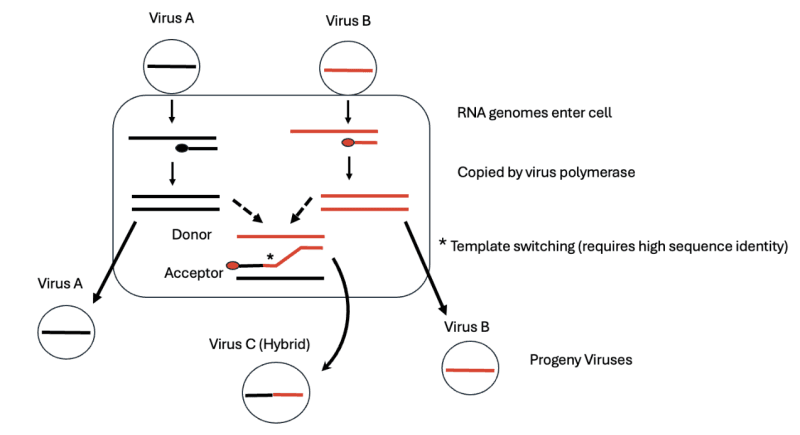
How probable is it that an unidentified progenitor Sarbecovirus lurking in a mysterious animal at the market (near the virology lab), used template switching to acquire a tiny 12 nucleotide FCS fragment? There is an extremely distantly related cat coronavirus with a similar FCS as SARS-CoV-2. Did an unrelated cat coronavirus and a “furin-less” SARS-CoV-2 bat virus prototype co-infect the same cell in a mystery animal at the market and template switch? First, the overall spike-encoding RNA sequences of these viruses are astronomically different. Thus, a successful template switch is highly unlikely to produce a successful offspring.
Second, this miraculous template switch would have required polymerase to initiate replication of the donor SARS-CoV-2 prototype RNA, then jump to the acceptor cat virus RNA to acquire only the 12 nucleotides needed to construct an FCS and then jump back to the donor strand. Third, the cat virus does not have a cgg-cgg doublet, so the progenitor SARS-CoV-2 RNA polymerase would have had to make a replication error to produce the doublet of non-preferred codons.
Should we be surprised that evidence of new recombination events in circulating SARS-CoV-2 are extraordinarily rare, albeit slightly less extraordinarily rare in the spike? Is it also surprising that after the start of the pandemic, clear cases of co-infection showed no evidence of recombination?
Rare events can happen under massive viral circulation. But to believe the market hypothesis, the SARS-CoV-2 progenitor had to acquire the FCS at the market, where there were too few animal hosts for massive circulation. The banter among Dr. Fauci’s crack team of virologists supports this point: “No way the selection could occur in the market. Too low density of mammals; really just small groups of 3-4 in [cages] (Dr. Eddie Holmes).”
To be clear, the SARS-CoV-2 genome is a patchwork. The spike appears to share ancestry with three viruses (i.e., RmYN02, RpYN06, and RaTG13) all of which lack an FCS. Did the “proximal ancestor” of SARS-CoV-2 go through a massive recombination binge while hiding out in a raccoon dog at the market and then practically stop recombining as it spread to hundreds of millions of humans? Did recombination and selection happen before the Wuhan market, resulting in a nuclear bomb virus that managed to restrain itself from exploding anywhere else but Wuhan (home of the coronavirus lab)?
There is also a non-replicative recombination mechanism in which the RNA from each invading genome is somehow cut and randomly spliced together. There is some evidence that this type of recombination has happened in a few viruses, but no such evidence for SARS-CoV-2. Aside from the cat coronavirus, a near match to the SARS-CoV-2 FCS was also found in a protein in human airway cells (i.e., ENaC-alpha). It’s no doubt coincidental that researchers that study ENaC-alpha share the same institution (University of North Carolina, Chapel Hill) as Dr. Ralph Baric, whose method of inserting FCSs into coronaviruses places him at the center of the SARS-CoV-2 origin debate.
How likely is it that a lone “proximal ancestor” member of the Sarbecovirus group jumped from a mysterious animal at the market into an airway cell of a bushmeat vendor, where it fortuitously picked up a tiny piece of FCS-encoding human RNA that floated to the exact spot in a genome of 30,000 nucleotides, spawning a variant that exploded into the world?
The novel SARS-CoV-2 FCS contains two additional putative functional motifs beyond furin cleavage. A fully analogous FCS containing all three putative motifs has so far only been found in one other virus: the artificial MERS infectious clone MERSMA30, which was created in a lab several years before the Covid-19 pandemic.
Perhaps the SARS-CoV-2 progenitor encountered the artificial MERSMA30 virus in a lab, or it encountered a “lab leaked” MERSMA30 in a camel (the intermediate host of MERS), acquired its FCS, and then found its way into a doomed raccoon dog on its way to slaughter at the market.
Unnatural Mechanisms of Coronavirus Evolution
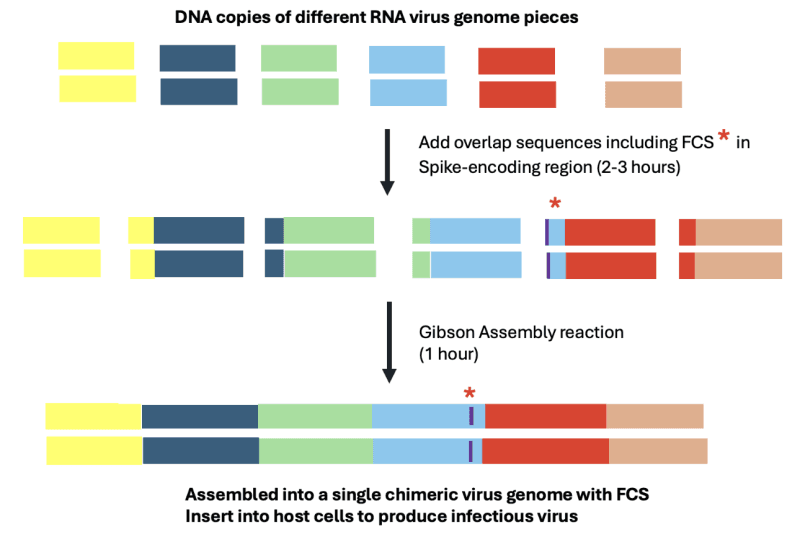
Coronaviruses can also unnaturally evolve when researchers modify their genome using simple genetic tools, such as Gibson assembly (Fig. 4). In just a few days this method can be used to create the genetic backbone of a novel FCS-carrying coronavirus with or without a “surgical scar.” This method is a relatively simple, seamless “no see um” approach that someone like Dr. Baric might use to construct artificial coronaviruses. The process can easily be modified to a “see um” method by inserting special sequences, like one encoding an FCS, or cut sites for flexible genetic modification. With Gibson assembly, up to six fragments can be “sown” together, with or without cut sites. Perhaps this is why the SARS-CoV-2 genome can be conveniently diced into six pieces.
Yes, natural evolution can lead to pandemic viruses, but so can lab accidents. With the forced release of the 2018 DARPA DEFUSE proposal, it is clear what was happening at the Wuhan Institute of Virology before the Covid-19 pandemic. “We will analyze all SARSr-CoV S gene [spike] sequences [from bat SARSr CoV viruses isolated at test cave sites in China] for appropriately conserved proteolytic cleavage sites…and for the presence of potential furin cleavage sites. Where clear mismatches occur, we will introduce appropriate human-specific cleavage sites and evaluate growth potential in Vero cells and HAE (Human Airway Epithelial) cultures.”
An EcoHealth Alliance spokesperson told Brownstone Institute, “Because the SARS-related research conducted by EcoHealth Alliance and the WIV dealt with bat coronaviruses that had never been shown to infect people, let alone cause significant mortality in humans, by definition it was not gain of function research.”
Using EcoHealth’s logic, the “thing” Timothy McVeigh used to blow up the federal building was not a bomb because it was made from harmless fertilizer. This “newspeak” definition of “gain-of-function research” justified Dr. Fauci’s obfuscation to Congress that this type of dangerous research was not happening and therefore he never funded it.
So, did a bat and cat virus have an astronomically improbable, fleeting interlude in a racoon dog at the market? Did interloping ENaC-alpha RNA drift into an unknown bat virus genome? Were the millions of virus genomes isolated from thousands of animals that have been analyzed simply not a big enough sample size to find anything close to a SARS-CoV-2 progenitor in nature? Or did the DARPA DEFUSE group take a few weeks out of their busy schedule and do precisely what they asked the government to pay them $14 million to do?
I wonder.
Join the Conversation
Published under a Creative Commons Attribution 4.0 International License
For reprints, please set the canonical link back to the original Brownstone Institute Article and Author.