
[This is the foreword to Joe Salatin’s magisterial work Food Emancipation, newly published]
Agronomy – a word no longer in much use – was at the core of the American experience from long before its Founding period through the early Progressive Era. We once had hands-on experience with the land and were shaped by everything about farm life. It’s how we fed our families, neighbors, and communities. Today, we import most food, process it into edible chunks with a forever shelf life, shop at the superstore, chow down at restaurants, click to get food delivered, and grab takeout.
As incredible as it seems, many people today haven’t thought at all about food production, any more than driving gives us consciousness of car factories or wearing clothes makes us aware of cotton fields and robotic looms. When asked, people just assume food as we know it comes from some factory out there somewhere and who cares anyway?
A laptop-class friend recently wrote, very innocently but with an air of intellectual arrogance, “How awful it would be if we still had to know how to farm!” My mind drifted back immediately to a few farm experiences I had as a kid, and the renewal of that experience recently at Joel Salatin’s Polyface farm. Thank goodness someone remembers how to farm.
The reason is that an entire way of life – a way toward health, well-being, and happiness – has been stolen from us. Not neglected, not outcompeted, but literally forced out of existence. This happened not by market forces as such, not by some impersonal mind of history, but by a labyrinth of regulations, mandates, taxes, controls, subsidies, and monopoly-creating controls, all conspiring to keep the way of life of our ancestors from returning.
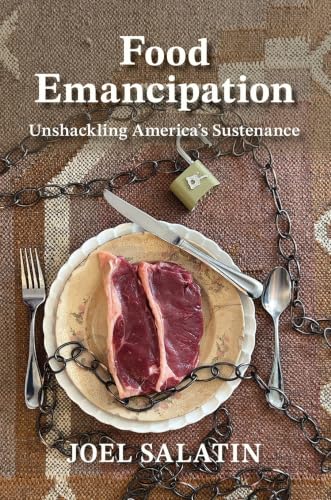
How and why this happened, and what to do about it right now, is the subject of this marvelous book by the farmer-philosopher Joel Salatin. It is revealing, thrilling, and destined to become a classic. It is a powerful manifesto on the production of food, a subject about which most people remain deeply confused, with real costs to health, liberty, and prosperity. It’s gripping and wise, fun and serious, detailed and passionate, scientific and packed with stories, just the right combination to cause a true disruption in understanding, policy, and practice.
You can grasp the essence in the fast-paced opening chapter, but don’t stop there. The rest brims with profound insights, biography, history, and granular detail that will reshape how you see agriculture, government, big business, health, and technology.
A few years ago, I was among the confused in thinking there were no real food issues that needed addressing, much less solving. The Covid era, with its seemingly endless layers of duplicity and propaganda, shattered many of my assumptions. I was ready to question everything.
What if our lords and masters have done to food production what they have done to medicine and public health? Study a bit and one’s worst fears are thus realized. The same class of people who managed the pandemic response have been managing our food supply for many decades.
Today, I’m fully aligned with Salatin’s vision, and I’m proud to call him my teacher. This book will likely challenge your own preconceptions just as radically.
At its heart, Salatin calls for food emancipation: dismantling over a century of heavy regulation and cartelization that has throttled small farmers and traditional wisdom. What we face is not benign oversight but a destructive alliance between Big Government and Big Agribusiness, one that suppresses competition, diminishes quality, tramples on property rights and the right to trade, and robs consumers of knowledge and choice.
If Salatin’s agenda prevails, we won’t just save existing small farms; we could spark thousands and millions of new ones, many right in our neighborhoods or on our own land. They would feed nations in healthier, more traditional ways.
Salatin proposes nothing like a central plan; in fact, he is quite down on the demand for any more government controls of anything. Instead, he calls for the American freedoms to own, produce, and trade that have been promised but systematically eroded.
What most distinguishes this book is the author himself. Unlike theorists, academics, or bureaucrats who dominate discussions of “science” and the public good, Salatin is a practitioner—a lifelong farmer with dirt under his nails and mud on his boots – a genuine expert with real experience (the words share a Latin root).
I’m honored to have visited his Polyface farm at an event sponsored by Brownstone Institute. I was in awe as he gave me a tour in his old pickup and we fed the happy pigs acorns that fell from trees overhanging the pasture where they live and play (if you can believe it), observed the many fowl walking everywhere, and watched as cows moved from pasture to pasture. I know nothing of this way of life but, my goodness, just being there was a revelation.
On weekends, I sometimes have the occasion to drive the rural areas of Connecticut and speak with the farmers and merchants at farm stands along the highway. We speak of their struggles, the unfair advantages of the biggest industrialists, the entanglements with regulators, their worries that they are slated for extinction, and consider possible solutions, all of which come down to permitting more freedom for everyone.
Those conversations always inspire me, and underscore Thomas Jefferson’s words: “Cultivators of the earth are the most valuable citizens. They are the most vigorous, the most independent, the most virtuous, and they are tied to their country and wedded to its liberty and interests by the most lasting bonds.”
Jefferson himself was much like Salatin: a visionary statesman, scholar, and architect, yet above all a passionate farmer, documenting crops, rotations, and techniques with the same zeal he brought to the Declaration of Independence. For both, farming is a vocational calling—an act of piety joining human labor with production to sustain life.
True, there was a time when I dismissed Salatin’s outlook as misguided, even primitive—a Rousseauian skeptic of modernity’s bounty. The grocery aisles overflowed; drive-thrus and delivery thrived. Surely America had solved food abundance. Why complain?
Then I examined the details. What actually are we eating and who is making it? Processed food cranked out by government-protected cartels. It’s no wonder American health is in freefall. Small farmers can’t sell directly without navigating a captured bureaucratic maze designed to favor industrial giants. The thicket of controls is everywhere: local, state, and federal. This is not new. It traces way back to the Progressive Era.
The usual claim is that industrialism evolved to displace agronomy but is this really true? Consider just Salatin’s revisionist take on the 1906 meatpacking laws—framed as consumer protection but really an end run around public outrage over Upton Sinclair’s The Jungle. Government ended up placing a stamp of approval on shady practices even while the industry crowded out farm-based meat processing. This description of this regulatory change as nothing more than an industrial conspiracy mirrors what my mentor Murray Rothbard described decades earlier.
Once that lens clicks, many mysteries dissolve. This book defies much of what passes for conventional wisdom in political economy and industrial history because it comes from actual experience, not abstraction.
Read it. Let it challenge you. Then act. Food emancipation is not about suburban poseurs who buy ribbon-wrapped jars of pickled cabbage at the holiday fair. It’s about a full way of life that we are losing at the hands of an industrial and governmental cartel, at great expense to our health.
Recovering real food and real farming – possibly produced by a neighbor or someone else you actually know – is essential to health, independence, and a truly free society. Jefferson was right and Salatin is too. Please consider the passionate arguments in this brilliant book carefully. All he is saying is give freedom a chance.
Salatin is a beacon of hope, a man who walks the walk, a practitioner of what he preaches, a true devotee of his craft. It’s rare in the intellectual world. Anyone can hypothesize, theorize, model, argue, and pontificate in peer-reviewed venues. To show how it is done is another matter. Salatin’s farm is an inspiration that would make even Jefferson blush. He and his farm are national treasures, and this book can be added to his legacy.
Join the Conversation
Published under a Creative Commons Attribution 4.0 International License
For reprints, please set the canonical link back to the original Brownstone Institute Article and Author.