
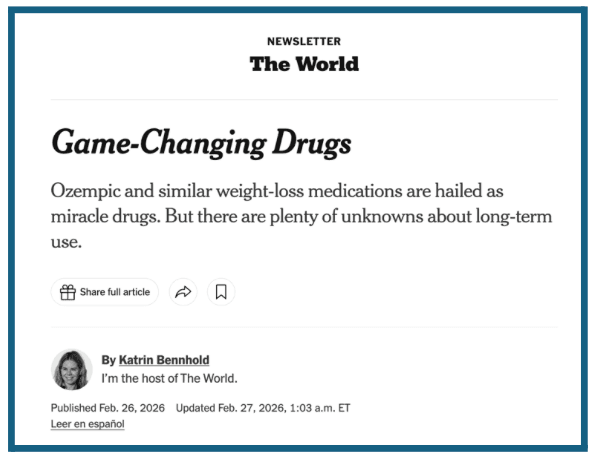
This is a slightly shortened version of a Feb 26th New York Times article where journalist Katrin Bennhold interviews Dani Blum of the Times’ “Well Team” about Ozempic and GLP-1 drugs.
The Fifth Doctor snoops in on the conversation and adds his two cents’ worth.
I’ve known several people who are on Ozempic who lost weight really fast. How exactly do these drugs work?
Dani: …Basically, the drugs mimic naturally occurring hormones that blunt our appetites and leave us feeling fuller, for longer. When people take these drugs, they’re just less hungry.
Fifth Doctor: Yes, less hungry, but also potentially more mentally unwell. Mounting reports of anxiety, worsening depression, and thoughts of suicide surround those taking GLP-1s, drugs like Ozempic. While it might be rare that the drugs make you go crazy, the potential troublesome psychiatric effects added to the long list of nasty physical effects makes the treatment intolerable for most patients. These effects are so severe that most patients stop taking the drug and thus a trial of these drugs becomes an expensive failed experiment for most people.
Do people have to stay on them forever to keep the weight off?
Dani: Basically, yes. It’s possible, but rare, for people to keep the weight off when they go off these drugs. Even Oprah gained back 20 pounds when she went off them. Doctors I talk to say we should think of these medications like statins — something to be taken long term.
Fifth Doctor: Look, if Oprah can’t sustain weight-loss post-Ozempic, what are your chances? Problem is, she probably found out the hard way that the weight comes back but the muscle you’ve also lost on GLP-1s stays lost, so you may end up in worse shape after you stop the drug than before you started. Also: “What the heck is ’“long term?’” At best we have up to 18 months randomized data for current doses of GLP-1s, plus several years of followup from real-world studies, but not decades-long randomized exposure at obesity doses. As for staying on statins “forever,” geez, that statement ranks among the dumbest bits of medical advice possible. It would take me a whole article to explain why “statins for life” is a loser’s game, so stand by for the Fifth Doctor’s advice on that file. But back to these game-changing weight loss drugs.
Do we know yet what the side effects of long-term use might be?
Dani: No, we don’t really know a lot about potential long-term side effects yet. We just don’t have decades and decades of data. We do know that these medications can have side effects in the short term. Most commonly, these are gastrointestinal issues: nausea, constipation, diarrhea, stomach pain. People can also get fatigued. In rare cases, people can experience more severe problems, like kidney or gallbladder issues, or pancreatitis.
Fifth Doctor: The tip-of-the-iceberg side effects are the ones we know, but like any new, widely-used drug there is that other thorny class of drug effects, the Rumsfeldian “Unknown unknowns” which for GLP-1s, are undoubtedly a minefield. Before you embark on your Ozempic-trip, you have to imagine yourself staring down the barrel of a .44 magnum and Clint Eastwood saying: “Ask yourself, do you feel lucky, punk?”
But at the same time, there seems to be a new study out every week showing GLP-1s help treat various ailments. What’s going on there?
Dani: Such a good question. We’ve seen positive data on how these drugs can help with things like sleep apnea, heart issues and kidney issues…Some think that these drugs can reduce inflammation throughout the body, which could have big benefits. But again, these drugs are pretty new, and there are many open questions.
Fifth Doctor: The caveats are welcome in an ass-covering sort of way, but let’s call a spade a spade. Every new study of a new drug is often little more than a marketing opportunity for the companies making them. When the manufacturers control the release of the research, ie: publishing the positive studies and hiding the negative ones, most research we’re gonna hear about GLP-1s will be the glowing new uses for these drugs. The media, in this regard, even the storied New York Times isn’t a ton of help.
If you get your news from the New York Times, or any news outlet for that matter, which receives tens of millions of dollars a year in drug advertising, will they ever really publish the deep-n-dirty investigations that any drug of this magnitude requires? Similarly TV programmers whose advertisers are hungrily slurping at the Ozempic teat have zero incentive to ask those hard questions, thus perpetuating the brainwashing bonanza of self-censorship. Sadly, most of the US public who consume mainstream media are swimming in a sea of GLP-1 propaganda and there are too few lifeguards standing by.
It sounds as though, if these drugs deliver on their promise and help with widespread obesity-related conditions like diabetes, they could help health care systems save a lot of money.
Dani: In theory, yes. These drugs could offer big health care savings by lowering the overall burden of disease in a lot of countries. But remember, they are quite expensive, at least for now, so there’s that, too.
Fifth Doctor: The laws of gravity and double-entry accounting must be respected when we discuss savings and value for money. Theoretical savings must always be measured against the real costs, both of the drug itself, the cost of clinician time, and their therapies to treat the frequent adverse effects caused by the GLP-1s as well as the opportunity cost of not using more effective, safer, and more lasting approaches (such as real lifestyle, diet, or physical activity options). Are we accounting for all the lost time for patients who are often nauseated or puking and thus missing work? How about the loss of productivity and missed work due to the fatigue caused by the drug? Onto the tally sheet, let’s also add all the extra doctor visits needed in order to get more drugs to treat the pancreatitis or constipation, or the botox to treat “Ozempic face.” I am all in favour for lowering the “burden of disease” with weight loss drugs but I keep tripping on one big question: Is there a single example in the past where a prescribed weight-loss drug didn’t land somewhere on the disaster scale (which spans from merely expensive/useless/ harmless/ unpleasant across the spectrum to life-threatening) for consumers and health systems?
If someone is healthy but still wants to lose weight, is there any reason not to take these drugs?
Dani: These really are not meant to be drugs you take to lose 15 pounds. These are powerful medications that you’ll most likely have to stay on for the rest of your life, if you want to keep the weight off. They come with side effects. They can be expensive. These drugs have helped a lot of people, but they’re not a casual commitment.
Fifth Doctor: I’m glad we’re beyond talking about taking the drug to look better in a bathing suit. However, anyone who tells you that you have to take a drug for the “rest of your life” is being disingenuous, as drugs are never in trials “as long as you live” and so no one can tell you with any certainty if it’ll extend or shorten your life. The missing part of the answer is that without sustained changes in how much food you consume, the quality of that food, and how much energy you expend, GLP-1 drugs will only be a temporary hiatus, in your lifelong struggle for the body size you want. This is what the fifth doctor should tell you: there are better places to look for a more ideal body size than the end of a needle.
Incidentally, and forgive me if I’m being rude, or clueless but whatever happened to the good old days of body positivity, where “love comes in all shapes and sizes?” Are we back to cruel fat-shaming of large-sized people who decide they’d rather live without these drugs? Even though you assert that these drugs “helped a lot of people” that’s a marketing slogan. I’d rather see the accountants and actuaries add up all the costs and benefits and then see what that balance sheet looks like. When you take the numbers of “people helped” and subtract the numbers in the category of “people hurt,” we might all be surprised how little net population benefit is derived from this class of drugs. We can hope and pray for a miracle, but these drugs are not “game-changers” as promised. The ‘game’ goes on and there is, sadly, no free lunch.
Join the conversation:

Published under a Creative Commons Attribution 4.0 International License
For reprints, please set the canonical link back to the original Brownstone Institute Article and Author.