

For decades, vaccines have been treated as the sacred cow of modern medicine. I was taught that they were the holy grail. To question them was heresy. To raise concerns about safety was to risk professional exile.
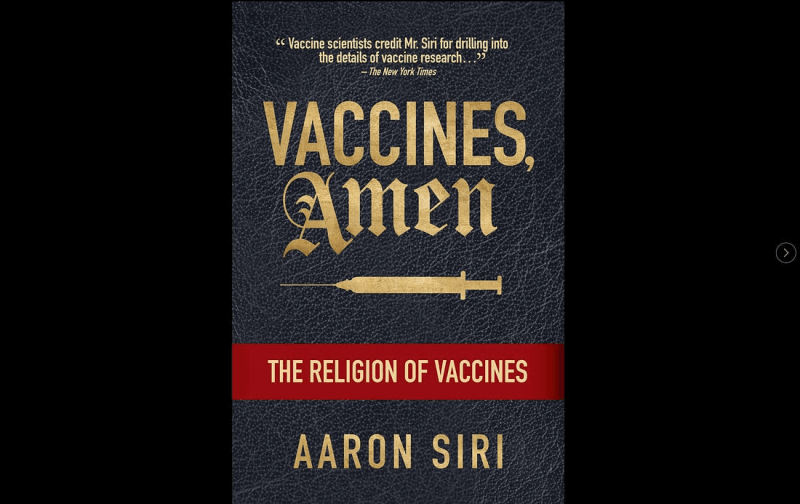
Aaron Siri makes it clear in Vaccines, Amen: The Religion of Vaccines that the story we’ve been told about vaccine science rests far more on belief than proof.
“No child should be sacrificed on the altar of the religion of vaccines,” Siri writes, as he turns his focus to America’s overcrowded childhood immunisation schedule.
I assumed little in this book would surprise me. I’ve spent years reporting on drug safety, regulatory capture, and the corruption of science. But Siri showed me how wrong I was.
Siri is not a doctor or a scientist. He is an attorney, and this, he says, is his advantage. In court, rhetoric won’t save you. Evidence does. As he puts it, he doesn’t get to say “trust me” the way many doctors do. “I need to prove claims with real data.”
And he does.
He has lived this work for years — representing vaccine-injured families, fighting Freedom of Information battles, and suing government agencies. The book reads like a cross-examination — precise, uncompromising, and hard to dismiss.
The Burden of Proof
One of Siri’s sharpest points is also the simplest. He asks, who bears the burden of proof?
“The onus is not on you to show that a product someone wants to inject into you or your baby is unsafe,” he writes. “The onus is on that person to prove to you it is safe. It is their burden.”
That principle should be uncontroversial, yet vaccine policy often flips it. Parents who ask questions are treated as obstacles, even threats. Siri’s argument is basic: the burden rests with the party making the claim.
He traces that inversion to 1986, when Congress passed the National Childhood Vaccine Injury Act, insulating vaccine manufacturers from liability.
I’ve reported on how this shifted incentives away from proving safety and towards expanding the schedule without fear of legal consequence. Once accountability was removed, the obligation to rigorously demonstrate safety eroded alongside it.
The Placebo Problem
Siri dismantles the myth of placebo-controlled vaccine trials in painstaking detail. A placebo, he writes, should be inert — saline, or something biologically inactive.
And yet, as he argues, “when it comes to children, every vaccine on the schedule was tested against a placebo control group, right? Sadly, that virtually never occurs.”
Instead, many vaccines were tested against other vaccines, or against aluminium adjuvants — substances specifically designed to provoke an immune response.
Siri calls this what it is: a corruption of science. Without a true placebo, you cannot reliably determine whether adverse events are caused by the vaccine itself.
I’ve reported on this same sleight of hand in the Gardasil trials, where young women were told they received a saline placebo when, in fact, they were given aluminium adjuvant — an active comparator with known biological effects.
Crediting Vaccines for Miracles
There’s another claim that comes up constantly in medicine — and in the interest of full disclosure, I’ve said versions of it myself.
People don’t value vaccines because they don’t see the diseases anymore. Measles, diphtheria, whooping cough — gone. “The evidence is clear,” I used to say, “and we can thank vaccines for that.”
Reading Siri’s chapters on this, I felt a growing discomfort.
He takes the belief apart slowly, drawing on historical mortality data I hadn’t previously sat with in any depth. What struck me wasn’t a single chart, but the consistency of the pattern.
For measles, deaths had already fallen dramatically before a vaccine was introduced. The same was true for diphtheria, tetanus, and pertussis. In each case, mortality had declined by more than 90% prior to vaccination.
What changed during that period was sanitation, clean water, nutrition, housing, and advances in acute medical care. Deaths from infectious disease fell alongside deaths from many other causes.
Siri doesn’t claim vaccines played no role at all. But he is blunt about how much credit vaccinologists have taken for trends that were already well underway before vaccines existed.
I found myself pushing back internally sometimes. Surely someone would have called this out if it were true, I kept thinking. Why haven’t they?
“The claim that ‘millions of deaths’ are averted each year in the United States is categorically false, off by well over 99.9%,” Siri writes.
It lands like a punch — not because it’s clever, but because it forces you to confront how casually those claims are made, and how rarely they’re interrogated.
What about Polio?
Polio was the example I thought was unassailable.
Like most people, I’d always believed polio eradication was straightforwardly attributable to vaccination. It was the story I’d absorbed, repeated, and never really questioned.
Siri describes how changes in diagnostic criteria and surveillance profoundly shaped the apparent collapse of polio cases after the Salk vaccine rollout.
As definitions tightened and laboratory confirmation became central, many conditions previously labelled “polio” were reclassified. The numbers fell — but not for the reasons the public was led to believe.
Siri describes first encountering these records as “breathtaking.” Reading them, I understood what he meant. There were moments that were genuinely unsettling — the kind where once you know something, you can’t unknow it.
What made it personal was realising how confidently I had repeated the orthodox narrative. I’ve said, on national television, without hesitation, “Vaccines work.”
As the public face of a national TV science program, I was asked to attend events and encourage people to vaccinate. I told audiences to rely on trusted government sources. Looking back now, I cringe at the certainty with which I spoke.
Not because I believe everything I said was wrong, but because I hadn’t done the work to know what was true. I trusted government websites. I trusted consensus. I didn’t look underneath.
The Altruism Claim
One of the most compelling arguments for vaccines is that they are uniquely altruistic. You don’t do it for yourself. You do it for others. Herd immunity depends on it.
Siri devotes a chapter to this assumption, titled “Vaccines prevent transmission.”
I knew early on where it was heading, because Covid had already cracked this belief for me. It became clear very quickly that Covid vaccines did not prevent transmission. Watching mandates roll out anyway was when I first openly questioned the logic.
Remember how they told us to inject children to ‘save granny.’
What unsettled me while reading this book was realising how long this assumption had gone unquestioned before Covid.
Polio is the clearest example. The inactivated polio vaccine (IPV), used for decades, does not prevent infection in the gut and does not reliably stop transmission. A vaccinated person can still carry and spread the virus.
That fact alone should have forced a more honest conversation long ago. Instead, the narrative of altruism persisted — and with it, a powerful moral pressure.
Once you accept that transmission has often been assumed rather than demonstrated, it becomes much harder to justify coercive mandates on ethical grounds.
Baptised Science and Buried Evidence
Siri extends his critique to the culture of medicine itself — a system that canonises certain studies while marginalising others.
Once a study is blessed by the establishment, it becomes untouchable. Doctors quickly learn the cost of questioning these articles of faith.
Siri refers to the Vaccines, Amen crowd as those with a fervent belief in vaccines. “This group is often impervious to reason and data,” he writes. They “regurgitate canned answers they have never researched.”
Reading that, I recognised a former version of myself. Eek!
Much of what the FDA and CDC treat as settled truth, he argues, flows from “Dr Plotkin and his disciples.”
Covid made this visible. When authorities had to decide whether natural immunity was sufficient, Siri explains they turned to Plotkin’s disciples — Paul Offit, Peter Hotez, Michael Osterholm. The conclusion was foregone.
“Only a zealot or someone truly uninformed would insist that prior infection does not provide sufficient immunity,” Siri writes. I remember how relentlessly the public was misled during the Covid pandemic.
When Evidence Becomes Inconvenient
The consequences of this culture are not theoretical.
Siri describes how Dr Marcus Zervos was approached to conduct a long-awaited “vaccinated versus unvaccinated” analysis. He completed the study, then refused to publish it.
The findings showed vaccinated children had markedly worse health outcomes than unvaccinated peers. Zervos feared publishing it would cost him his job.
The study eventually surfaced at Senator Ron Johnson’s (R-WI) hearing on corruption in science. Siri published the study in Vaccines, Amen, ensuring it could not simply be buried.
In that sense, the book functions as both exposé and archive — preserving evidence that others would prefer to erase.
Sure, There Were Also Moments of Anger
There were sections of Vaccines, Amen that made me angry at times.
Siri documents how public health agencies misrepresent data, obscure uncertainty, and withhold information central to informed consent. Reading those passages, I felt a familiar rage — because this has been the core of my work for years.
As a journalist, I’ve filed FOI requests that took years, only to receive documents so heavily redacted they were useless. I couldn’t sue agencies the way Siri does. I didn’t have subpoena power. All I could do was persist.
Sometimes it felt as if agencies operated on the assumption that if they could keep delaying records requests, they would eventually grind you down and you’d give up.
Seeing Siri’s legal record laid out only reinforced how deliberate the pattern has been.
“Vaccines Do Not Cause Autism”
For years, the CDC stated unequivocally that vaccines do not cause autism. Siri spent years trying to force the agency to provide the studies supporting that claim.
They couldn’t provide them.
“After years of asking, requesting, demanding, deposing and suing the pivotal entities and figures in the world of vaccinology and federal ‘health’ agencies, there is literally nobody left to ask,” he writes.
Since the book’s publication, the CDC quietly revised its website. As I reported at the time, the categorical claim was softened — reflecting what Siri had argued all along.
Siri does not claim vaccines cause autism. Instead, he argues that the assertion ‘Vaccines do not cause autism’ is not grounded in comprehensive science, but in ideology.
The Bigger Picture
The danger of treating vaccines as a ‘religion’ is not abstract.
Vaccines, Amen insists on something more than scepticism. It insists on honesty. That means admitting when trials obscure harms. It means rejecting coercion. And it means restoring the basic principle that those who claim safety must prove it.
For some readers, this book will be infuriating. For others, it will be revelatory. Either way, it cannot be ignored.
Because once you’ve read it, many of the stories we’ve told ourselves about vaccines no longer sit as comfortably as they once did.
Republished from the author’s Substack
Join the Conversation
Published under a Creative Commons Attribution 4.0 International License
For reprints, please set the canonical link back to the original Brownstone Institute Article and Author.