I always knew that corruption existed in every field. I assumed that when it came to Big Pharma, the same was true, but I thought of it as something abstract: an inflated contract here, an outrageously profitable deal there, an abusive markup somewhere else.
I assumed that yes, some products might have low-quality batches, like any product on a profit-driven production line. I understood that when discovered, everything was reported in newspaper headlines, properly investigated, with all wrongdoers prosecuted or jailed. I figured these things might cause some harm to public health, but that it was all under intense surveillance and control.
Before the pandemic, following news from the field through the papers, we knew that every now and then, some scientist or group of scientists, for various reasons, would commit fraud in a study. Whenever that happened, it would go straight to the headlines. The way I saw it, “science” always had mechanisms to protect itself, with serious scientists quickly moving to expose and expel fraudsters. After all, it’s an absolutely noble branch of science: the one dealing with everyone’s health, including my own.
In other situations, still before the pandemic, I found myself in conversations where someone would suggest that treatments for various diseases already existed but were being hidden from the public. Out of respect for the friends who raised these topics, I didn’t quite laugh, but in my head, I understood all of it as hypothetically plausible, but given the lack of concrete evidence, nothing more than a “conspiracy theory.”
Then the pandemic came, and instead of spending lockdown watching movies or playing video games, I decided to follow every detail of the studies coming out. Before all this, I had no deep interest in the subject. I used to read the headlines alongside sports scores and weather forecasts. But during the pandemic I had a good reason to pay close attention: I wanted to come out of Covid-19 alive. And to be able to guide the people I care about toward the best options.
So I followed the various treatment possibilities closely, as well as the data from each vaccine rollout. I wanted to understand the details, straight from the sources, before everything was filtered through “science communicators” and experts in newspaper headlines.
What Was Covid-19?
I’ll give you a simple summary. And I know this summary will make a lot of people stop reading right here. If that’s you, I’ll say it upfront: I can explain why you feel that way.
The pandemic in a nutshell: Covid-19 always had very effective and inexpensive treatments, right from the start. Millions were left to die because it was, of all things, profitable.
The lockdowns, when the world stopped as it never had before in history, was never necessary beyond two weeks, because with the disease properly treated, fewer people would have died than in a common flu season.
Yes, that’s exactly what I said: millions dead for profit. For money. Does that shock you?
I know it’s a hard story to believe. I understand. Because to believe it, given that it involves an enormous number of people, institutions, medical societies, scientific bodies, regulatory agencies, all in sync to cover up and steer people away from valid treatments, you have to believe something else: that humanity, at its core, doesn’t care. It’s a blow to your faith in human goodness. That’s not easy to let go of.
Let’s Get Straight to the Biggest Contrast of Covid-19
Six years after the pandemic, some striking contrasts remain. Let’s look at the most remarkable one: the hydroxychloroquine saga.
Today, the words “chloroquine” and its slightly younger but still septuagenarian sister, “hydroxychloroquine,” have become synonymous with lunacy. “That person is chloroquine-brained,” someone might say, invoking the drug as a punchline. The word “chloroquine” became a setup for jokes. People made comedy sketches, genuinely funny ones, and songs mocking anyone who kept insisting on talking about the medication during Covid-19.
But how did this happen? Everyone knows that the WHO, understood as the final authority on such matters, never recommended hydroxychloroquine. Everyone knows that the FDA and other major regulatory agencies around the world, along with the most respected medical associations and scientific journals, never recommended it against Covid-19. Quite the opposite, in fact. They all recommended against it. The reasoning was that if desperate, frightened people believed in false cures, they would stop following the things that actually worked: vaccines, lockdowns, and masks.
In the US, newspapers treated the subject as a “conspiracy theory.” In Brazil, a physician named Luana Araújo appeared before Congress during a parliamentary investigation and stated that “Discussing chloroquine is choosing which edge of the flat Earth we’re going to jump off.” That made headlines in Brazil’s most important newspapers. Flat-earther stuff, you understand? Are you a science denier, or are you intelligent?
Now follow my thinking. If three or four thousand people were dying every day from Covid, and there was something effective out there, everyone would say it was effective, right? Nobody would commit the immeasurable evil of speaking against it, steering people away from valid treatments, letting millions die around the world. Therefore, faced with that obvious reality, only completely deranged people could claim that hydroxychloroquine had scientific evidence behind it.
And yet, despite all the clarification across every major newspaper that HCQ was “conclusively proven ineffective” against Covid, as the mainstream media put it, some physicians, clearly delusional, kept insisting that there was, in fact, evidence. Many of them were fired, faced investigations, and even lost their medical licenses. After all, only someone as deluded as a flat-earther could promote such dangerous nonsense and put society at risk.
Now let’s get to the contrast. Open a link with me. It’s a news article. Let’s open it, check the website address, verify the source carefully: “Hydroxychloroquine provides moderate COVID-19 prevention, large clinical trial shows.”
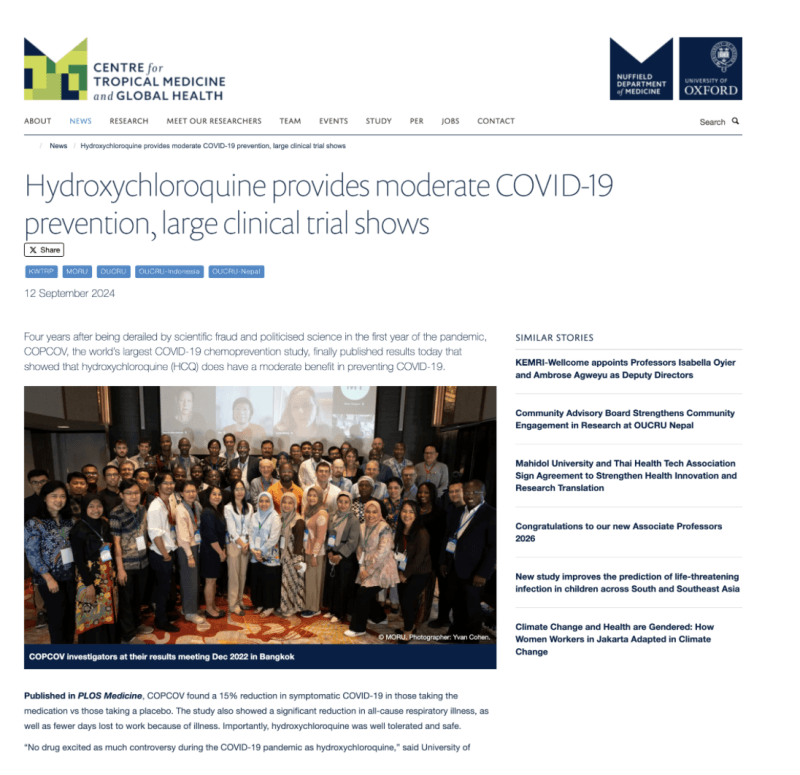
No, this is not some obscure corner of the internet. It’s right there, on the University of Oxford’s website: chloroquine is effective against Covid-19. Worth remembering that Oxford consistently ranks among the three most prestigious universities in the world by any measure, competing directly with MIT, Harvard, and Stanford. With nearly a millennium of history, the University of Oxford was a cornerstone of the Enlightenment, playing a crucial role in humanity’s transition from the darkness of the Middle Ages into the age of reason and the scientific method.
Quite a contrast, isn’t it?
Things Worth Noticing About the Oxford Study
Oxford only delivered its verdict because this was a meta-analysis of randomized trials – the highest possible level of evidence a medication can reach. For reference: according to a study published in JAMA in 2019, only 8.5% of recommendations in the major American cardiology guidelines meet that standard (multiple randomized controlled trials). To flip the numbers: 91.5% of the guidelines cardiologists follow are based on weaker evidence than what Oxford presented for HCQ.
HCQ against Covid-19, then, belongs to a select group of the most thoroughly proven treatments in existence. That’s exactly why Oxford didn’t use the cautious language typical of scientific studies – none of the usual “may be effective,” followed by “further studies are needed.” They brought the hammer down: it works. Full stop.
It’s a peer-reviewed study published in a medical journal. But it also became a news item on Oxford’s own website. So there’s no room for the dodge of “those are Oxford researchers, not the University of Oxford itself,” trying to move the goalposts. The institution gave its unequivocal endorsement.
And there’s more: the news article includes a photo of the research team. Over 70 people signed the study, not much room for argument, outrage, or grandstanding. Because outrage and personal wishes count for nothing in science. Among the signatories is Sir Nicholas John White, a scientist with an H-index above 200, the world’s foremost expert on tropical diseases. Is there anyone left foolish enough to call Oxford a “flat-earther?”
Necessary Questions About Oxford
I’d like to now move on to chlorine dioxide and say more about (Pierre) Kory’s book, but I can’t yet. I need to go a little deeper into the HCQ story first. Either way, it’s important for you to understand a bit more about how this field works. Think of it as the warmup before the main event.
The first question: why did Oxford take more than 800 days to publish the study’s results? Can you think of any reason why findings would sit in a drawer for more than two years?
Oxford conducted its gold-standard clinical trial on pre-exposure prophylaxis (that is, taking the medication before any contact with the virus, with the goal of preventing infection). In Oxford’s trial, the use of chloroquine and hydroxychloroquine showed a 57% reduction in PCR-confirmed Covid-19 cases. Then, within the same study, they conducted a meta-analysis, pooling their trial with similar pre-exposure prophylaxis studies. Every previous study also showed positive results.
The second question: why did they change the outcome measure to seroconversion midway through the study? Vaccine trials didn’t use that metric. They all used PCR testing. Seroconversion only measures whether the body produced antibodies, not whether the person actually got sick. Could changing the outcome be what made the result, as the headline put it, merely “moderate?”
A note to close this topic: this Oxford meta-analysis covers pre-exposure prophylaxis, taking hydroxychloroquine before infection to prevent it. For that use, it reached the highest possible level of evidence. But HCQ is also highly effective for early treatment, taking it in the first days after infection to prevent the disease from worsening. The evidence there is solid, though not at the same peak level. It’s also effective for post-exposure prophylaxis, taking it after contact with an infected person to prevent catching the disease. Again, good evidence, but not at the maximum tier. (Side note: it is not effective in intubated patients, in extremis, or in overdose conditions. And yes, studies conducted under overdose conditions made the front pages of the world’s most important newspapers.)
Second note: the evidence for ivermectin in Covid is also overwhelming, but I didn’t use it as my example here because I don’t have a contrast as sharp as a study from an Oxford-caliber institution. The Oxford contrast is simply devastating.
I watched all of this unfold in real time, right in front of me. And it led me to an inevitable question: what else was buried before this, throughout the history of medicine?
Chlorine Dioxide
“The Medicine That Could End Medicine;” that’s the subtitle Dr. Pierre Kory and Jenna McCarthy, journalist and co-author, chose for the book. At the very least, it’s intriguing, isn’t it? End it all. Remake everything.
They use that phrase because they believe that chlorine dioxide (ClO₂) poses an existential threat to the business model of the modern pharmaceutical industry, just as hydroxychloroquine threatened Big Pharma’s grip during Covid-19.
Chlorine dioxide is a cheap, non-patentable molecule that people can prepare at home, with reported efficacy against a wide range of infectious and chronic diseases. It could replace or eliminate the need for countless expensive, cartel-controlled medical treatments. Does that unsettle you?
But the book isn’t only about scientific evidence. It tells the story of the molecule itself, and of the people who, throughout history, tried to bring it into wider use. The result? Three suspected murders, including that of Dr. Eugene Blass, who was beaten to death in front of his own laboratory. Another survived multiple poisoning attempts. And there was even a man whose legs were blown off by a bomb planted in his hotel room. Dangerous business, messing with this topic.
Then there are the people who were imprisoned. One case involves a professor and researcher who conducted and published a highly positive study of 500 malaria patients treated with chlorine dioxide in Cameroon, Africa. He traveled to a meeting, and on his way back, someone asked him to carry a package. It contained cocaine. He was arrested for drug trafficking. And the study he had already published? Retracted from the scientific literature. The book reads more like a Hollywood spy thriller than a medical text. It’s a page-turner.
Pierre and Jenna also surface some remarkable details, like the fact that in 1987, NASA called chlorine dioxide a “universal antidote” due to its efficacy against 42 known pathogens.
One of the book’s most brilliant moments is the “Kory Scale.” It’s a satirical but grounded metric he developed to assess the likely efficacy of “unproven” therapies. The premise is simple: the effectiveness of a treatment is directly proportional to the brutality of the attacks it suffers from the medical establishment: the FDA, the media, health agencies. On the scale, media attacks are worth 4 points, imprisonments 10, and murders 50.
The hydroxychloroquine story I told above never reached the level of assassinations. There were intimidating police raids, professionals losing their jobs, others losing their medical licenses, and a staggering volume of media attacks, but on the Kory Scale, that scores relatively few points.
The book has many other striking passages, like the researcher who installed a water treatment system that eradicated malaria in an entire city. Consider the stakes: 600,000 people die of malaria every year.
But one thing needs to be said clearly. For hydroxychloroquine against Covid, we now have the highest possible level of scientific evidence, produced by one of the most important universities in the world. For chlorine dioxide, we don’t have that. But this reminds me of 2020. Early in the pandemic, the first evidence for HCQ in prophylaxis began emerging from observational studies, low on the evidentiary ladder. Yet there were many of them, from many different places, and all positive. Some scientists argued at the time that it was enough, that prophylaxis should begin immediately and the pandemic could be brought to an end. The picture, taken as a whole, was clear. Instead, everyone dragged their feet, held back, buried results in drawers, delayed studies. There was even outright fraud to derail or interrupt ongoing research, with the Surgisphere case being the most glaring example. “Monumental fraud,” said Richard Horton, editor-in-chief of the Lancet.
The book presents striking accounts of a vast range of conditions that reportedly responded to chlorine dioxide: acute infections such as malaria, HIV/AIDS, hepatitis, influenza, and multidrug-resistant tuberculosis; chronic and inflammatory conditions including autism, diabetes, Lyme disease, and hard-to-heal wounds, among them severe cases of gangrene and diabetic foot that avoided imminent amputation.
There are even case series documenting stable remissions in patients with metastatic cancer, pancreatic, prostate, and renal, who had exhausted all conventional options. Dr. Kory acknowledges that formal trials are still needed to determine the precise magnitude of the effect at scale. But the clinical impact of watching diseases labeled “incurable” simply recede is something that both astonishes and challenges the business model of conventional medicine.
Reading the book, I feel the way I did at the start of the pandemic. The evidence for chlorine dioxide, as it stands, shows a great deal. But given the violence of what surrounds this topic, I doubt anyone will ever manage to conduct large, randomized, gold-standard trials on it. One researcher who tried ended up in prison as an international drug trafficker, arrested on his way back from a meeting where he had been seeking funding for another study.
Who This Book Is Not for
If you don’t find the Oxford hydroxychloroquine story important, if it didn’t leave you shaken, this book is not for you.
Think carefully about what happened: with the efficacy Oxford confirmed for prophylaxis, the pandemic could have been over in 2020. One month of lockdowns at most, not a year and a half. Lockdowns that permanently shuttered small businesses, that generated the largest transfer of wealth from the poor to the rich in human history, that destroyed the livelihoods of millions of families, that left lasting illness and psychiatric damage in its wake. If all of that seems reasonable to you, this book is not for you.
Now try a simple exercise. Open Google and type “chlorine dioxide.” For me, the first thing that appeared was not a study, not a news article. It was a large yellow icon reading: “Serious health risks.” Below it: “No medical benefit.” And an official instruction to report to the authorities any advertisement or sale of the product.
If that’s enough for you, if a yellow Google icon closes the case, this book is not for you.
In my case, those flashing danger signs don’t impress me. I’ve been vaccinated against them. In Brazil, one of the most prominent science YouTubers, when the possibility of HCQ treatment was raised in 2020, claimed that using chloroquine for five days as early treatment could cause “a severe loss of vision, possibly even blindness.”
After this, I went to PubMed and looked it up. A 2003 study found no retinal toxicity from hydroxychloroquine in any of the 526 patients studied during the first six years of continuous treatment. Six years of continuous use. No problems. And no one ever went blind. Warnings driven by interest don’t frighten me.
Now type “Pierre Kory” into Google. The first link that came up for me was: “Doctors accused of spreading misinformation lose their certifications.” The article is about Kory and Dr. Marik. They fought together on the Covid-19 front lines. One of the pieces of “misinformation” in question? Hydroxychloroquine.
The same medication Oxford confirmed as effective, at the highest level of scientific evidence, after sitting in a drawer for more than two years.
If you think that was fair, this book is definitely not for you.
This book is for people who ask questions: The War On Chlorine Dioxide.
Join the Conversation
Published under a Creative Commons Attribution 4.0 International License
For reprints, please set the canonical link back to the original Brownstone Institute Article and Author.