

Christopher Morales’ 9/26/2026 post, “AI Has Made an Old Education Problem Harder to Ignore,” (written in Minding the Campus, a project of the National Association of Scholars) has touched a nerve with many:
Students can now generate essays, summaries and discussion posts in seconds. The danger is real, but the underlying weakness is older. AI did not create the gap between completing work and mastering knowledge. It made that gap much harder to ignore.
Morales reveals the staggering statistics on the prevalence of remedial courses offered to first-year undergraduates in colleges and universities:
The evidence supports academic under-preparedness was widespread, visible and costly long before AI could write a polished paragraph.
I would suggest that the problem is even more widespread and pernicious and stretches beyond the confines of academia. It is the tension between Competence and Capability in most walks of life, including my own, medicine and healthcare.
To understand the roots of this present-day dynamic, we need to go back a bit…quite a bit…and understand the significant social, political, and economic upheavals in Great Britain in the late 1970s:
- Economic stagflation was stifling, with inflation hitting a high of 25%.
- Rapid decline in traditional manufacturing and industrial sectors.
- Widespread strikes and the Winter of Discontent.
- Economic frustration and generational friction.
- Increasing violence in Northern Ireland and inability, or lack of interest, of the political parties in addressing the problem.
- Breakdown in prior political consensus.
At the time, Great Britain was facing serious societal breakdown in a number of areas. Brian Grant explained how a committed group of diverse individuals spontaneously formed around a belief that imbalance in the core activities of education and training fueled much of the socioeconomic disruption in society.
The watchword of the proposed reforms to deal with this disruption was capability. This group’s actions culminated in newspaper declarations taken out in the Times and the Guardian and became known as The Capability Manifesto. This concept had 4 main pillars of change, linked to the following verbs:
- To do: move from passive memorization of facts for a test to the successful execution of real projects.
- To make: value craftsmanship, engineering, and art as well as pure academic knowledge.
- To organize: value teamwork and leadership. The practical value of this was later emphasized in such works as Tribal Leadership by David Logan, John King, and Halee Fischer-Wright.
- To adapt: understand that problem-solving often has multiple answers and methods of inquiry, depending upon the circumstances.
It is interesting that these concepts (such as the importance of starting point and nonlinear system dynamics) echo those of the nascent Complexity Science being founded at about the same time at The Santa Fe Institute and described in an extremely readable fashion by M. Mitchell Waldrop. The emphasis of verbs rather than nouns in the successful execution of projects is similar to the “Action Learning” concept of Complexity Science described by Stewart Hase and Chris Kenyon.
The “Move to Capability” in Britain was not a smooth one. There was pushback. In Education for Capability: A Critique, Keith Thompson submitted that the Manifesto was flawed on a number of points:
- Capability only implies potential, not actuation.
- It forms a caricature of an educated person as only knowing what and not knowing how.
- Although the socioeconomic decline is real, there is not significant evidence to assume that the proposed remedies would reverse that descent.
This critique was rebutted by such authors as Mark Grant Ashton in “Educated Man as an Action Man: A Reply to Keith Thompson.” Over the years, a spirited discussion ensued: Which is more important, theory or practice? Should we concentrate on basic knowledge or application? This seemed to always consist of a binary choice! Why couldn’t it be both?
That is what Reva Berman Brown and Sean McCartney suggested in “Let’s Have Some Capatence Here” in their 2003 article in Education + Training. Let me summarize their key points:
- Competence is narrowly focused and based upon recognition of past accomplishments. The knowledge is static and based on a specific arena. It can be tested in the present.
- Capability is broadly focused on what can be accomplished in the future. The knowledge is fluid and in a continual state of development drawing from multiple sources outside of any given vocational or professional arena. It is future-based and cannot be tested in the present.
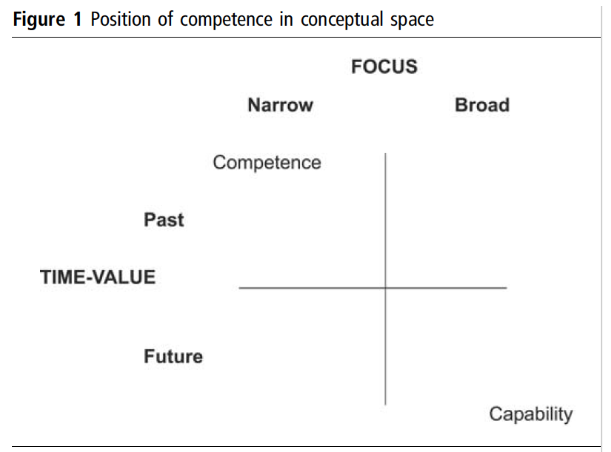
- They meet in the middle and constitute what the authors term Capatance. There is a necessary symbiosis between the two concepts. Both are needed to optimize education. The unanswered question is how best to do that.
The same authors expounded upon the time element of Competence and Capability in a second article, “The Development of Capability: The Content of Potential and the Potential of Content.”
- A further exploration of capability reveals it can be a potential for action, but not necessarily the achievement of that action.
- Capability must be seen in concert with the content of that potential.
- Capability is a continuum…it is the journey, and along that journey new knowledge/skills (in which one becomes competent) increases that potential.
Perhaps insight can be drawn from yet another source. In their seminal work “A Leader’s Framework for Decision Making” in the November 2007 issue of Harvard Business Review, David Snowden and Mary Boone described the Cynefin Framework. They describe four key domains: Simple, Complicated, Complex, and Chaotic with a fifth (the dark figure in the middle of the diagram) being unclassified or confused.
The large grey dot at the apex of the pyramid represents the “System,” the black dots represent the “Agents,” and the connecting lines represent the strength of control. In the Simple domain, tight control is exerted by the System; it is shared in the Complicated domain; the Agents are in relative control in the Complex domain and there is no control in the Chaotic domain. The three actions in italics represent the role of the Leader in such a domain and the type of Practice that leads to is below those actions.
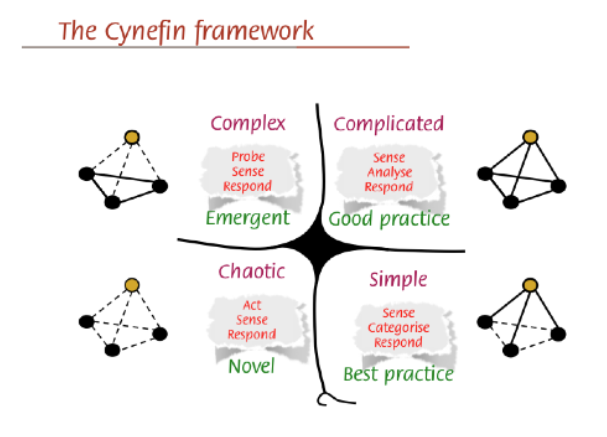
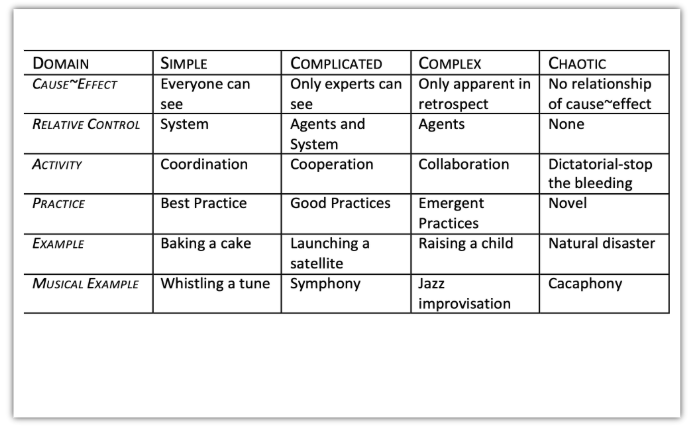
Since many arenas (including and especially medicine and healthcare) include problems in all these domains, one needs to understand and use the appropriate tools for each of them. When the problem (or that part of the problem in question) is Simple or Complicated, Competence is needed: knowledge of existing Best and Good Practices is paramount.
However, when dealing with the Complex Domain, the predictability horizon of actions is exceedingly short and frequent monitoring is crucial and adaptability to the reality (rather than the assumption) is a necessity. It is like tacking a sailboat when traveling upwind. This is where medicine failed during Covid.
In the Chaotic Domain, decisive action to stop deterioration is necessary: stop the bleeding!
Where does AI fit in all of this? I posed this question to Gemini, the AI engine in Google: Does AI undermine the development of capability? Here was the answer:
Yes, AI can stunt the development of capability when it leads to cognitive offloading—handing over the entire thinking and problem-solving process to the tool rather than doing the mental work. (emphasis added—this “silver bullet” wish is prevalent in medicine today)
Recent studies and educational research highlight several key ways AI impacts capability:
- Short-Term Gains vs. Long-Term Deficits: Research (such as studies on students using basic generative AI for math or writing) shows that while AI can spike immediate performance or grades, users often perform worse on subsequent tests or tasks once the AI is removed compared to those who learned the hard way.
- Loss of the “Productive Struggle”: Building neural connections and deep understanding requires struggling through mistakes and problem-solving. Bypassing this effort creates an “illusion of mastery,” where people feel more capable in the moment but have weaker retention and analytical depth.
- Metacognitive Laziness: Over-reliance on AI can reduce critical reflection, analytical reasoning, and the tendency to verify information. As noted in research from EDUCAUSE, instant answers interrupt the mental unrest that normally drives inquiry.
- Contrast with Active Collaboration: AI does not automatically stunt capability; the effect depends heavily on how it is used. Structured AI use that acts as a Socratic tutor (asking probing questions and refusing to just give the answer) enhances learning, whereas passive consumption or direct copying causes skill decay.
I like this answer from Gemini. AI can be extremely valuable as a “library” of what is already known. When used as a tool in the Simple and Complicated domains, it streamlines the understanding of the problem. However, it can be counterproductive in the Complex Domain, as the journey to asking the right question is just as important as obtaining the right answer.
Its utility in the Chaotic Domain is still nebulous. When faced with a ticking time bomb, it is not important that the wiring be understood but that the bomb be rapidly defused with a water disrupter. Analysis can come later.
Melanie Mitchell, David Krakauer, both at the Santa Fe Institute, and John Krakauer of The Johns Hopkins University of Medicine have discussed the difference between emergent capabilities (which some Large Language Models of AI seem to express) and emergent intelligence, which they do not yet, and may never, demonstrate.:
Human intelligence is a low-bandwidth phenomenon, and is as much if not more about the scaling down of effort as the scaling up of capability. As Einstein wrote, ‘The grand aim of all science is to cover the greatest number of empirical facts by logical deduction from the smallest number of hypotheses or axioms’. We know that for any elegant algorithm there is an alternative brute force solution that does the job. It might even be the case that there are uncountable problems that require brute force and that this is a domain where LLMs and their cognitively alien relatives, including SAT solvers, will provide extraordinary utility. What Donald Knuth said of programmes might also be applied to intelligence: ‘Programs are meant to be read by humans and only incidentally for computers to execute.’ Similarly, intelligence is a property of understanding and only incidentally a matter of capability.
In this essay, Melanie Mitchell explains that AI built on Large Language Models can demonstrate impressive capability, but the actual “intelligence” is jagged. It lacks an appreciation of context and thus can at times be dangerous:
Why won’t training on language alone suffice? Because human development and learning are entirely unlike the training process of LLMs. We humans, like most other biological intelligences, are active seekers of information, not passive predictors of next tokens. Unlike LLMs, we are curious, constantly intervening in the world, driven to gain both rewarding experiences and understanding. And, perhaps most important, unlike LLMs we are embodied creatures with a sense of self, a sense of others, and (at least for most of us) a profound caring about the consequences of our actions. An LLM has no body, of course, no conception of itself as a “self,” and no self-generated desires or motivations.
The optimum results for the present occur when AI is used in concert with Human Intelligence (HI) to supply that very context that AI lacks.
The answer to the question in the subtitle of this essay, Is AI a Positive or a Negative?, is “Yes” and “No”—it depends on how it is used, who is using it, and why.
Perhaps the most graphic illustration of massive capability without context is contained in this closing clip of the 1965 movie The Bedford Incident.
Join the Conversation
Published under a Creative Commons Attribution 4.0 International License
For reprints, please set the canonical link back to the original Brownstone Institute Article and Author.