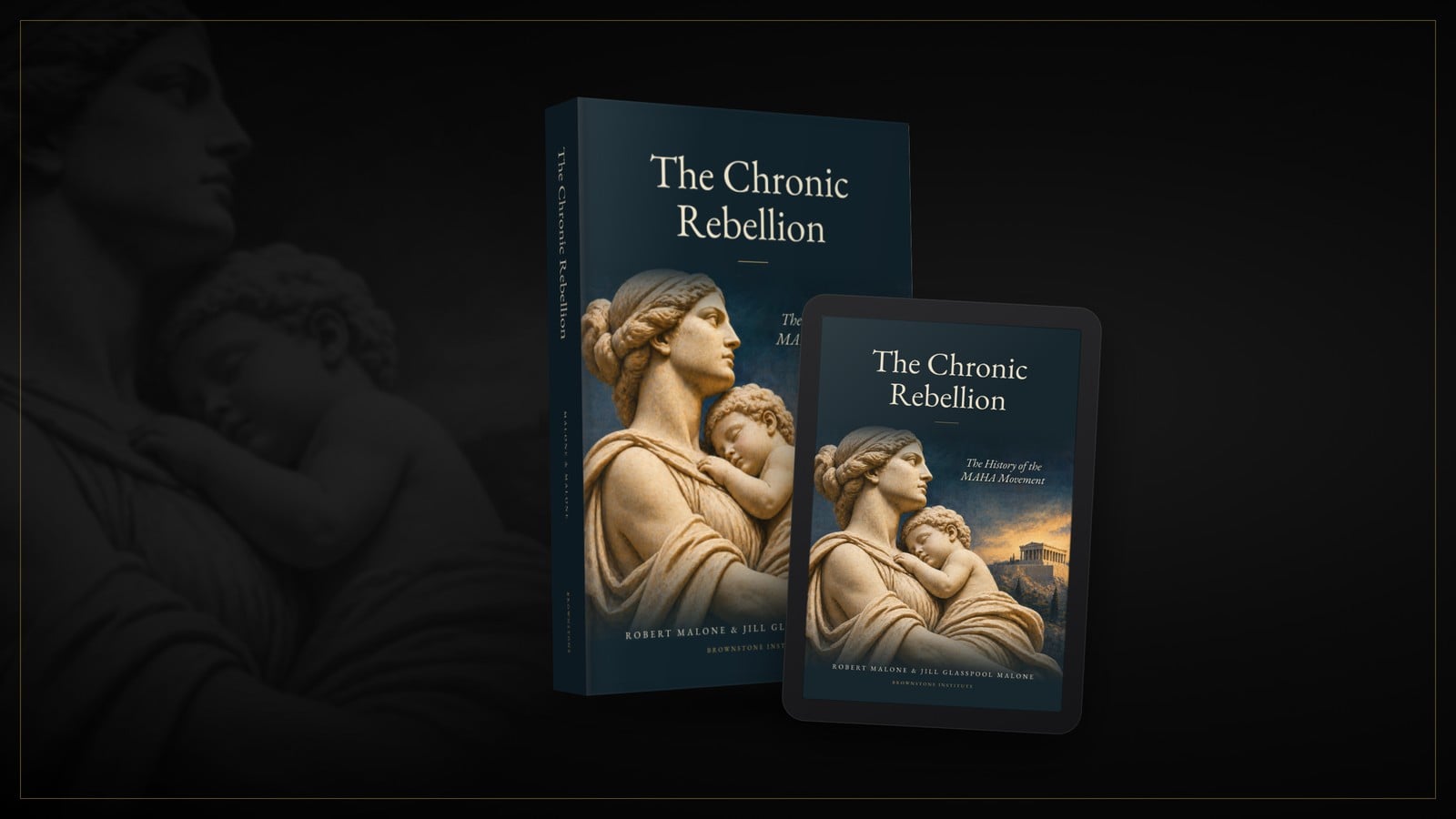
This is an excerpt from the Introduction to The Chronic Rebellion: The History of the MAHA Movement by Robert Malone and Jill Glasspool Malone (Brownstone Institute, 2026).
On the morning of September 5, 2025, Dr. Tracy Beth Hoeg returned from a long run, sat down at her computer, and began pulling cases from the Vaccine Adverse Event Reporting System. She would spend a couple hours pulling cases and a couple more reading them. Hoeg is a marathoner. She is also an interventional spine and sports physician who holds a PhD in epidemiology and public health from the University of Copenhagen. Before her 2025 return to the Food and Drug Administration she had held appointments at the Massachusetts Institute of Technology and the University of California, San Francisco. That morning she was a senior adviser at the FDA.
The work she was doing was painstaking. She pulled VAERS case reports for pediatric deaths following COVID-19 mRNA vaccination. She cross-checked them against medical records obtained from the treating institutions and from the families of the deceased. To each case she applied standard causality-assessment methodology, the framework FDA has used for decades to determine whether a temporal association between an exposure and an adverse event reflects a causal relationship.
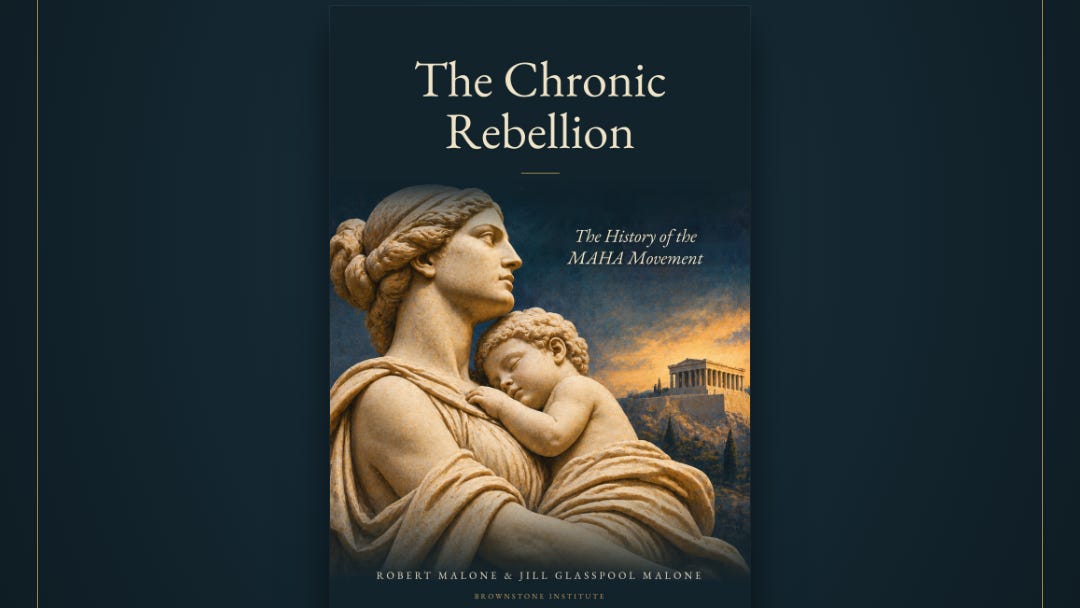 The Chronic Rebellion
The History of the MAHA Movement
Robert Malone & Jill Glasspool Malone · Brownstone Institute
Buy on Amazon
Applying that methodology, the CBER career staff would eventually conclude that the evidence supported a possible or probable relationship in at least ten of the cases.
Five days later, on the morning of Wednesday, September 10, 2025, the COVID-19 Vaccine Workgroup of the reconstituted Advisory Committee on Immunization Practices met by Zoom from 8:30 to 10:30 AM Eastern to hear what she had found. The Workgroup, unlike the public ACIP plenary, did not gather in person. Its members joined from offices and home studies across the country, faces arrayed in rectangles on the screen, and Hoeg’s image was one rectangle among the others as she walked the group through her PowerPoint. I sat on the Workgroup that morning, having been appointed to the reconstituted ACIP three months earlier. The committee’s work, by that point, had become the most closely watched project in American vaccine policy. What Hoeg read aloud that morning, through the speakers, in the careful clinical voice the work needed, is part of the reason this account exists.
The pharmacovigilance work Hoeg had brought to the Workgroup had been made possible, in its present institutional form, by a political alliance. That alliance had been forged fourteen months earlier in Pennsylvania, on a different morning, in different conditions, between two men who had not earlier met.
On the afternoon of July 13, 2024, a twenty-year-old Pennsylvanian named Thomas Crooks climbed onto the roof of the AGR International manufacturing building in Butler, Pennsylvania, with a semi-automatic rifle he had practiced firing only the day before. He lay on the warm roof for some minutes. Below him, on the fairgrounds, Donald Trump was twenty-eight minutes into a campaign speech. Crooks fired. Corey Comperatore, a fifty-year-old retired fire chief who had brought his wife and daughters to the rally, was immediately killed protecting them with his body. Two other spectators, David Dutch and James Copenhaver, were critically wounded, and one has since died of complications from his injuries. The bullet that would have killed the former President instead clipped his right ear, because at the instant Crooks squeezed the trigger Trump had turned his head to look at a chart.
Associated Press photographer Evan Vucci took the photograph within seconds. In the image, the wounded candidate rose with his fist raised against a sky of Pennsylvania clouds. It became one of the most widely circulated political images in American history before the evening was out.
Ten days later, on a telephone call whose details would not be fully reconstructed for months, a wellness entrepreneur named Calley Means put Robert F. Kennedy Jr. on the phone with the man in that photograph. Means was thirty-eight years old, had sold a metabolic-health analytics company, and was carrying, by his own account, the grief of having watched his mother die in 2021 of a preventable metabolic disease. Kennedy was seventy, a fourth-generation Democrat running as an independent, and had spent two decades campaigning against the pharmaceutical and food industries on grounds the Democratic Party had largely declined to defend. Trump, between the call that day and the one that followed it, asked Kennedy what he wanted. Kennedy said he wanted to do something about American children, who were sicker than the children of any other developed country on earth.
The conversation ran long. On August 23, 2024, in Phoenix, Kennedy suspended his campaign and endorsed Trump. MAHA, Make America Healthy Again, was absorbed into the Trump coalition that day.
What that alliance produced through the November 2026 midterms is the subject of the book. Consider what came out of it. A phase-out of petroleum-based food dyes. A restructuring of the childhood vaccine schedule. The first federal acknowledgment that COVID-19 mRNA vaccines had been associated with pediatric deaths. State laws on school lunches, fluoride, and ultra-processed food labeling in more than three dozen states. The most thoroughgoing internal reorganization of the Department of Health and Human Services in its modern history. A preliminary federal injunction blocking the administration’s vaccine-schedule reforms, now on appeal at the First Circuit. The October 22, 2026 resignation of Calley Means from the White House. The November 6, 2026 departure of Chief of Staff Susie Wiles in the aftermath of Republican midterm losses, and the elevation of Stephen Miller in her place.
And throughout, a sustained internal struggle among the movement’s founders, political operatives, and White House minders over what the movement should, in the end, become. Taken together, it is the most consequential attempt at reorienting federal health policy since the establishment of Medicare. Parts of that reorientation have succeeded. Parts have not. The next two years will settle which parts last.
The book that follows tells that story from the vantage point of participants who built the movement and who now carry it forward. Its argument, reduced to a sentence, is this: MAHA is the product of three American political lineages meeting, for the first time in the republic’s modern history, in a single political formation.
The first of those lineages is the conservative-populist tradition. Its line runs from William Jennings Bryan through Barry Goldwater and George Wallace, carrying forward through Jerry Falwell’s religious-right organizing and the insurgent candidacy of Ross Perot. It continues through the Tea Party and through the 2016 campaign that first brought Donald Trump to the presidency. Its habitual grievance is that elites have captured the institutions of common life. Its characteristic tribune is a charismatic outsider who promises to displace them.
The second is the health-freedom and alternative-medicine tradition. Its line runs from Sylvester Graham and Upton Sinclair through Rachel Carson and J. I. Rodale, through Barbara Loe Fisher’s work in the aftermath of the 1986 National Childhood Vaccine Injury Act, through the organic-food movement and the vaccine-critical parents’ organizations of late-twentieth-century California and the Pacific Northwest. Its political coding, through most of its history, has been left-heterodox rather than right-populist. Its quarrel is with the industrialization of American food and medicine.
The third is the libertarian and Austrian-School intellectual tradition. Its line runs from Ludwig von Mises and Friedrich Hayek through Murray Rothbard, from the Ron Paul and Rand Paul presidential campaigns through the Mises Institute and the Brownstone Institute. Its analytical vocabulary, especially Rothbard’s, supplied the MAHA base with its theoretical apparatus. That apparatus includes the idea of regulatory capture, the concept of the court intellectual, and the description of the federal bureaucracy as an interest group rather than an arbiter. These are the frames through which the movement came to interpret the institutional resistance its agenda met.
These three, in combination, had not appeared before in American politics. The conservative-populist tradition had never been shaped by the health-freedom tradition. The health-freedom tradition had never embedded itself inside a conservative-populist electoral coalition. The libertarian political project had never drawn its mass base from Democratic-leaning wellness influencers and Catholic mothers of children on the autism spectrum. MAHA has done all three.
That is what makes it both strange and interesting. Kennedy’s lifelong Democratic biography is not an anomaly to be explained away. Neither is the coalition of former Sanders and Gabbard supporters who followed him across the aisle, nor the Brownstone- and Mises-affiliated credentialed dissenters who populate key positions in the Kennedy HHS. They are central to the story.
Join the Conversation
Published under a Creative Commons Attribution 4.0 International License
For reprints, please set the canonical link back to the original Brownstone Institute Article and Author.
Author