General health checks, called annual physicals in the United States, are sold to the public under false pretenses with claims that aren’t true.
This also applies to targeted health checks, and mammography screening is a good example. Women have been told for 40 years in invitations to screening that by detecting breast cancers early, screening saves lives and leads to less invasive surgery. The truth is that breast screening detects cancers very late, it doesn’t save lives, and more women lose a breast.1
Mammography screening is harmful and general health checks are also harmful. Like breast screening, they detect many things that should not have been treated because they are either insignificant or will disappear again. In contrast to cars, our body has a remarkable capacity for self-healing.
Our Review of General Health Checks
Health checks can result in large bills for no gain just like car checks can. I never send my car to the annual car check, which has saved me an enormous amount of money. I only see a mechanic when there is something wrong with my car or for simple issues such as changing oil. I have the same relationship with my doctor.
Once, when I was on holiday on Maui, I passed a booth where people could have their blood pressure checked. Just for the fun of it, I stretched my arm out. “What is your usual blood pressure,” a woman asked. “I have no idea,” I replied, which made her laugh in disbelief. I was 58 years old and fit, and the few times in my life that someone had taken my blood pressure during a hospital admission, it had been low, so why should I bother about that? I couldn’t help provoking her a little and therefore told her I had no idea either of what my cholesterol was. At that point, she asked me which country I came from!
In Denmark, the doctors were sceptical towards general health checks, but in 2007, the Danish Association of the Pharmaceutical Industry convinced the politicians to introduce them, even though an industry spokesperson admitted that their goal was to sell more drugs.2
Nothing happened, however. But in 2011, our new government wanted to introduce general health checks. I asked to have a meeting with the Minister of Health, Astrid Krag, because our review of the randomised trials, which we had just completed but not yet published, had found no effect on mortality. I brought a colleague to the meeting who had just finished a large trial in Denmark, which had also failed to find an effect.
We told Krag that health checks are probably harmful, leading to more diagnoses, more drugs, and psychological problems because people are told they are less healthy than they think. She aborted her plans on the spot and said it was the first time the new government had broken a pre-election promise in an evidence-based manner.
We had included 14 trials in adults unselected for diseases or risk factors. We published our review in 20123 and updated it in 2019.4 There was no reduction in total mortality (risk ratio 1.00), cardiovascular mortality (risk ratio 1.05), or cancer mortality (risk ratio 1.01), and with 21,535 deaths, our results were very convincing.
There were no benefits either for clinical events, hospital admissions, or other measures of morbidity, but there were harms. More people got a disease label and more became treated with antihypertensive drugs. We concluded cautiously that general health checks are unlikely to be beneficial, but in fact they are harmful.
We had also studied 56 Danish websites selling health checks and found that 17 of the 21 most-used tests were unjustified or there was evidence against using them for screening purposes.5 None of the websites mentioned any harms of health checks and they presented a median of only one of the 15 information items recommended by the WHO and the Danish Board of Health when screening healthy people. Thus, there was no informed consent.
Our review saved billions of crowns for Danish taxpayers. Amusingly, statistician Bjørn Lomborg, who denied the existence of climate change in his book, The Sceptical Environmentalist, arranged the 2011 Copenhagen Consensus Conference where three health economists concluded that health checks would give the most health for the investment, 26 crowns for every crown invested.6
Quite an impressive gain for something that doesn’t work. We explained what was wrong with the methods.7 The estimate was based on the smallest trial we had included in our review, the Danish Ebeltoft study, which contributed only 0.4% of the weight in our updated meta-analysis of mortality.4 It is very bad science to cherry-pick a single, tiny trial. Moreover, the economists calculated life years gained based on an extrapolation from changes in risk factors, which was wishful thinking. In fact, a review of 55 trials with interventions against elevated risk factors in healthy people had not found less morbidity or mortality.8
The UK “Yes Minister” Farce
In the UK, the reactions to our review were so laughable that they could have been an episode in the BBC’s Yes Minister satire series.
The predicament was that the National Health Service already offered universal health checks for people between 40 and 74 years of age who were tested for cardiovascular disease, diabetes, and chronic kidney disease. A slide show claimed that annual health checks would prevent at least 9,500 heart attacks and strokes, 2,000 deaths and 4,000 people from developing diabetes. A slide with a graveyard ensured that no one would miss what would happen if they didn’t attend health checks:
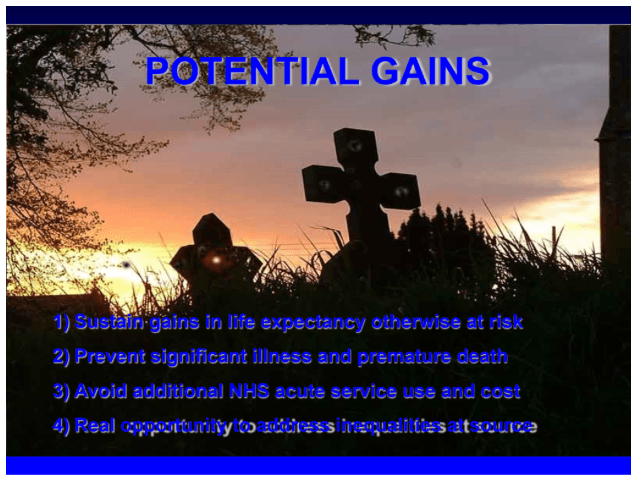
Once something has been introduced as a national priority, it is very difficult to stop it. When our review came out, a Department of Health representative told the BBC that the NHS Health Check programme was based on “expert guidance.” This was even better magic than what Lomborg’s health economists had invented in Denmark. The programme was based on evidence until our review showed it didn’t work. Then, all of a sudden, it was based on “expert guidance” instead.
A year later, we had had enough of all the tricks and published a letter in The Times, with the funny title, “Health check check,”9 which resulted in a front-page interview next to a large photo of Prince William, his wife and child, and a royal dog:
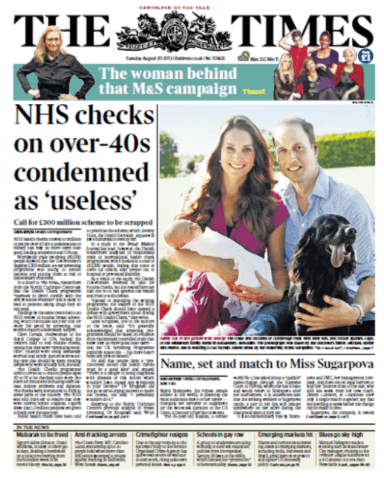
Ministers now insisted that 650 lives a year could be saved10 – a sharp retreat from the previous claim of 2,000. But the chief executive of Diabetes UK, Barbara Young, continued undeterred. She said that routine checks could uncover 850,000 people with undiagnosed type 2 diabetes. However, labelling almost a million healthy people as diseased has no value in itself, and we had found that screening for diabetes is not helpful.
After repeated calls from politicians for the programme to be scrapped, Public Health England needed to do something. They announced that an expert panel would be established to review the effectiveness and value-for-money of NHS Health Checks.11
The attempts at finding a fig leaf and continue with the programme were now so bizarre that I came to think of Monty Python’s Ministry of Silly Walks.12 I decided to add to the amusement in the BMJ, with a quote from the Yes Minister series as my title: “I don’t want the truth, I want something I can tell Parliament!”:13
Public Health England will establish an expert panel to review the effectiveness and value for money of NHS Health Checks, and it will refresh the economic modelling behind the programme. We are furthermore told that “although we recognise that the programme is not supported by direct randomised controlled trial evidence, there is nonetheless an urgent need to tackle the growing burden of disease which is associated with lifestyle behaviours and choices.” The truth, that health checks don’t work and are likely harmful, is too much to bear for Public Health England, it seems. An expert panel is the modern version of the Oracle in Delphi, and statistical modelling is like whispering in a wizard’s ear which result you would like to hear. Saying that there is an urgent need to tackle the growing burden of disease as an excuse for going against clear evidence from randomised trials reminds me of another episode of Yes, (sic) Minister where it was skilfully argued why a huge number of administrators were needed for a hospital that had no patients…Like health checks, mammography screening is harmful, but such trifles don’t affect the leaders of the NHS or the UK Government.
There was also censorship.14 The website for the NHS Health Check programme published a criticism of our review, which appeared to be serious but was unfounded and highly misleading.15 We asked for our reply to be published on the website, which was declined with the argument that the government had already decided that health checks were a national priority and that the website was not a forum for debating their merits.
This was hypocritical because the NHS had done exactly that but denied us the opportunity to respond. It would have been appropriate for the NHS programme to publish its criticism in the BMJ, where we had published our review,3 so we could respond to it. The NHS preferred censorship for an enriching debate, which they knew they would lose.
The absolute low point was yet to come, however. In 2014, the National Institute for Health and Care Excellence (NICE), supposedly an independent institution, behaved as the lapdog for the NHS and the drug industry in a press release:16
“Helping local authorities to encourage people to attend NHS Health Checks and support them in making changes needed to improve their health, is the focus of a new NICE briefing…providing the best value for money…A report from Public Health England found that checking blood pressure, cholesterol, weight and lifestyle of people in this age group could identify problems earlier and prevent 650 deaths, 1600 heart attacks and 4000 diagnoses of diabetes a year…The NHS Health Check programme is currently part of the health delivery infrastructure in England, so NICE seeks to support its effective delivery.”
Prevent 4,000 diagnoses of diabetes a year? Diabetes UK had claimed that routine checks could uncover an estimated 850,000 people with undiagnosed type 2 diabetes. Are we supposed to find 850,000 or to avoid finding 4,000?
One of my UK colleagues talked about “Stalinism in the NHS” because members of Parliament were highly critical and had noted that health professionals had been pressured to refrain from criticising the project in public.17 Only about 50% attended health checks and Public Health England said its aim was to drive the acceptance rate up to 70-75%. That would not be possible without deceiving the public even more than before.
Despite all the Yes Minister manoeuvres, people paid attention to our review and the media interest was phenomenal. Many websites, also in the United States, where overdiagnosis, overtreatment, and waste of money is far greater than anywhere else, questioned health checks.
The Danish Farce
Denmark was a great contributor to the farce and, like in the UK, it was not intended by those who made themselves laughable.
One of the poorest tricks I have been exposed to when my systematic reviews showed that something doesn’t work, e.g. also in relation to mammography screening,18 is to criticise the included trials or the methods of the review, as if this would by some magic render a negative result positive. This was also the case for health checks.19
The key spokesperson for the tiny Ebeltoft study, Torsten Lauritzen, wouldn’t give up. He was amazingly stubborn, but all his arguments were false, e.g. that our screening tests and treatments were outdated and that the trials were old (we included all trials, also the newest ones).20 He referred to a meta-analysis of surrogate outcomes, to retrospective non-randomised comparisons, and to modelling studies, which are the standard “rescues” when results from randomised trials are too painful to accept.
Lauritzen carried on with his wishful thinking that health checks reduce mortality using modelling based on risk factors.21 He mentioned a systematic review of trials in general practice showing an effect of screening on risk factors for cardiovascular disease but failed to note that it also showed that 30% more people died from cardiovascular disease in the screened group than in the control group. As this difference was statistically significant, Lauritzen was scientifically dishonest.
Lauritzen continued propagating misinformation about our research and published a “State-of-the-Art” article in our medical journal, which was cherry-picking in the extreme.22 He only mentioned his own study and an irrelevant diabetes trial that was not about health checks.
Torturing Your Data in Secrecy Till They Confess
Lauritzen had a contender to the Fool’s Prize in this area, our new Minister of Health, Nick Hækkerup, who had replaced Astrid Krag and had different ideas than hers. He admitted to a speaker on health in Parliament that our review had not found any effect of health checks but added that the Board of Health had stated that this did not rule out that other forms of health checks could have an effect.
I referred to philosopher Bertrand Russell, who had pointed out how meaningless such statements are.23 He said we cannot rule out that there is a porcelain tea set in orbit circulating around the Earth. Scientifically, we cannot rule out that something might exist. But is it likely that there are UFOs or Martians, or a tea set in orbit?
There was a cartoon in my article that was spot on. The man with the phone is from the European Space Agency:
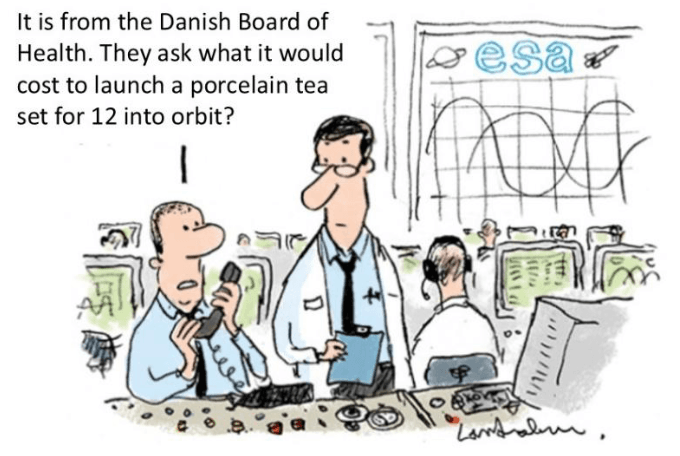
The Board of Health gave the minister a counterfactual fig leaf, which, according to my dictionary, belongs to the “department for nonsense.” It rings hollow when the Board calls itself the country’s supreme authority on health while it engages in politicisation at a nonsense level.
I asked the Board for access to the documents, 30 in all, which was refused.24 At the same time, a feature article in a newspaper criticised that civil servants did not hold on to “legality, matter-of-factness, professionalism and truth,” but manipulated the evidence to embellish the government’s image and advance its interests.
I complained to the ministry and got access to 14 documents, including a smoking gun. It was about screening for chronic obstructive pulmonary disease, cardiovascular disease, and diabetes. The document stated that early detection can lead to fewer disease complications, reduce mortality, reduce healthcare costs, and provide opportunities for a better life, improve the quality of life, and even stop the development of the disease.
This mendacious information came from our Board of Health!
Next, I asked for access to the remaining 16 documents, which should not be a problem according to our law because the case was now closed.
But the Board’s reply was another smoking gun. Access to the documents would mean that the Board’s professional advice could limit the minister’s political range of manoeuvres. It could also limit the civil service’s freedom in relation to professional advice, which could lead to deterioration of the professional advice the minister receives from civil service. Thus, there are very special needs for confidentiality, the Board argued.
What an impressive load of pompous bullshit! I had never seen such an admission from a health authority that the “professional advice” is totally unprofessional. If the professional advice had been okay, the Board should have been proud of it and have nothing against putting it on public display. If you have nothing to hide, then hide nothing.
And yet, there was a third smoking gun: The ministry referred to a document which “was exchanged between the ministry and the Board of Health in several different versions, which reflected the ongoing development in the work with qualifying the initiative to introduce health checks.”
What? This is what the Americans call torturing your data till they confess.25
I complained to the Parliamentary Ombudsman, who supported me. After a year, I got access to the document, which was the fourth smoking gun. It referred to the Ebeltoft study and stated that health checks had a positive effect for men with a short education. This was a lie. In our review, we had included a WHO study with 60,000 male factory workers and 2,511 deaths, and there was no effect. In the Ebeltoft study, there were only 92 deaths, and those with short education made up a minor part of these.
Then came smoking gun number five. The Board of Health discussed our review in a very cursory, almost condescending way: “Various studies show that general health checks have no effect on health (among them studies from Glostrup Hospital and the Nordic Cochrane Centre).” Various studies? We had included all the studies in our review!
The government had announced that it would cooperate with “central actors in the health service” to clarify who would benefit from health checks. I strongly doubted that those of us who knew most about the matter and had provided the most reliable evidence would be consulted, and I was right. The Board only asked the Ebeltoft people for advice. This was like asking a radio amateur for advice about how to launch a Moon rocket.
I wondered what the documents I had not seen contained. Were they even worse? Would that be possible considering the Machiavellian process I had uncovered?
Hækkerup was very pleased that the Danish Society for General Practice had offered to assist with the work, but this was also incorrect. Only the chairman had announced this and several of the members called for his resignation because of it.
The Danish Society of Public Health wrote to the Parliament that they wondered why the government, despite massive knowledge of the lack of effect of health checks, had made a decision that was very costly and would mean that cuts had to be made elsewhere.
Hækkerup was grilled in the media. He declared he was convinced that people would live longer. When a journalist pointed out that there was no evidence for this, Hækkerup replied that he was not a scientist but a politician. The journalist then said that he must rely on science: “Nah, I am an opinionated person,” he replied. Imagine if the Minister of Transport was fond of bamboo and decided that the Fehmarn Bridge to Germany should be built of bamboo, with a remark that he was an opinionated person, not an engineer.
What should we do when ministers of health and civil servants conspire to deceive the public and harm our citizens and our economy? I noted that the new law about reduced public access to government documents introduced in Denmark in 2014 was heavily criticised for undermining democracy and increasing the risk of abuse of power in the public administration.24 When our authorities comply with the whims and gut feelings ministers and conflicted experts have, instead of being truthful to science, we must change our laws about openness in public administration and introduce stiff penalties for those who abuse their power, including ministers.
Hækkerup had talked to three renovation workers and asked them if they thought health checks would be a good idea. That was the positive evidence he had. When he announced this, he also said the men could pleasure their wives. Indeed, a minister for the people.
Hækkerup, a social democrat, succeeded to convince the government about introducing health checks to “vulnerable citizens.” Luckily, we got a liberal government in 2015, which cancelled his foolish plan.26 We still don’t have general health checks in Denmark, and of course they still have them in the UK.27 And they are also recommended in the US by the Centers for Disease Control and Prevention.28 Yes Minister!
Why Don’t Health Checks Work?
In 2014, the BMJ asked us to write an editorial about health checks.19 It is counter-intuitive that they don’t work, and there are two likely explanations for it. Many physicians already advise their patients and test for cardiovascular risk factors or diseases in patients whom they judge to be at risk when they see them for other reasons. It has been documented that even brief counselling about smoking will make some people quit, and several of the trials we included advised the participants about this and other unhealthy lifestyles.
The other explanation is that beneficial effects of screening could be outweighed by harmful ones, and type 2 diabetes is a good example. Our drug regulators approve diabetes drugs based on their glucose-lowering effect without knowing what they do to patients, although several drugs in widespread use, e.g. tolbutamide and rosiglitazone, increase cardiovascular mortality.29
Our review did not include trials of geriatric screening, as they evaluated many other interventions in addition to screening, such as falls prevention and specialist drug review. A large meta-analysis showed that community-based multifactorial interventions significantly increased the chance of living at home and reduced falls and hospital admissions.30
Thus, there might be niches where interventions could work, but these interventions are not general health checks, which we recommended be stopped.
The UFO Trick Is Very Common in Public Health
Many people who view themselves as scientists behave as pseudoscientists or cheats when they try to reject strong evidence with weak evidence, which is usually about not losing power or face.
The research literature and the media are full of what I call UFO tricks. If you use a fuzzy photo to “prove” you have seen a UFO when a photo taken with a strong lens has clearly shown that the object is an airplane or a bird, you are a cheat. Many people believe in such UFO tricks because they don’t have a science education, and most of those that have one are unable to distinguish between good and bad science.
Observational studies are the most common raw material for such deceptions. When randomised trials have shown something with great certainty that people with vested interests don’t like but cannot refute, they often say that observational studies have arrived at the opposite result and then discard the trial evidence.18,29,31-33
References
1 Gøtzsche PC. The Three Big Lies about Mammography Screening. Brownstone Journal 2026; March 6.
2 Andersen NV. Medicinalindustrien skruer op for lobbyismen. Mandag Morgen 2007; Sep 3:20–3.
3 Krogsbøll LT, Jørgensen KJ, Larsen CG, Gøtzsche PC. General health checks in adults for reducing morbidity and mortality from disease: Cochrane systematic review and meta-analysis. BMJ 2012;345:e7191.
4 Krogsbøll LT, Jørgensen KJ, Gøtzsche PC. General health checks in adults for reducing morbidity and mortality from disease. Cochrane Database Syst Rev 2019;1:CD009009.
5 Larsen CG, Jørgensen KJ, Gøtzsche PC. Regular health checks: cross-sectional survey. PLoS One 2012;7:e33694.
6 Andersen TK. 10 forslag til mere sundhed for pengene. Mandag Morgen 2011; Feb 21.
7 Krogsbøll LT, Jørgensen KJ, Gøtzsche PC. Skal befolkningen tilbydes generelle helbredsundersøgelser? Ugeskr Læger 2011;173:1671.
8 Ebrahim S, Taylor F, Ward K, et al. Multiple risk factor interventions for primary prevention of coronary heart disease. Cochrane Database Syst Rev 2011;1: CD001561.
9 Krogsbøll LT, Jørgensen KJ, Gøtzsche PC. Health check check. The Times 2013; Aug 20:25.
10 Hope J. Are NHS over-40s health checks a waste of time? Critics say they’re useless but ministers insist 650 lives a year could be saved. Daily Mail 2013; Aug 20.
11 Gould M. Expert panel will assess cost effectiveness of health checks. BMJ 2013;347:f5222.
12 Ministry of Silly Walks. Monty Python.
13 Gøtzsche PC. “I don’t want the truth, I want something I can tell Parliament!” BMJ 2013;347:f5222.
14 Krogsbøll LT, Jørgensen KJ, Gøtzsche PC. Universal health checks should be abandoned. BMJ 2013;347:f5227.
15 Krogsbøll LT, Jørgensen KJ, Gøtzsche PC. Re: Government’s plans for universal health checks for people aged 40-75. BMJ 2013; Aug 12.
16 NICE support for local government to encourage people to attend NHS Health Checks and make changes for better health. Press release 2014; Feb 26.
17 Price C. NHS Health Checks programme stalling amid poor uptake and critical MPs’ report. Pulse 2014; Feb 28.
18 Gøtzsche PC. Mammography screening: truth, lies and controversy. London: Radcliffe Publishing; 2012.
19 Gøtzsche PC, Jørgensen KJ, Krogsbøll LT. General health checks don’t work. BMJ 2014;348:g3680.
20 Gøtzsche PC, Jørgensen KJ, Krogsbøll LT. Authors’ reply to Lauritzen and colleagues, Newton and colleagues, and Mangin. BMJ 2014;349:g4790.
21 Jørgensen KJ, Krogsbøll LT, Pisinger C, Jørgensen T, Gøtzsche PC. Upålidelige metoder kan ikke berettige helbredstjek. Ugeskr Læger 2014;176:2004-5.
22 Krogsbøll LT, Jørgensen KJ, Gøtzsche PC. ”Statusartikel” om helbredstjek var et subjektivt partsindlæg. Ugeskr Læger 2014;176:1505.
23 Gøtzsche PC. Den politiserende Sundhedsstyrelse. Dagens Medicin 2014; Oct 10.
24 Gøtzsche PC. Fakta om sundhedstjek er mørkelagt. Politikens kronik 2016; Jan 14.
25 Mills JL. Data torturing. N Engl J Med 1993;329:1196-9.
26 Ringgaard A. Ny forskning slår fast: Helbredstjek virker ikke. Videnskab.dk 2017; March 28.
27 NHS Health Check. 2023; Aug 14.
28 Are You Up to Date on Your Preventive Care? CDC 2024; May 15.
29 Gøtzsche PC. Deadly medicines and organised crime: How big pharma has corrupted health care. London: Radcliffe Publishing; 2013, pages 125 and 176.
30 Beswick AD, Rees K, Dieppe P, et al. Complex interventions to improve physical function and maintain independent living in elderly people: a systematic review and meta-analysis. Lancet 2008;371:725-35.
31 Gøtzsche PC. Deadly psychiatry and organised denial. Copenhagen: People’s Press; 2015.
32 Gøtzsche PC. Critical psychiatry textbook. Copenhagen: Institute for Scientific Freedom; 2022, page 55 (freely available).
33 Gøtzsche PC. Whistleblower in healthcare (autobiography). Copenhagen: Institute for Scientific Freedom; 2025 (freely available).
Join the Conversation
Published under a Creative Commons Attribution 4.0 International License
For reprints, please set the canonical link back to the original Brownstone Institute Article and Author.