
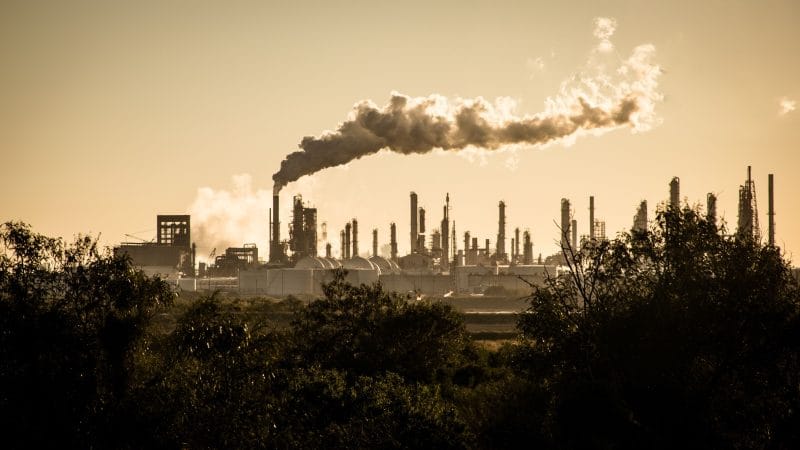

Trump’s cancellation of the so-called “endangerment finding” with respect to CO2 made by the Obama White House back in 2009 is so profoundly important as to make up for a legion of Trump’s spending, borrowing, easy money, and tariffing sins. Among countless others.
The entire notion that fossil-fuel-based industrial civilization threatens to boil the planet alive is sheer crackpottery. Actually, as we reprise below, the geologic and climatic history of the planet so clearly refutes the Climate Crisis nonsense as to point to an even more malefic force at work than just an egregious policy mistake.
In fact, the entire Climate Crisis Hoax was a deliberately Manufactured Lie, which emanated from the permanent political class and career nomenklatura domiciled in Washington, the UN, London, and Brussels. Their purpose was transparent: Namely, the propagation of an entire gestalt centered on an existential threat to the very life of the planet, thereby implicating sweeping emergency expansion of state power to override and supplant the very rudiments and rhythms of our fossil-fuel-based industrial society and the free market-rooted lifestyles and prosperity it enables.
Stated more bluntly, the Climate Change Hoax was the most blatant grab for state power in human history to date (possibly exceeded only by the Covid-era attempt to control the microbial kingdom). And, now, perhaps with no more intentionality than that of the proverbial blind squirrel which stumbles upon an acorn, Trump has struck decisively at the entire prosperity-endangering predicate of this great lie. Not only will the cantilevered green energy regulatory and subsidy structure predicated on the Obama endangerment finding now rapidly fall by the wayside, but the whole absurd religion of mankind’s alleged sinful stewardship of the planet will be up for honest refutation for the first time in three decades.
Perhaps it will take a year or two, or even a decade or more, but the phony “science” and risible economics on which the climate scam was based will now unravel into a heap of discredited propaganda and modern-day witchcraftery. With some luck and leadership from now emboldened dissenters in government, industry, science, and the public conversation alike, we may even benefit from a “never again” syndrome in our national politics capable of keeping the statists at bay for at least a few decades longer.
Perforce, therefore, the foundation myths of the Climate Crisis scam needs to be eviscerated limb-for-limb in order to document that the entire story was and is bogus. The truth is, the equipoise of the planet is not remotely in danger from burning fossil fuels or other human endeavors that make modern life more pleasant and tolerable.
In the first place, there never has been planetary equipoise!
What there’s been is 4.5 billion years of wildly oscillating and often violent geologic evolution and climate disequilibrium owing to manifold natural causes including:
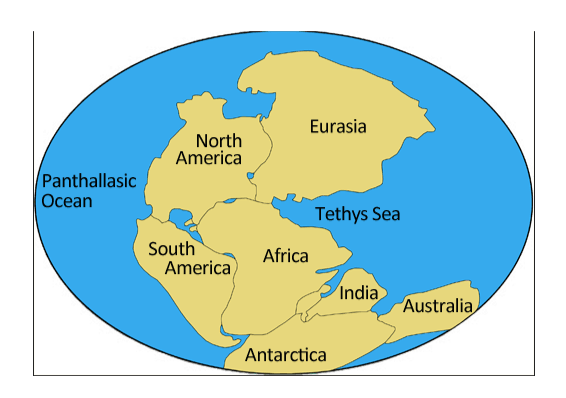
- Plate tectonics which have sometimes violently impacted climate systems, especially the assembly and breakup of Pangaea between 300 million and 175 million years ago and the continuous drift of the present day continents thereafter.
- Periodic asteroid bombardments.
- The 100,000-year cycles of the earth’s orbital eccentricity (it gets colder when it’s at maximum elongation).
- The 41,000-year cycles of the earth tilt on its axis, which oscillates between 22.1 and 24.5 degrees and thereby impacts the level of solar intake.
- The wobble or precession of the earth’s rotation which impacts climate over the course of its 26,000-year cycles.
- The recent 150,000-year glaciation and inter-glacial warming cycles.
- The 1,500-year sunspot cycles, where earth temperatures fall materially during solar minimums like the Maunder Minimum of 1645-1715, which occurred at the extreme of the LIA when sunspot activity virtually ceased.
The natural climate change now underway is therefore the product of these powerful planetary forces—forces that long predated the industrial age and which massively exceed the impact of industrial era emissions. So the fact that the present conflation of these forces have resulted in a teeny-tiny warming cycle is nothing new—warming has happened repeatedly even in modern times.
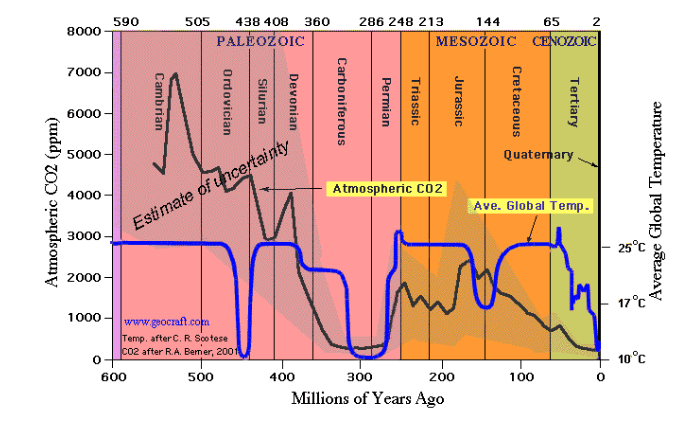
So we need begin with the most relevant eras of climate change that cover the past 600 million years—the period after the planet took on the essentials of its current form. The fact is, from the so-called Cambrian Explosion (530 million years ago) forward the earth has rarely been as coolas at present; and almost never has it had as low CO2 concentrations as the 420 ppm level that today’s Climate Howlers decry.
In short, mankind and industrial society are in the cool shade of historical climate cycles, not on the cusp of some kind of red-hot cataclysmic demise.
Thus, according to the careful reconstructions of actual earth scientists based on ocean sediments, ice cores, tree rings, and the like, there have been only two periods encompassing about 75 million years or 13 percent of that immensely long 600-million-year stretch of time where temperatures and CO2 concentrations were as low as at present. These especially cold/low CO2 periods were:
- the Late Carboniferous/Early Permian time from 315 to 270 million years ago, centered right above the 300 million years ago marker in the graph below.
- the Quaternary Period on the very right-hand edge of the tertiary period shown in green, which hosted modern man from 2.6 million years ago to the present.
You might say, therefore, that the possibility of a warmer, CO2 richer environment is nothing new: it’s actually a case of planetary “Been there, done that, almost forever!”
And most certainly it is not a reason to wantonly dismantle and destroy the intricate low-cost energy system which is the root source of today’s unprecedented prosperity and human escape from poverty and want.
But that’s hardly the half of it. What actually lies smack in the center of our warmer past is a 220 million-year interval from 250 million years ago through the re-icing of Antarctica about 33 million years ago that was so warm as to be mainly ice-free.
As shown by the blue line in the chart during most of that period (highlighted in the brown panels), temperatures were up to 12 degrees C higher than at present and Mother Earth paid no mind to the fact that she lacked polar ice caps or suitable habitats for the yet unevolved polar bears!
As it happened, during what has been designated as the Mesozoic Age the planet was busy with another great task. Namely, salting away the vast deposits of coal, oil, and natural gas that power the modern economy and allow billions of people to have a living standard enjoyed only by kings just a few centuries ago.
There is no mystery as to how this serendipitous gift to present day man happened. In a world largely bereft of ice and snow, the oceans were at vastly higher levels (i.e. hundreds of feet above present levels) and flooded much of the land mass, which was verdant with plant and animal life owing to warmer temperatures and more abundant rainfall.
For instance, had we typed this missive from our home in Miami back then, we’d have needed a raft or a wet suit to complete our post.
Stated differently, Mother Nature was harvesting massive amounts of solar energy in the form of carbon-based plant and animal life which over the eons of growth and decay resulted in the buildup of vast sedimentary basins.
As the tectonic plates shifted (i.e. the single continent of Pangaea broke up into its modern continental plates beginning about 200 million years ago) and the climate oscillated, these sedimentary deposits were buried under shallow oceans. And with the passage of time, heat, and pressure they were converted into the hydrocarbon deposits that dot the first 50,000 feet (at least) of the earth’s crust.
In the case of coal, the most favorable conditions for its formation occurred 360 million to 290 million years ago during the Carboniferous (“coal-bearing”) Period. However, lesser amounts continued to form in some parts of the Earth during subsequent times, in particular the Permian Era (290 million to 250 million years ago) and throughout the Mesozoic Era (up to 66 million years ago).
Likewise, the formation of petroleum deposits began in warm shallow oceans, where dead organic matter fell to the ocean floors. These zooplankton (animals) and phytoplankton (plants) mixed with inorganic material that entered the oceans by rivers. It was these sediments on the ocean floors that then formed oil sands while buried during eons of heat and pressure. That is to say, the energy embodied in petroleum initially came from the sunlight which had become trapped in chemical form in dead plankton.
Moreover, the science behind this isn’t a matter of academic armchair speculation for the simple reason that it has been powerfully validated in the present-day commercial marketplace.
That is, trillions of dollars have been deployed in the last century in the search for hydrocarbons, based on immensely complicated petroleum engineering research, paleontological theory, and geologic models. Oil drillers weren’t throwing darts at a wildcatter’s wall, but were coincidentally proving that the science of these “facts” of climate history were correct, given that they led to the discovery and extraction of several trillions of BOEs (barrels of oil equivalent).
Consequently, it is solidly estimated by industry experts that today’s petroleum deposits were roughly formed as follows:
- About 70 percent during the Mesozoic Era (brown panels, 252 to 66 million years ago) which was marked by a tropical climate, with large amounts of plankton in the oceans;
- 20 percent was formed in the Cenozoic Era (last 65 million years) which was trending dryer and cooler;
- 10 percent were formed in the earlier warmer Paleozoic Era (541 to 252 million years ago).
Indeed, at the end of the day petroleum engineering is rooted in true “climate science” because it was climate itself that produced those economically valuable hydrocarbon deposits.
And a pretty awesome science it is. After all, billions of dollars have been pushed down the well bores in up to two miles of ocean waters and to sediments 40,000 feet below the surface in what amounts to amazingly calibrated and targeted search for oil-bearing needles in a geologic haystack.
For instance, the Cretaceous Period from 145 million to 66 million years ago, which was especially prolific for oil formation, was a period with a relatively warm climate, resulting in high open ocean levels and numerous shallow inland seas. These oceans and seas were populated with now extinct marine reptiles, ammonites, and rudists, while dinosaurs continued to dominate on land. And it is knowing this science that permits multi-billion barrel hydrocarbon needles to be found in the earth’s vast deep.
Needless to say, the climate warmed sharply during the Cretaceous, rising by about 8 degrees C and eventually reached a level 10 degrees C warmer than today (i.e. about 25 degrees C versus today’s alleged heated-up planet at 15 degrees C). That is to say, on the eve of the asteroid-driven Great Extinction Event of 66 million years ago, planet Earth was both far hotter and more carbon-rich than any of the “catastrophe” models offered today by the Climate Howlers currently predict.
As shown in the graph below, at that point there were no ice caps at either pole and Pangaea was still coming apart at the seams. So there was no circulating ocean conveyor system in the infant Atlantic, either.
Yet during the Cretaceous CO2 levels actually went down while temperatures were rising sharply. That’s the very opposite of the Climate Alarmists’ core claim that it is rising CO2 concentrations which are currently forcing global temperatures higher.
Moreover, we are not talking about a marginal reduction in CO2 concentrations in the atmosphere. During this extremely warm 80-million-year interval CO2 levels actually dropped sharply from about 2,000 ppm to 900 ppm. This was all good for hydrocarbon formation and today’s endowment of nature’s stored work, but it was also something more.
To wit, it was yet another proof that planetary climate dynamics are far more complicated and ridden with cross currents than the simple-minded doom loops now being used to model future climate states from current far lower temperatures and CO2 levels.
As it happened, during the periods since the Great Extinction Event 66 million years ago, both vectors have steadily fallen: CO2 levels continued to drop to the 300-400 ppm of modern times, while temperatures dropped another 10 degrees C, as well.
It is surely one of the great ironies of our times that today’s fanatical crusades against fossil fuels are being carried out with not even a nod to the geologic history which both contradicts the entire “warming” and CO2 concentration hysteria and also made present fossil energy consumption levels and efficiencies possible.
That is to say, the big, warm, and wet one (the Mesozoic) got us here. True global warming is not the current and future folly of mankind, but the historical enabler of present-day economic blessings.
Yet here we were in the year 2026 still being urged to manically focus on reducing emissions to the levels required to keep global temperatures from rising more than1.5 degrees Celsius from pre-industrial levels. The very idea is ludicrous, but perhaps the Donald’s exceedingly timely blow against this outbreak of modern-day witchcraftery parading as the “science” will finally show that our heretofore ideological emperor is naked indeed.
To repeat, the whole scam was based on a small fraction of the documented temperature increases of the geologic past. And, besides, exactly which pre-industrial level were the alarmists actually referring to? We will address the more recent evolution including the Medieval Warming and the Little Ice Age below, but suffice it to say that this chart reflects broadly accepted geologic science. Yet we are hard-pressed—even with the aid of a magnifying glass—to see any time in the last 66 million years in which the global temperatures weren’t well higher than 1.5 C above current levels. And that includes much of the far-right margin labeled the “PleistoceneIce Age” of the past 2.6 million years.
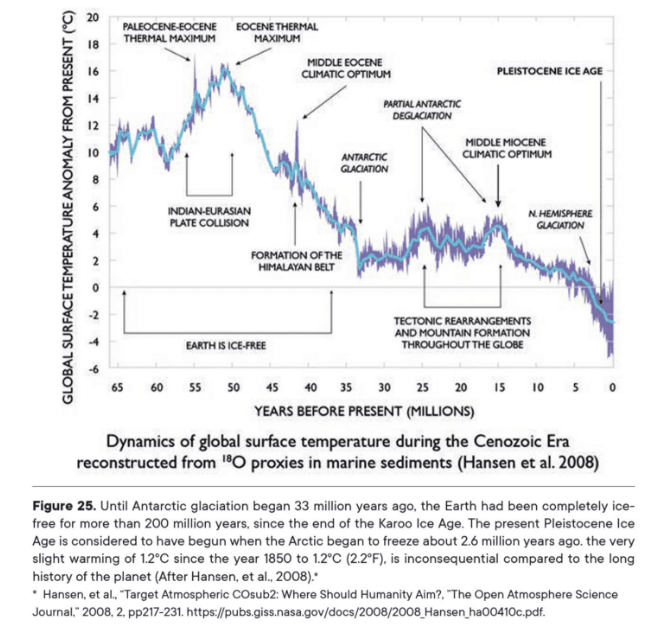
If your brain is not addled by the Climate Change narrative, the very term rings a resoundingly loud bell. That’s because there have been on the order of 20 distinct “ice ages” and inter-glacial warming periods during the Pleistocene Epoch, of which the latest ended about 18,000 years ago and from which we have been digging out ever since.
Of course, the climb away from retreating glaciers in Michigan, New England, Northern Europe, Siberia, etc. to warmer more hospitable climes has not been smoothly continuous, but a syncopated sequence of advances and retreats. Thus, it is believed that it got steadily warmer until about 13,000 years ago, which progress was then interrupted by the Younger Dryas, where the climate suddenly became much dryer and colder and caused the polar ice caps to re-expand and ocean levels to drop by upwards of 100 feet as more of the earth’s fixed quantity of water was reabsorbed back into the ice packs.
After about 2,000 years of retreat, however, and with no help from humans who had repaired to cave-living during the Younger Dryas, the climate system swiftly regained its warming mojo. During the subsequent runup to what the science calls the Holocene Optimum about 8,000 years ago, global temperatures rose by upwards of 3 degrees C on average and up to 10 degrees C in the higher latitudes. Overall, the resulting temperatures on the planet were far higher than they are today.
And it happened quite rapidly. One peer-reviewed study showed that in parts of Greenland temperatures rose 10 degrees C (18 degrees F) in a single decade. Actually, scientists believe that on a global basis half of the rebound from the “ice age” conditions of the Younger Dryas may have occurred in barely 15 years. Ice sheets melted, sea levels rose, forests expanded, trees replaced grass, and grass replaced desert—all with startling alacrity.
But unlike today’s climate models, Mother Nature clearly did not go off the rails in some kind of linear doomsday loop of ever increasing temperatures, and without any hectoring from Greta, either. Actually, Greenland got all frozen up and thawed several more times thereafter.
The Holocene Optimum 8,000 years ago is not the “preindustrial” baseline from which the Climate Howlers are pointing their phony hockey sticks. In fact, other studies show that even in the Arctic it was damn warm, a healthy population of polar bears notwithstanding.
Thus, among 140 sites that have been studied across the western Arctic, there is clear evidence for conditions that were warmer than now at 120 sites. At 16 sites for which quantitative estimates have been obtained, local temperatures were on average 1.6 degrees C higher during the optimum than they are today.
Say what?
Isn’t that the same +1.6 degrees C above current levels which has caused the Climate Howlers to threaten to turn off the lights of prosperity?
In any event, what did happen was far more beneficial. To wit, the warmer and wetter Holocene Optimum and its aftermath gave rise to the great river civilizations 5,000 years ago including the Yellow River in China, the Indus River in the Indian subcontinent, the Tigris-Euphrates, and the Nile River civilizations among the most notable.
Stated differently, that +1.6 degrees C (rise from the Younger Dryas) was reflective of the climate-based catalyzing forces that actually made today’s world possible. From the abundances of the river civilizations there followed the long march of agriculture and the economic surpluses and abundance that enabled cities, literacy, trade and specialization, the advancement of tools, and technology and modern industry—the latter being the ultimate human escape from life based on the back muscles of man and his domesticated animals alone.
At length, the quest for higher and higher industrial productivity spurred the search for ever cheaper energy. Accordingly, the intellectual, scientific, and technological advances which flowed from these civilizations led to the rise of a fossil-fuel-powered economy based on energy companies harvesting the condensed and stored solar BTUs captured by Mother Nature during the planet’s long warmer and wetter past.
In a word, what powers prosperity is ever more efficient “work,” such as moving a ton of freight by a mile or converting a kilogram of bauxite into alumina or cooking a month’s worth of food. Alas, during the 230 million mainly ice-free years of the Mesozoic, the planet itself accomplished one of the greatest feats of “work” ever known: Namely, the conversion of massive amounts of diffuse solar energy into the high-density BTU packages embodied in coal, oil, and gas-based fuels.
This drastic concentration of the BTUs amounted to free work, available to be exploited by modern man only for the cost of extraction and combustion.
In any event, the natural process of climate change now underway remains the product of powerful planetary forces that long predated the industrial age and which massively exceeded the impact of industrial era emissions. So the fact that the present conflation of these forces has resulted in a warming cycle is nothing new—warming has happened repeatedly even in modern times.
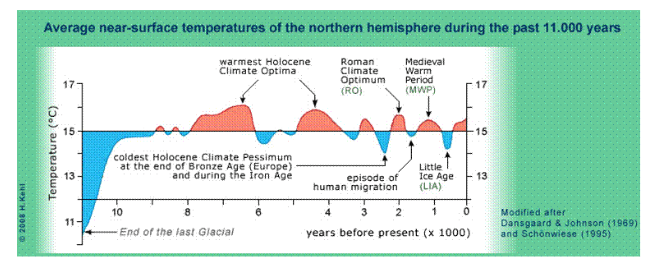
These modern warmings include the previously discussed Holocene Climate Optimum (5000 to 3000 BC); the Minoan Age (2000-1450 BC), the Roman Warming (200 BC to 500 AD); and most recently the Medieval Warm Period (1000-1300 AD).
Contrary to the false claims of the Climate Howlers and in support of Trump’s shit-canning of Barry’s “endangerment finding:”
- Current mildly rising temperatures are in keeping with the historical truth that warmer is better for humanity and most other species, too;
- Continued planetary balances require no interventions whatsoever by the state to retard the use of prosperity-fostering fossil fuels or to subsidize and accelerate the adoption of high cost renewable energy.
Indeed, we think the planet’s climatic resilience is especially evident by the fact that after five major ice ages, warming forces returned with robust energy but that didn’t heat the planet to a Mercury-like boil. Instead, temperatures reversed course toward colder time and again, thereby proving there is no doomsday loop that leads in linear fashion to inexorable catastrophe as is embedded in the climate models.
As we indicated above, regarding the most recent Quaternary era, the last glacier retreat/melting gathered warming steam about 14,000 years ago until it was interrupted by a sudden cooling at about 10000 – 8500 BC known as the aforementioned Younger-Dryas.
The warming resumed, however, by 8500 BC such that by 5000 to 3000 BC average global temperatures reached their maximum level during the Holocene Optimum, clocking in at 1 to 2 degrees Celsius warmer than they are today.
During the Holocene Optimum many of the Earth’s great ancient civilizations began and flourished because conditions were especially hospitable for agriculture and generation of economic surpluses. The Nile River, for instance, had an estimated three times its present volume, indicating its waters were being gathered from a much larger tropical region. In fact, 6,000 years ago the Sahara was far more fertile than today and supported large herds of animals, as evidenced by the Tassili N’Ajjer frescoes of Algeria.
This is yet another proof that warmer and wetter was far better for mankind than prior bouts of cold.
Nevertheless, from 3000 to 2000 BC a renewed cooling trend occurred. The latter caused large drops in sea level and the emergence of many islands (Bahamas) and coastal areas that are still above sea level today (including our home in Miami!).
A shorter warming trend took place from 2000 to 1500 BC, which precipitated a renewal of the Egyptian dynasties and the rise of Minoan civilization, followed once again by colder conditions from 1500 – 750 BC. That caused renewed ice growth in European continental glaciers and alpine glaciers, and a sea level drop of between 2 to 3 meters below present day levels. Incidentally, that period is also known as the dark ages which preceded the flowering of Greek and Roman civilizations.
The period from 750 BC – 800 AD brought a general warming trend and the rise of Greco-Roman civilization. During the final years of the Roman Empire, however, a cooling began which intensified after 600 AD and resulted in a renewed dark age until about 900 AD.
During the 600 – 900 AD Dark Age global average temperatures were significantly colder than today. From writings of the time, we know that at its height the cooling caused the Nile River (829 AD) and the Black Sea (800 – 801 AD)to freeze, neither of which obviously happen today.
Thereafter came the crucial Medieval Warm Period from 1000 – 1300 AD. As shown in the chart below, temperatures were at or above current readings during most of the period, which saw a rejuvenation of economic life, trade, and civilization in Europe.
Indeed, prior to the post-1850 warming, there had been five distinct warming periods (red areas) since the last glacier 18,000 years ago during which temperatures were above current levels. Never, of course, did this chart see the light of day in the mainstream climate change narrative.
Also, during this period the Vikings established settlements on Iceland and Greenland. Long before the industrial era, Greenland was so warm, wet, and fertile that major colonization occurred after 980 AD. At its peak it included upwards of 10,000 settlers, extensive farming, numerous catholic churches, and a parliament that eventually voted for union with Norway.
So, obviously, the Vikings named their settlement not because they were color blind, but because it was hospitable to human settlement.
As another measure of comparison, studies show that the snow line in the Rocky Mountains was about 370 meters above current levels (it was warmer there than today).
Thereafter, the climate trend again reversed in the colder direction. There are ample records from around the world of floods, great droughts, and extreme seasonal climate fluctuations up to the 1400s. Horrendous floods devastated China in 1332 (reported to have killed several million people).
Likewise, by the 14th century the Viking colony was lost to sea ice expansion and the fact that the growing season got ever shorter, thereby undermining the economic viability of these farming settlements. Food eventually got so scarce that the remaining settlers’ last winter turned out to be one of rampant cannibalism as archeologists have documented with respect to the remains of the settlement pictured below.
As the last Viking may have muttered, warmer is better for mankind!
Nor was the reversal from the hospitable climate of the Viking-era settlements in Greenland merely a regional anomaly as some Climate Howlers have claimed. During the Medieval Warm Period great civilizations flourished in many other areas which then became uninhabitable.
For instance, a great drought in the American Southwest occurred between 1276 and 1299. Grand settlements like those in Chaco Canyon and Mesa Verde that were developed during the Medieval Warm Period became abandoned. Tree ring analysis has identified a period of no rain between 1276 and 1299 in these areas as the culprit.
Needless to say, these extreme weather perturbations were not caused by industrial activity because there was none, and they occurred during a period when it was getting colder, not warmer!
From 1550 to 1850 AD global temperatures were at their coldest since the beginning of the Holocene 12,000 years ago. Hence the designation of this period as the Little Ice Age (LIA).
In Europe, glaciers came down the mountains, thereby covering houses and villages in the Swiss Alps, while canals in Holland froze for three months straight–a rare occurrence before or after. Agricultural productivity also dropped significantly, even becoming impossible in parts of northern Europe. The cold winters of the Little Ice Age were famously recorded in Dutch and Flemish paintings such as Hunters in the Snow by Pieter Bruegel (c. 1525-69)
During the period 1580 to 1600, the Western United States also experienced one of its longest and most severe droughts in the last 500 years. Likewise, cold weather in Iceland from 1753 and 1759 caused 25 percent of the population to die from crop failure and famine.
Self-evidently, when the LIA finally ended by 1850 global temperatures were at a modern nadir. No wonder the Climate Howlers started their charts in the middle of the 19th century!
But the significance of this fact goes well beyond deceptively cropping the temperature charts at 1850. Actually, in order to erase the above described oscillations of the modern climate, the climate change advocates have actually gone so far to literally attempt to airbrush them out of existence.
We are referring to what we call the climate Piltdown Mann—named for one Michael Mann, newly-minted PhD in 1998 who became the IPCC’s (International Panel on Climate Change) lead investigator and advocate for what famously became the “hockey stick” proof of global warming.
The latter, of course, was the blatant fraud embedded in the image that Al Gore made famous in his propagandist movie called An Inconvenient Truth in 2006. Suffice to say that the purpose of the hockey stick was to wipe out all of the evidence summarized above.
That is, in lieu of the planet’s long-term and recent severe climate oscillations, the IPCC posited an entirely opposite thesis. Namely, that for the pre-industrial millennium before 1900, global temperatures were nearly flat as a board.
Accordingly, only when the industrial age got a head of steam and reached full force after 1950 did today’s warming temperatures first appear, or so it was alleged. The suggestion, of course, was that an uncontrolled temperature breakout to the upside was well underway and that a planetary disaster was just around the corner.
The only problem is that Mann’s graph was as phony as the Piltdown Man itself—the latter famously being confected in England in 1912 and conveniently “discovered” by an amateur anthropologist who claimed it was the missing link in human evolution. At length, it was shown that the fossil was a forgery; it consisted of a modern human cranium and an orangutan jaw with filed-down teeth.
In this case, professor Mann and his accomplices at the IPCC doctored the evidence, used misleading data from Southwestern US tree rings in lieu of abundant alternative data showing the contrary, and jiggered their computer models to generate pre-specified results.
That is, the models were goal-seeked by Mann and his associates to prove the man-made warming thesis. In essence, it was accomplished by simply pasting modern temperature records showing steady increases on top of a pre-industrial baseline that never happened.
The phony pre-industrial baseline is depicted by the yellow area in the graph for the period 1400-1900. The hockey stick-like eruption of the yellow space after 1900, of course, allegedly depicts the man-made temperature rise since the onset of the hydrocarbon age.
By contrast, the corrected version is in the blue area. In this version—which comports with the history of climate oscillations cited above—there is no hockey stick because the shaft never happened; it was invented by computer model manipulations, not extracted from the abundant scientific data on which the Mann study was allegedly based.
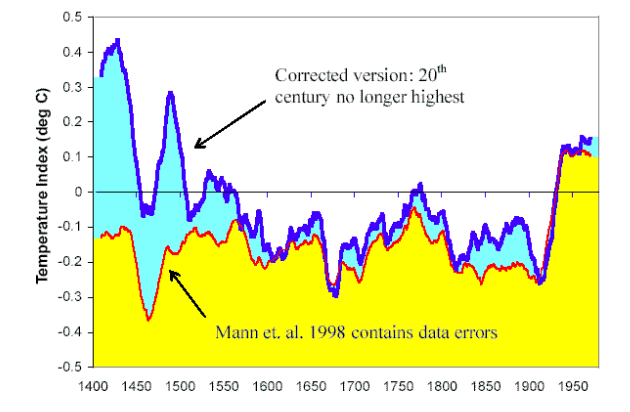
So the question is answered. The mid-19th century is exactly the wrong baseline from which to measure global temperature change during modern times.
The blue area of the chart, in fact, is the smoking gun which obliterates the whole predicate on which the Climate Crisis Hoax is being foisted upon the everyday people of the world.
So, yes, a blind squirrel sometimes makes a life-saving find, and Donald Trump has just made one that will help sustain industrial civilization itself for a long time to come.
Reprinted from David Stockman’s private service
Join the conversation:

Published under a Creative Commons Attribution 4.0 International License
For reprints, please set the canonical link back to the original Brownstone Institute Article and Author.











_-_Google_Art_Project.jpg)