

Hollywood loves a good sequel and so does politics and pharmaceutical development.
Since Covid, there have been several attempted disease scares – Mpox, Swine flu, Bird flu, Chikungunya, Measles – but nothing has really caught the attention of audiences like the new Hantavirus frenzy.
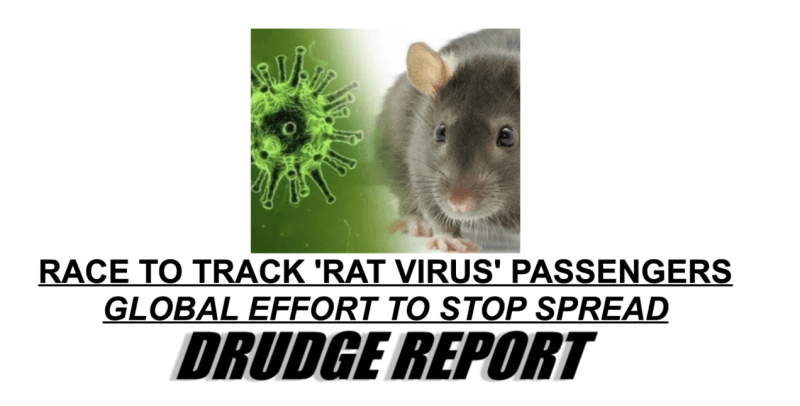
Today’s evidence comes from DRUDGE REPORT: global effort to stop the spread. Is “flatten the curve” next?
Let’s remember how this began last year, with of course, a hantavirus death in the family of one of America’s most beloved Hollywood actors. It was Betsy Arakawa, Gene Hackman’s wife, who died February 12, 2025, from apparent hantavirus infection from rodents in the home. Terrifying image.
At that point, no regular person had ever heard of such a disease. There is a reason. It’s rare and human-to-human spread is nearly unknown. Strange that it would hit the wife of the appropriately named Gene Hackman (get it?), leading man of the prescient 1998 movie Enemy of the State.
Next up we have a reprise of the Plague Ship motif. Like the Diamond Princess, it is a cruise ship, the MV Hondius operated by Oceanwide Expeditions with 147 passengers, departing from Argentina and now anchored off Cape Verde, West Africa.
It was headed to the Canary Islands when three people died, two with lab-confirmed hantavirus. No port would allow the ship to dock. With the assistance of rescue boats, the dead have been carefully removed by workers in hazmats and masks.
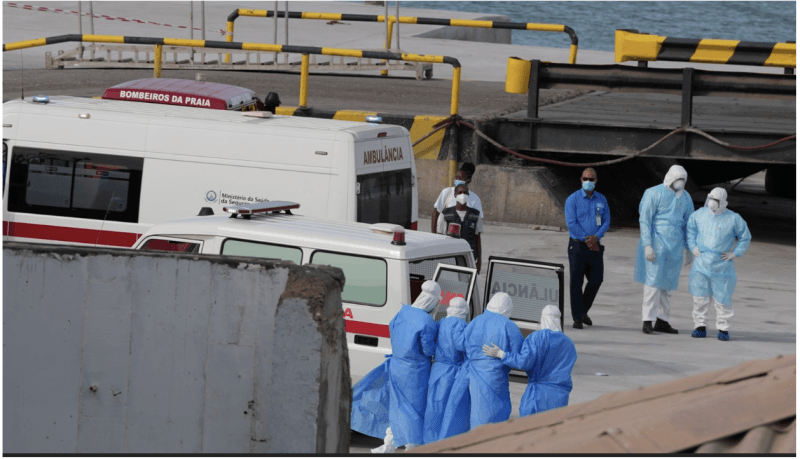
A flight attendant who came in contact with a dead body is now hospitalized and in rough condition, suggesting that even coming close to a person with hantavirus is risky stuff. No one can figure out how this is even possible. So mysterious, so unusual, so terrifying, just like the movie Contagion.
This fits with the theory of Drs. Fauci and Morens that we need not worry about lab-created pathogens when animal-to-human spillover is becoming more common. This is why, they wrote in August 2020, that we must commence to “rebuilding the infrastructures of human existence, from cities to homes to workplaces, to water and sewer systems, to recreational and gatherings venues.”
Ready to opine for the press is the World Health Organization’s Dr. Maria Van Kerkhove, she of Stanford University pedigree, now widely quoted as the go-to authority.
You might remember Dr. Kerkhove from the original cast of the Covid production. It was she who wrote the WHO’s report to the world following the February 2020 junket to Wuhan. (We know this from the metadata of the report, which she failed to cleanse in the rush to publication.)
“Achieving China’s exceptional coverage with and adherence to these containment measures,” she wrote of the CCP’s extreme lockdowns, “has only been possible due to the deep commitment of the Chinese people to collective action in the face of this common threat. At a community level this is reflected in the remarkable solidarity of provinces and cities in support of the most vulnerable populations and communities.”
Many close observers credit Kerkhove’s report with inspiring the worldwide lockdown of all nations but four in the following weeks. She still works at the WHO. Hardly anyone remembers any of this. There is no mechanism in place for her to be held to account for her role.
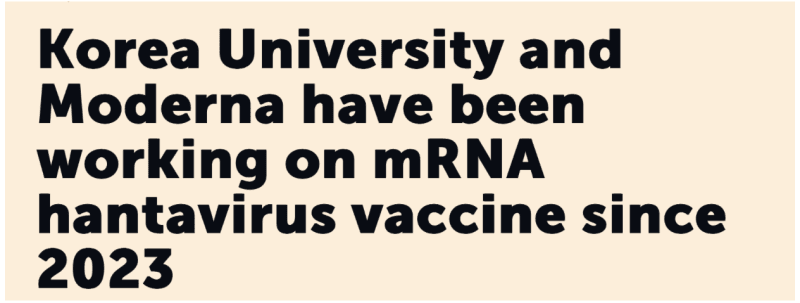
There is no known cure but a vaccine is in development by Moderna based on the mRNA platform.
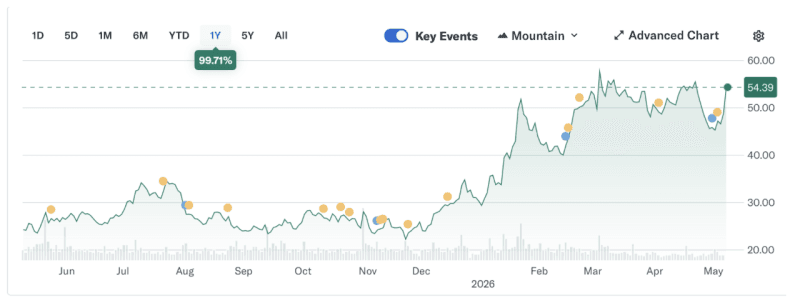
As a result, Moderna’s stock, down dramatically from its highs, is now starting to recover. It is now up 100 percent year over year. The buy signal is strong with this one.
Looking back at the Covid prequel, there was always a flaw in the coronavirus caper, namely its short period of latency, roughly that of a cold or flu. You are infectious for a few days without symptoms while you pass it on. A genuine disease panic needs a longer period of latency. You need to be infected for weeks while spreading it far and wide.
Why is this? Because every infectious disease confronts the logic of survival. A smart virus does not kill its hosts – it needs them to infect others – but a dumb one does, which is why dumb viruses are not good candidates for pandemics.
This persistent trade-off between severity and prevalence can only be gamed by a long period of latency. That’s extremely rare and not even lab-created viruses manage this balancing act well.
As it turns out, this hantavirus does have a very long period of latency, we are assured by the Harvard School of Public Health. It has issued a pronouncement: “The incubation period – the time between when a person is infected and when they begin to experience symptoms – is usually in the range of two to three weeks, but may be as long as eight weeks.”
Two months! Imagine that. Here we might finally have our candidate for the silent killer about which Deborah Birx fantasized during the last iteration of this story.
Keep in mind that no high institution in the US has repudiated lockdowns, even if two-thirds of the public believes they were pointlessly damaging. The call for Covid Justice has now 37,300 signatures but not enough to cause the Senate, House, or any other legislative body to speak clearly that this will never be tolerated again.
To this day, the plan of the World Health Organization – which is already practicing for the next pandemic – is to push for lockdowns until vaccination in the event of a new disease scare. “Every country should apply non-pharmaceutical measures systematically and rigorously at the scale the epidemiological situation requires,” they say.
Meanwhile, the Biden plan was for a 130-day lockdown in the event of a new pandemic.
There are few mechanisms in place in any country to prevent this from happening. There are good people in government who would oppose this with strong conviction but will they even be asked their opinions? Or does this all occur with any obvious evidence of democratic volition?
Who precisely is directing and producing this sequel? No one knows for sure. Will it be a box office hit like the last time or only have a limited release to test market interest? All the ingredients are here for an Academy Award: rodents, long latency, spread through casual contact with the dead, workers in hazmat suits, no known cure, a vaccine in rushed development.
The real beauty of disease panic is that it has broad audience appeal and crosses partisan lines. National Review is all in already, as it was with Covid, and surely The Nation will join the effort in days.
These are well-worn plot devices and sequels are rarely as compelling or profitable as the original. But when one is out of other ideas – and the public clamor to indict Fauci grows by the hour – it’s always worth a shot.
Join the Conversation
Published under a Creative Commons Attribution 4.0 International License
For reprints, please set the canonical link back to the original Brownstone Institute Article and Author.