

I had a very good laugh a while back. A few actually. So many, they are worth sharing.
T’was in May of this year when the storied New England Journal of Medicine published a study about a new and novel influenza vaccine, designed to conquer the seasonal flu. Lucky for us, this new bit of medical innovation was made from the same sort of whizbang mRNA technology that went into the Covid vaccines produced by Pfizer and Moderna.
Yippee. Clearly this new jab is designed for those who didn’t get the joke last time when a big corporation came looking for us carrying a syringe full of what-the-heck-is-that?
But I digress. Even the premise of this vaccine study is like the setup to a stand-up routine, where you know that stuff is going to get weird fast. Soon you find some in the audience are busting a gut as others are looking befuddled and scratching their heads over which the joke flew.
For starters, the biggest warning sign of any study is its size. A big study almost always means a small effect. Yup. In this case, to show some sort of effect they had to cadge together a group of over 40,000 people over 50, randomly injecting them with the trivalent mRNA-1010 or a “different licensed standard-dose flu shot” and following them for about 6 months.
We’re all in the dark about what “mRNA 1010” is but rest assured that this “investigational messenger RNA (mRNA)-based vaccine encodes hemagglutinin glycoproteins from World Health Organization-recommended influenza strains.” That should make everyone start feeling all warm and fuzzy, thanking their lucky stars that the WHO is all over this.
Speaking of which, the backstory of the annual flu campaign, often led by the big infectious disease brains in Geneva, is typically marked by hefty amounts of flu-mongering and vaccine salesmanship. There’s science and there’s marketing but when we’re talking the good old flu, the twain shall never meet.
For the most concise breakdown of the study, we can turn to the good folks at ICAN (the Informed Consent Action Network) who sent a letter to FDA’s Vaccines and Related Biological Products Advisory Committee (VRBPAC) and cut to the chase:
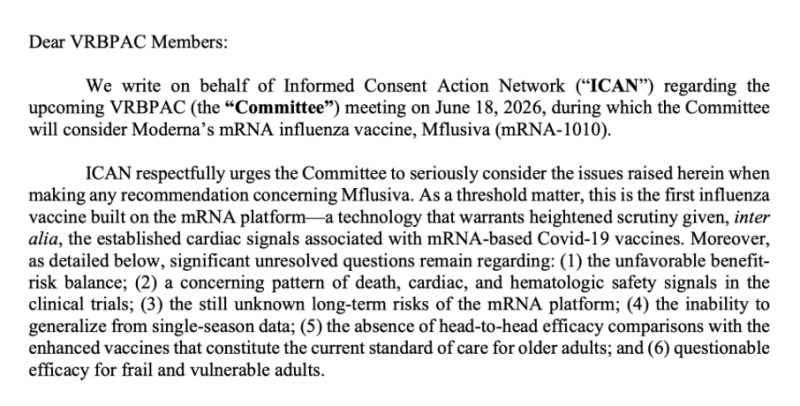
Moderna’s new mRNA flu vaccine, mFlusiva was a joke, especially if you take “the science” behind it seriously.
Of the 40,000 people in this trial, those who got “Mal-flusiva” (do I get bonus points for coining the first nickname for this mRNA miracle?) reduced their absolute influenza risk by 0.8%. That’s right, it might help 8 people out of 1,000. Meanwhile 6.4% of recipients (64 out of 1,000) suffered severe reactions (pain, fatigue, weakness, headaches), at rates which were five times the rate of the standard flu shot.
But did it prevent deaths from the flu?
No, fool. It caused them. In the “Phase 3 Immunogenicity trial” of the new vaccine, five patients died (versus one in the standard shot group). Hard to put lipstick on that one.
What about cardiac risks? Ah, you have a good memory, grasshopper. Events such as fatal cardiac arrest and congestive cardiac failure—similar to what was documented in the Covid mRNA vaccine technology– was also a feature here.
What about cancer? Also, good catch. As to that issue, ICAN blithely noted the “growing body of peer-reviewed scientific literature that identifies potential biologically plausible oncogenic or tumor-promoting mechanisms and purported preliminary population-level cancer signals.” A little verbose, but ICAN’s suggestion is sound. Let me translate its substance: “Wouldn’t it be better to find out if these vaccines cause cancer before injecting them into everyone, instead of after?”
Oh Prudence, you’re such a stickler. Doing so would kill this new vaccine in its tracks so the committee, predictably, shot Prudence in the foot. Clearly these “peripheral” issues identified by ICAN can be dealt with after it gets on the market and used by everyone. Funny indeed.
Here’s the penultimate laugh: we tend to push flu vaccines on the older population, and residents of long-term care facilities because the risk of a flu spiraling into a fatal pneumonia is higher than normal. However, the vaccine’s effects among the frail and vulnerable over-65 population was not statistically significant. Basically: Malflusiva has been proven not to work among the population most needing it.
You can’t make this stuff up. Truth is stranger, and weirder, than fiction.
And here’s the last laugh. Given all the bad news of a huge, well-controlled study of this vaccine, the committee decided to give it the thumbs down and refused Moderna a license to market this vaccine in America. Wow, didn’t see that coming.
Nah. Just kidding. The committee gave fulsome lip service to the vaccine’s many drawbacks but approved it anyway. And the US federal government is going to shell out over a billion of your tax dollars so that we can offer it to every older person in America. We can study for any safety or efficacy outcomes later, because, well, that’s the American Way.
Cue the sound of Wheeking guinea pigs. According to PetMD.com, guinea pigs make a variety of expressive sounds, including a signature high-pitched whistle called a “wheek.” They are highly vocal animals, and their noises change depending on their mood and what they are trying to communicate.
The most infuriating part of the VRBPAC meeting was that the members actually acknowledged and discussed some of these concerns, but instead of postponing its recommendation, the committee simply recommended further studies be done after malflusiva’s approval.
Meaning, America’s most vulnerable seniors will once again be used as guinea pigs while the FDA takes years to figure out if the vaccine is actually harming people.
This publication was incredibly funny in a cringy kind of way. It’s like that older uncle, known for his politically-incorrect language and his effusive, swashbuckling storytelling where he’s relaying something particularly odiferous. You can’t help but laugh out loud but you equally can’t tell him to stop because you want to hear the punchline.
Wheeking indeed.
Join the Conversation
Published under a Creative Commons Attribution 4.0 International License
For reprints, please set the canonical link back to the original Brownstone Institute Article and Author.