

Many people want to be done with Covid lockdowns as a topic. The trouble is that Covid lockdowns are not done with us. Nothing like this had ever been tried in real life, a forced stoppage of most human activity as it affects the material and social world. The impact would be far reaching, long lasting, and devastation – one of the more significant calamities of modern times.
Prevailing economic weakness and resulting stagnation for living standards is only one result. It’s nowhere near over.
The Friday, March 6, 2026, jobs report from the Bureau of Labor Statistics was far more grim than anyone expected. Employers shed 92,000 positions for the month as the unemployment rate ticked slightly higher to 4.4 percent. December and January jobs growth was revised down by 69,000.
The more alarming fact (which you can peruse at B-1) is that these losses were unconstrained.
In addition to health-sector sector losses, we have:
- Leisure and hospitality: Down 27,000 jobs, including accommodation and food services down 34,700, indicating ongoing weakness or contraction in consumer-facing services.
- Transportation and warehousing: Down 11,300 jobs, with couriers and messengers seeing a steep drop of 16,600.
- Information sector: Down 11,000 jobs, including movies and sound recording industries down 9,500.
- Administrative and support services (within professional and business services): Down 14,300 jobs, signaling problems in business support.
- Manufacturing: Down 12,000 jobs (with nondurable goods down 8,000).
- Construction: Down 11,000 jobs.
None of these sectors had fully recovered from the body blow of 2020, as small businesses were forcibly shut and large businesses shot up their employees with an experimental potion. All enterprises have struggled ever since. But with high tariffs and soaring costs of health insurance hitting in 2025, it was just too much.
There’s nothing to be gained by blaming AI. These are not jobs AI can do. Labor costs eat into profitability so maintaining it requires offloading as much as possible to deal with hard times.
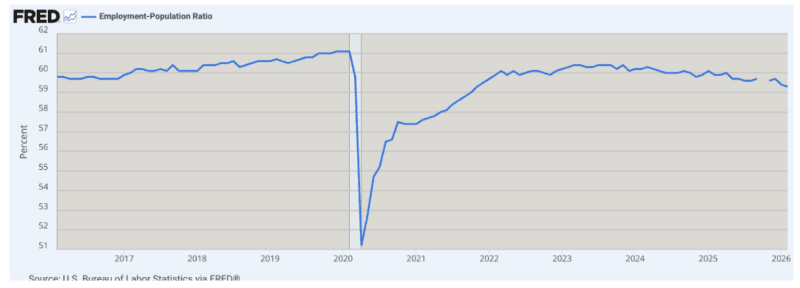
More revealing are the numbers of employment/population ratios. They were dealt a huge hit with lockdowns, obviously, and have not regained their strength going from 2019. It amounts to a permanent downshift. Every time we see gains here, the gravity of the economic environment pushes them down again.
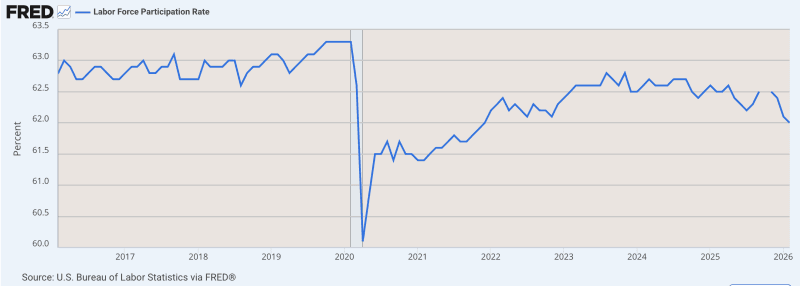
The chart itself makes for a salient picture, a huge gash into labor markets, resulting in many permanently sidelined and many having left the labor force permanently. You cannot just “close the economy” without long-lasting consequences.
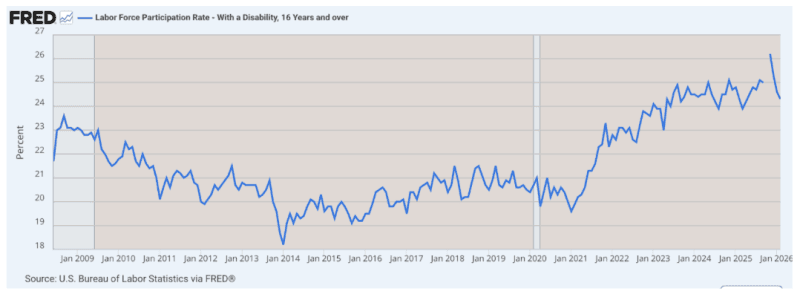
Among many existing workers, we’ve seen an explosion of people listed as disabled. You might think this is partially due to increased benefit offerings and probably some degree of fraud. But you might also consider that vaccine injury is far more extensive than people know, amounting to millions of people who have been physically harmed by the shots distributed to prevent against a virus that everyone contracted anyway.
There is no way the truth about these injuries can be permanently suppressed.
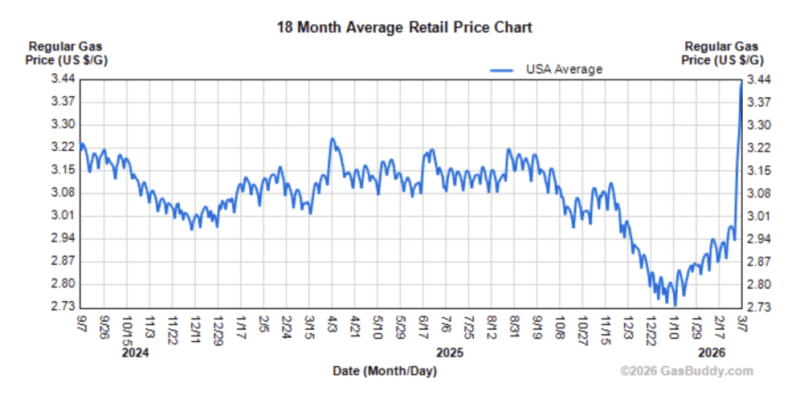
The higher gas prices are in the news and the obvious culprit is the war on Iran which has disturbed shipments through the Strait of Hormuz. But there is another factor here rarely mentioned. Refining capacity in the US never recovered from lockdowns. Before, the previous peak was 19M barrels per calendar day. That dropped in 2021 to 18.1M and further to 17.9M in 2022. We are still 0.5-0.6 million below the pre-lockdown peak, meaning that any disruption was destined to have a big effect on oil prices and prices at the pump.
That disruption came with the Iran war. As for the Strategic Petroleum Reserve, that was already tapped out during the last lockdown-driven and inflation-induced price spike. The low prices of 2025 could not last with any stress on production structures.
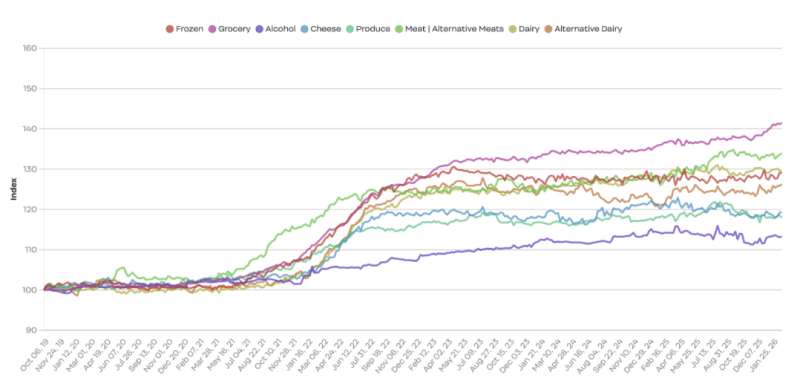
And speaking of inflation, that lockdown-triggered money flood from 2020-2023 ended up taking a 30-40% bite out of the dollar’s purchasing power, causing a flattening of wages and salaries in real terms, even as housing prices skyrocketed far beyond middle-class affordability. Groceries never came back to being affordable again.
Manufacturing was devastated during the Covid years with global supply-chain disruptions. Trump came to office a second time determined to fix this but chose the blunt instrument of tariffs which are higher now than in a century. The effect of these has not been to lower the trade deficit but rather increase it (the opposite of what was supposed to happen), even as manufacturing employment continues to fall.
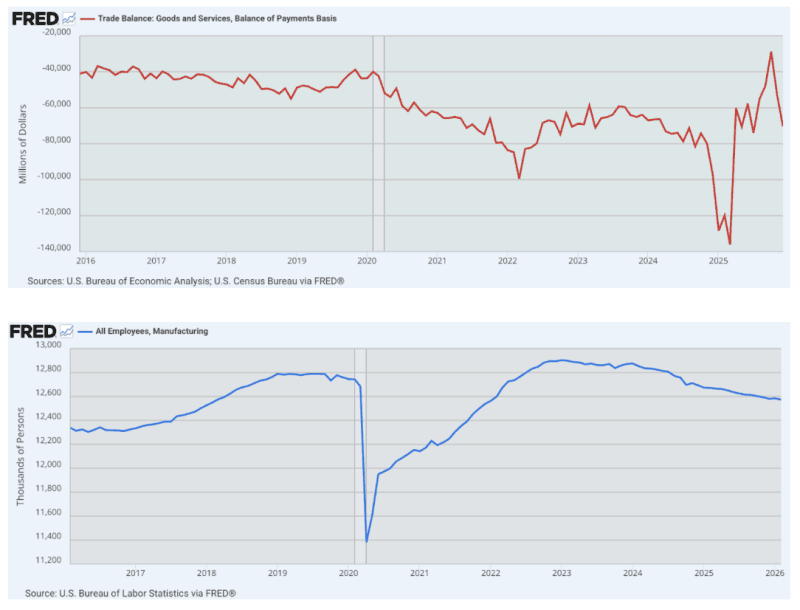
At this point, there is no evidence that this strategy has worked in any sense, except to raise money for the federal government and provoke a Supreme Court decision that essentially restates what is already in the US Constitution. One wishes the Court would do that more often.
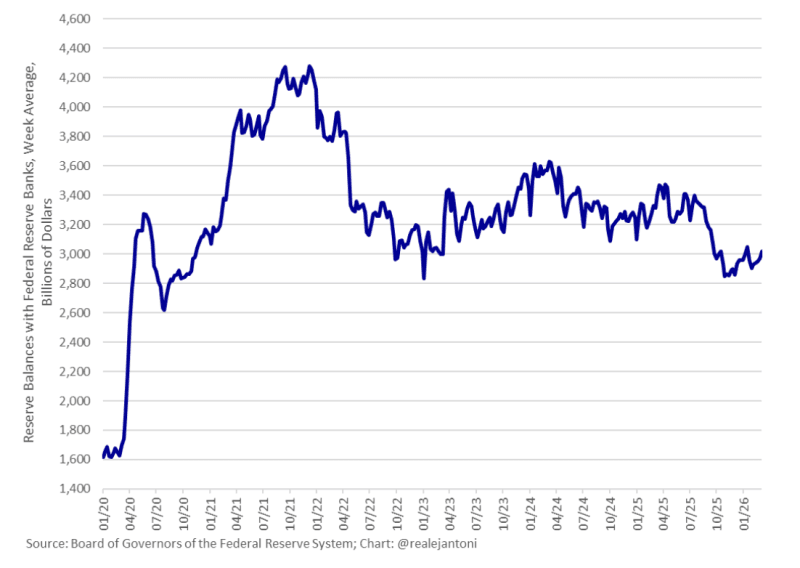
Back to the Federal Reserve, EJ Antoni documents how the Fed was working to fix its balance sheet before the quantitative easing of the Covid years. It was on track to offload all its mortgage-backed security products but that progress was interrupted. Even now, the Fed’s balance sheet is a disaster to the point that the Fed is paying out $300 million in interest daily, mostly to foreign financial firms and central banks.
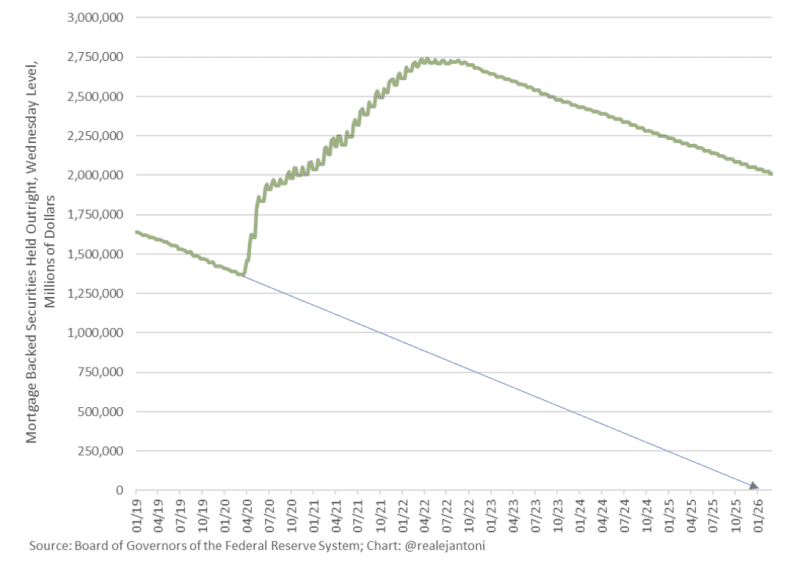
Fed printing and borrowing had already broken all records and now will get worse to finance the war.
Other indicators of economic health provide only illusory gains. Once adjusted for the devastating inflation, they largely vanish. So it is with retail sales, which were rising in real terms before lockdowns, jumped up with stimulus cash, but have stayed flat in the post-lockdown period.
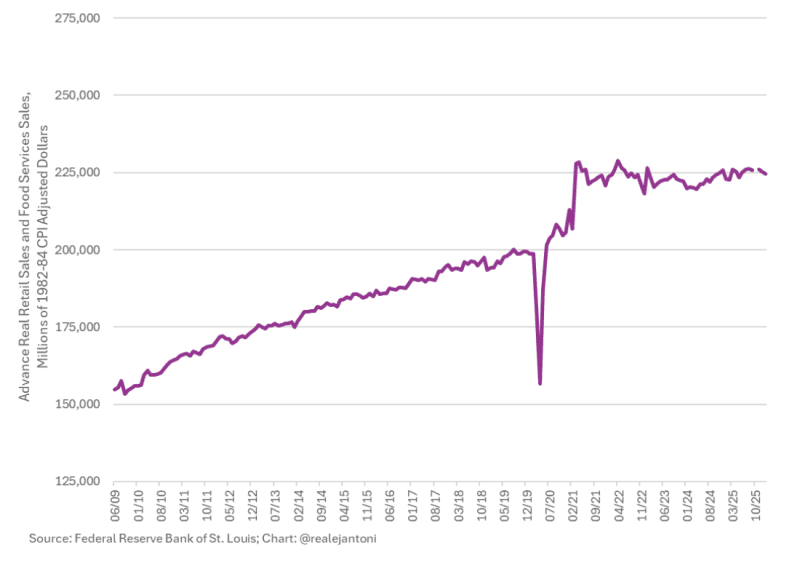
One of the strangest features of the lockdown is how crazy, cockamamie, convoluted data reports, on and off again – all of which were distorted by $10 trillion in stimulus and money creation – caused business-cycle tracking to become nearly impossible. Trends of a century or more became mired in a mess of countervailing forces such that it became nearly impossible to know what was a downturn and what was recovery.
The jobs report from this past week had the word recession all over it but we do not and cannot know for sure, or even if we ever truly left recession from 2020 at least in any sustainable way. We are still digging our way out of this, only to get hit because of health-insurance shocks, import taxes, and more supply-chain disruptions stemming from war.
This is only a brief look at some economic indicators and they all point to the great turning point of the lockdowns as a blow to functioning on a level not experienced in living memory. This does not even touch on the educational, cultural, and social damage of this period, all of which is existential.
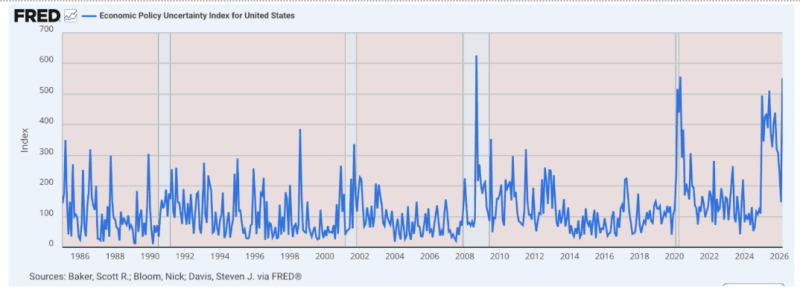
Features of our times look not only like the prolongation of the lockdowns but actually analogous, almost like they never go away. Hence the Economic Uncertainty Index which parallels 2020 and 2008.
There’s never been a better time to sign the resolution at CovidJustice.org. There is every intention on the part of high-level elites to try lockdowns again under some other excuse. They can and likely will, whether for infectious disease or some other justification.
Avert not your eyes: life for civilized people entered into a period of barbarism from which we’ve yet to emerge.
Join the conversation:

Published under a Creative Commons Attribution 4.0 International License
For reprints, please set the canonical link back to the original Brownstone Institute Article and Author.