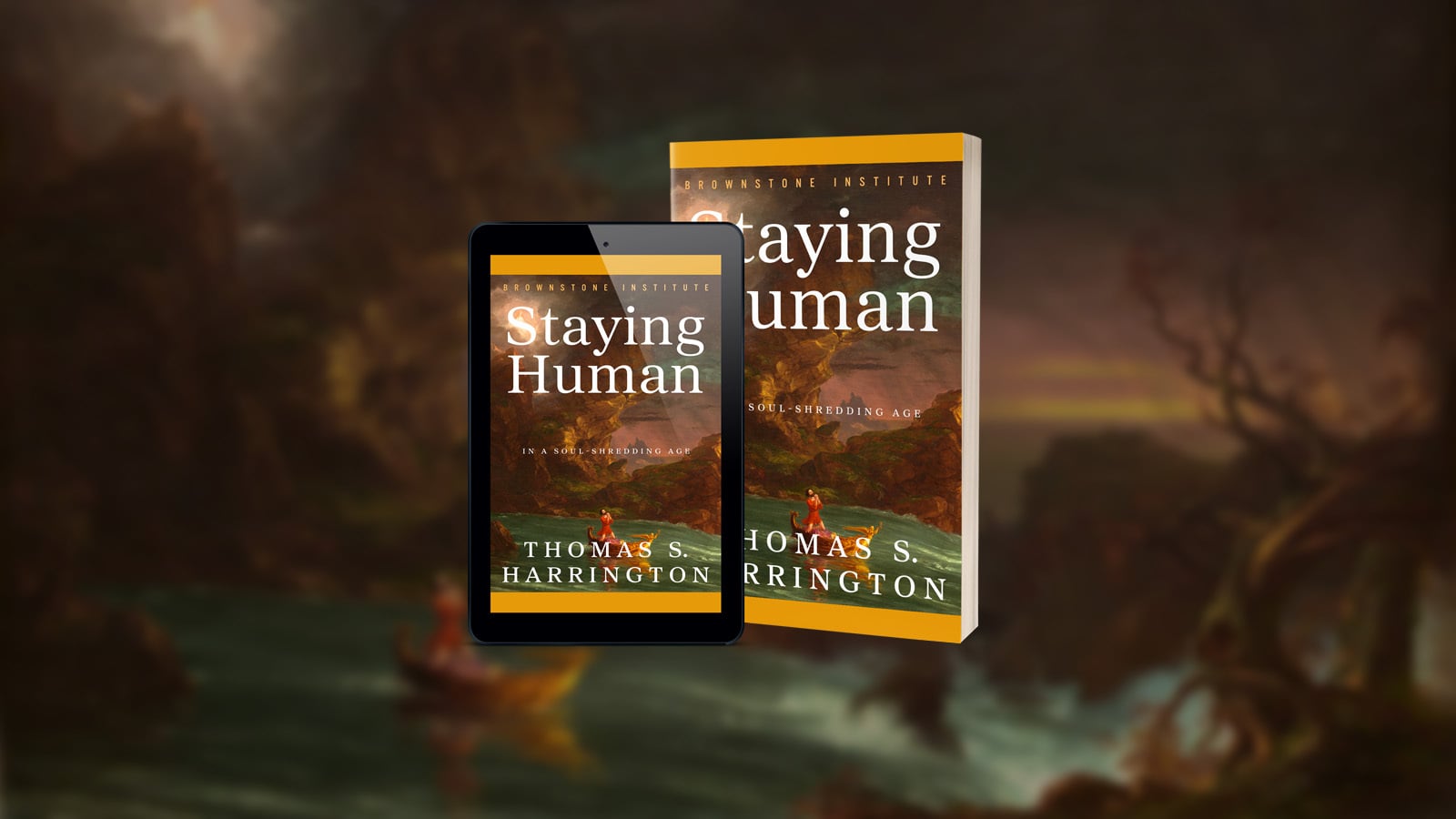

[The following is the Introduction to Thomas Harrington’s book, Staying Human: In a Soul-Shredding Age.]
It began spontaneously on an unusually warm day in the Fall of 2021 when, after exchanging the generally muted pleasantries in the way one does in such situations, I locked onto the tired visage of the overheated and masked woman behind the supermarket check-out counter and asked, “Are you staying human?”
Suddenly her previously somnolent eyes became focused, indicating a desire to confirm that she had heard me right, a signal to which I responded with a soft restatement of the initial query.
Given the chance to step out of her assigned role as a human automaton, viewed by the executives of company that pays her as a more costly and less reliable version of the bank of self-service scanners 15 feet away from where we stood, she confessed demurely that staying human was “really hard” for her these days.
But seconds later her face lit up as she told me about her three babies at home and the classes she was taking fulltime at night to get her LPN degree. When I expressed amazement at her ability to manage all she had on her plate, she shot me a smile that was an equal mix of determination and resignation and said, “What are you going to do? You just got to keep your head up, right?”
She wanted to continue, but after seeing the impatient looks on the faces of the customers behind me, she knew our little tête-a-tête needed to end. She understood all too well that she was there not to cultivate human warmth, affection, or even humor, but to swiftly and accurately register the store’s revenue flows. And so I grabbed my bags and, turning round once more to face her and say thanks, headed for the door.
I have continued to ask the same simple question intermittently and in various social settings since then. At times I am met with blank stares, and occasionally outright hostility. But more often than not people are delighted, and in many cases clearly relieved to have been approached in this way, reactions that, in turn, tell me that much is amiss in the ways we are currently conducting our daily lives.
For most of my life, it would have never occurred to me to conjure up such a question, never mind serially pose it to others. Being human was for me, and I suspect for many others fortunate to grow up in the glow of the US postwar prosperity, a highly stable category, different in its particular qualities but akin in its ontological stability to things like trees, rocks, or dogs.
But the happenings of the last six years have conspired to expel me from that zone of conceptual complacency. I am now increasingly convinced that becoming and staying human is not, as I once believed, a simple matter of remaining alive, but the fruit of an intense and highly self-conscious effort to align ourselves, as Lincoln famously said, with “the better angels of our nature.”
To believe in angels, even metaphorical ones, is to admit that there are forces in our lives that transcend the scope of our tools of rational analysis, and that we are, in some mysterious way, subject to their powers. It is also to suggest, moreover, that there are mental concepts, such as love, beauty, and dignity, that, while impossible to fully capture, explain, or quantify, are absolutely central to human flourishing.
The idea that every human is condemned to hosting a perpetual struggle between their material and ethereal selves is, of course, not new. What is relatively new is the belief that such a struggle need not exist because, as that great scholar of metaphysics, the singer Madonna, announced to us back in 1984, “We are living in a material world” where anything worth having or knowing can be apprehended through the senses of hearing, sight, and touch.
To accept that we are and always have been mere seekers of material comfort and gain is to erase the aspiration that we humans can be something different and better than the predatory animals with which we have long shared the planet, or that we hold within ourselves the ability to heal others, to fix what is broken, and to create beauty where only ugliness and desolation were previously known.
And perhaps most ominously it is to play into the hands of the small group of people who, having become fabulously wealthy and powerful, have come to see their often-ill-gotten riches as a sign of their “right” to control the destinies of the vast majority of the world’s population.
The key to the success of large predators, be they human or animal, is to force their chosen prey to agree to terms of engagement that play to their own particular strengths and gifts. A lion and a monkey have very different approaches to survival and hence feel comfortable and in control in very different physical settings. The lion thus naturally seeks to draw the monkey out of the trees where he is safe and onto the plain where the lion is truly king. The wise monkey will avoid the temptation to become denatured in this dangerous way.
And so, it is in the dynamic between the predator class of our own species and the vast majority of human beings.
They know that we are at our best and most impervious to their entreaties to enter the lawless jungle they have built to exploit their own “gifts” of ruthlessness when we have time and space to reflect upon the wonderfully absurd mysteries of being alive, of experiencing love, of gazing upon word-stealing beauty, and of feeling intense gratitude for the gifts of devotion and sacrifice bestowed on us by those who have gone before us.
But dazzled by their self-produced fables of elegance, ease, and glory and the accompanying lie that this supposed life of glitter and fame was available to all that truly wanted to achieve it, we began to cede to their predatory logic, coming down, as it were, from our “trees” of moral and spiritual safety and into the lawless plain where the odds of achieving dominance are perpetually stacked in their favor.
We then compounded this error by acritically opening our homes, and through our naively lax oversight of the electronic devices they foisted upon us a condition for existing as social beings, our children’s minds to an exponential explosion of conscience-numbing propaganda.
While the first phase of this mental onslaught was, as mentioned, anchored in the practices of bedazzlement, the second, which we are now living through, is rooted in the semiotics of disorientation and debasement; that is, of hammering home the belief that the most humans have been or can ever hope to be are crude, reflectionless, and historyless seekers of wealth and ephemeral sensations.
Why?
Because elite culture-planners know that in a confrontation between an impoverished and presently-imprisoned population and a fabulously wealthy elite with powerful propaganda tools at their disposal, the wealthy claque will win 99 times out of a hundred.
And it is clear that they believe that if they can just maintain their current regime of information management for a decade or so more, until most of those born and raised with a consciousness of existing within a glorious concatenation of cultural persistence die off, they will finally be able to achieve what elements of the US government openly and shamelessly refer as “cognitive security;” that is, the ability to insure that most members of the citizenry not even entertain or harbor any ideas that have the potential to contravene the strategic plans that the government and its chosen corporate partners have regarding the governance (read: control) of the citizenry.
To put it bluntly, they see us as trainable animals and believe that they are only a few technological tweaks away from getting most of us to also see ourselves in this same way.
So, what is to be done? As someone grew up immersed in the “You can do it if you try” culture of late 20th and early 21st century America, I know that my implied narrative task at this point is to provide a succinct action plan for getting us out of the mess in which we find ourselves.
But that’s not going to happen, not because I lack relevant ideas, but because to do so would be to reify the notion, deeply ingrained within current Western culture, that most of the social problems we face today are legislative, technological, or organizational in nature.
While the problems we face are undoubtedly inflected by these three modes of thought, they are primarily spiritual, psychological, and volitional in nature. And like all productive speculations in these realms, they must be undergirded with a desire to look unflinchingly at our past, especially the legacy of modernity which has been the invisible driving force of Western culture for the last five centuries.
What began as a movement to exalt the long under-recognized sparks of creative divinity present in each human being, enhancing in this way our appreciation of the transcendent forces from which they spring, has morphed in time into a forced adoration of the narrowly constituted capabilities of what Iain McGilchrist has called the once subsidiary “getting and grabbing” left part of our brains.
Subsidiary to what you ask?
To what McGilchrist describes as the holistic, integrative, and thus meaning-making right-brained “master” of our ontology.
You know, the part of our being to which I opened both myself and my tired and masked interlocutor when, in the midst of the ever more grimly algorithmic and dehumanized routine of human commerce, I dared to inquire ever so minimally about the part of her that imagines, hopes, dreams, and loves.
When we ponder the use of the word flight today, we moderns generally fixate on its associations with liberation in the sense of getting past or beyond something, such as gravity, or an unfortunate circumstance that is perceived as hindering us or holding us back from achieving or possessing something we desire or need. And it is certainly not wrong to do so.
What we often fail to acknowledge is the term’s simultaneous relationship to the verb “to flee,” which is generally used to describe the process of running away from something we find threatening, difficult, or troubling.
I recently learned that the word human shares an intimate etymological kinship with the word humus, the organic matter in soils that makes possible the cultivation of nutritional food, a life-giving secret sauce that, paradoxically, comes into being through the death and decomposition of previously living things.
Our civilizational forebears clearly understood that we could only remain human were we to retain our links to the soil and its continuous cycles of death and renewal which, though our present-day culture seeks to conceal it, mirror those of the human condition.
Philosophers and theologians have long known that feeling cleaved by a desire to escape mortality on one hand, and having the humility (yes, it too is derived from term humus) that comes from knowing that death is inevitable on the other, is central to the condition of being and remaining human.
But today we have a predator class telling us that if we just hand over our power and our agency to them and their all-knowing technologies, we will be able to escape this contradiction-laden crucible of passions in which all those who came before us struggled, and will experience a perpetual and linear ascent of life betterment for all.
Do you believe them? Do you believe that the profoundly cyclical nature of a universe whose point of origin remains entirely inexplicable to even the greatest minds among us will, under their generally self-involved and wonder-deprived tutelage, lead us to the achievement of the type of price-resistant dignity we all covet on one level or another?
I don’t for a moment.
No, I see their plans to inventory, track, and control all living and non-living elements of the earth as an updated version of what Tacitus, speaking through the personage of the Caledonian warrior Calgacus, called imperial Rome’s habit of “creating a desert and calling it peace.”
No, I won’t be willingly commending my life energies into their hands any time soon.
I plan, rather, to spend my remaining days rooting around in the humus of the daily in the hope of coming to better recognize and embrace its abundant stores of beauty, connection, loyalty, and love.
Care to traipse along with me on this journey?
Join the Conversation
Published under a Creative Commons Attribution 4.0 International License
For reprints, please set the canonical link back to the original Brownstone Institute Article and Author.