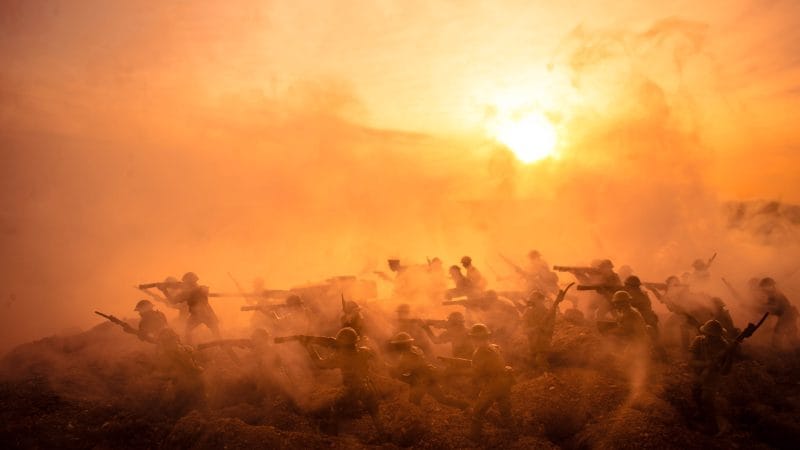

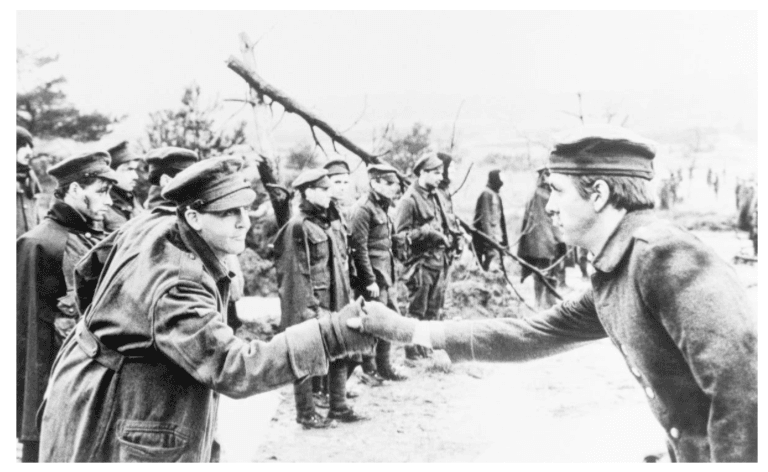
A few months after the horrendous slaughter of World War I had been unleashed by the “guns of August 1914,” soldiers along the Western Front famously broke into spontaneous truces of Christmas celebration, song, and even exchange of gifts.
For a brief moment they wondered why they were juxtaposed in lethal combat along the jaws of hell. As Will Griggs once described it,
A sudden cold snap had left the battlefield frozen, which was actually a relief for troops wallowing in sodden mire. Along the Front, troops extracted themselves from their trenches and dugouts, approaching each other warily, and then eagerly, across No Man’s Land. Greetings and handshakes were exchanged, as were gifts scavenged from care packages sent from home. German souvenirs that ordinarily would have been obtained only through bloodshed – such as spiked pickelhaube helmets, or Gott mit uns belt buckles – were bartered for similar British trinkets. Carols were sung in German, English, and French. A few photographs were taken of British and German officers standing alongside each other, unarmed, in No Man’s Land.
The truth is, there was no good reason for the Great War. The world had stumbled into war based on false narratives and the institutional imperatives of military mobilization plans, alliances, and treaties arrayed into a doomsday machine and petty short-term diplomatic maneuvers and political calculus. Yet it took more than three-quarters of a century until the end of the Cold War in 1991 and disappearance of the Soviet Empire into the dustbin of history for all the consequential impacts and evils to be purged from the life of the planet.
The peace that was lost last time has not been regained this time, however. And for the same reasons.
So those reasons and culprits need to be named once again—just as historians can readily name the culprits from 111 years ago.
The latter include the German general staff’s plan for a lightning mobilization and strike on the Western Front called the Schlieffen Plan; the incompetence and intrigue in the court at St. Petersburg; the lifelong obsession of Austrian chief of staff Franz Conrad von Hotzendorf with the conquest of Serbia; French President Raymond Poincare’s anti-German irredentism owing to the 1871 loss of his home province, Alsace-Lorraine; and the bloodthirsty cabal around Winston Churchill, who forced England into an unnecessary war, among countless others.
Since these casus belli of 1914 were criminally trivial in light of all that metastasized thereafter, it might do well to name the institutions and false narratives that block the return of peace today. The fact is, these impediments are even more contemptible than the forces that crushed the Christmas truces one century ago.
Imperial Washington—The New Global Menace
There is no peace on earth today for reasons mainly rooted in Imperial Washington—not Moscow, Beijing, Tehran, Damascus, Beirut, or the rubble of what remains of the Donbas. Imperial Washington has become a global menace owing to what didn’t happen in 1991.
At that crucial inflection point, Bush the Elder should have declared “mission accomplished” and parachuted into the great Ramstein air base in Germany to begin the demobilization of America’s vast war machine.
So doing, he could have slashed the Pentagon budget from $600 billion to $300 billion (2015 $); demobilized the military-industrial complex by putting a moratorium on all new weapons development, procurement, and export sales; dissolved NATO and dismantled the far-flung network of US military bases; reduced the United States’ standing armed forces from 1.5 million to a few hundred thousand; and organized and led a world-disarmament and peace campaign, as did his Republican predecessors during the 1920s.
Unfortunately, George H. W. Bush was not a man of peace, vision, or even middling intelligence.
To the contrary, he was the malleable tool of the War Party, and it was he who single-handedly blew the peace when, in the very year the 77-Years War ended with the demise of the Soviet Union, he plunged America into a petty argument between the impetuous dictator of Iraq and the gluttonous emir of Kuwait. But that argument was none of George Bush’s or America’s business.
By contrast, even though liberal historians have reviled Warren G. Harding as some kind of dummkopf politician from the hinterland of Ohio, he well understood that the Great War had been for naught, and that to ensure it never happened again the nations of the world needed to rid themselves of their huge navies and standing armies.
To that end, he achieved the largest global-disarmament agreement ever during the Washington Naval Conference of 1921, which halted the construction of new battleships for more than a decade (which incidentally the true dummkopf in the Oval Office now wants to revive). And even then, the moratorium ended only because the vengeful victors at Versailles never ceased exacting their revenge on Germany.
And while he was at it, President Harding also pardoned Eugene Debs. In so doing, he gave witness to the truth that the intrepid socialist candidate for president and vehement antiwar protestor, who Woodrow Wilson had thrown in prison for exercising his First Amendment right to speak against US entry into a pointless European war, had been right all along.
In short, Warren G. Harding knew the war was over and the folly of Wilson’s 1917 plunge into Europe’s bloodbath should not be repeated. At all hazards.
But not George H. W. Bush. The man should never be forgiven for enabling the likes of Dick Cheney, Paul Wolfowitz, Robert Gates, and their neocon pack of jackals to come to power—even if he eventually denounced them in his doddering old age.
Alas, upon his death, Bush the Elder was deified, not vilified as he deserved, by the mainstream press and the bipartisan Uniparty. And that tells you all you need to know about why Washington is ensnared in its Forever Wars and is the very reason why there is still no peace on earth.
Even more to the point, by opting not for peace but for war and oil in the Persian Gulf in 1991 Washington opened the gates to an unnecessary confrontation with Islam and nurtured the rise of jihadist terrorism that would not haunt the world today save for forces unleashed by George H. W. Bush’s petulant quarrel with Saddam Hussein.
We will momentarily get to the 52-year-old error that holds that the Persian Gulf is an American Lake and that the answer to high oil prices and energy security is the Fifth Fleet.
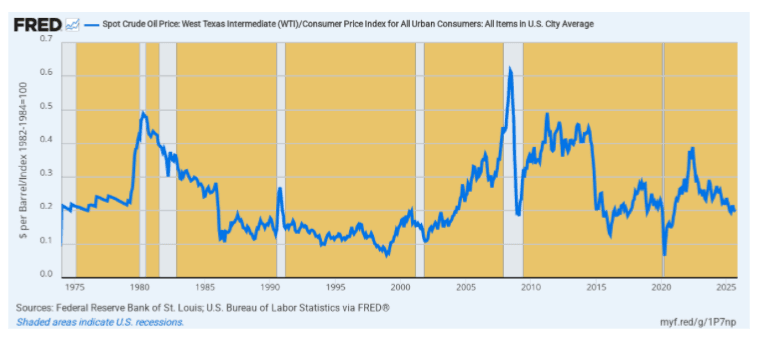
Suffice it to say here that the correct answer to high oil prices everywhere and always is high oil prices. This truth was driven home in spades by the oil busts of 2009, 2015, and 2020, and the fact the real price of oil today (2025 $) is no higher than it was in the mid-1970s.
But first it is well to remember that in 1991 there was no plausible threat anywhere on the planet to the safety and security of the citizens of Springfield, MA, Lincoln, NE, or Spokane, WA when the Cold War ended.
The Warsaw Pact had dissolved into more than a dozen woebegone sovereign statelets; the Soviet Union was now unscrambled into 15 independent and far-flung republics from Belarus to Tajikistan; and the Russian motherland would soon plunge into an economic depression that would temporarily leave it with a GDP about the size of the Philadelphia SMSA.
Likewise, China’s GDP in 1991 was even smaller and more primitive than Russia’s. Even as Mr. Deng was discovering the People’s Bank of China’s printing press, which would enable it to become a great mercantilist exporter, an incipient Chinese threat to national security was never in the cards.
After all, it was the 4,000 Walmarts in America upon which the prosperity of the new Red Capitalism inextricably depended and upon which the rule of the Communist oligarchs in Beijing was ultimately anchored. Even the hardliners among them could see that in swapping militarism for mercantilism and after invading America with tennis shoes, neckties, home textiles, and electronics—that the door had been closed to any other kind of invasion thereafter
So, yet another Christmas is here and there is still no peace on earth. And the proximate cause of that vexing reality remains the $1.3 trillion Warfare State planted on the banks of the Potomac—along with its web of warmaking capabilities, bases, alliances, and vassals stretching to the four corners of the planet.
So positioned, it stands in stark mockery of John Quincy Adams’s sage advice to his new nation 200 years ago:
Wherever the standard of freedom and Independence has been or shall be unfurled, there will her heart, her benedictions and her prayers be.
But she goes not abroad, in search of monsters to destroy.
She is the well-wisher to the freedom and independence of all.
She is the champion and vindicator only of her own.
She will commend the general cause by the countenance of her voice, and the benignant sympathy of her example.
She well knows that by once enlisting under other banners than her own, were they even the banners of foreign independence, she would involve herself beyond the power of extrication, in all the wars of interest and intrigue, of individual avarice, envy, and ambition, which assume the colors and usurp the standard of freedom.
The last bolded sentence pretty much sums up the foolish, destructive, unnecessary, and fiscally calamitous Forever Wars hatched in Washington all the way back to 1950.
Nearly without exception they were waged against alleged foreign “monsters” of the very kind which John Quincy Adams urged his countrymen not to pursue: Kim Il-Sung, Mohammad Mosaddegh, Fidel Castro, Patrice Lumumba, Ho Chi Minh, Sukarno, Salvador Allende, Ayatollah Khomeini, Daniel Ortega, Saddam Hussein, Muammar Gaddafi, Bashar al-Assad, Nicolas Maduro, Xi Jinping, and Vladimir Putin are but the most prominent among these targets of Washington’s relentless global-spanning search for “monsters to destroy.”
Yet without exception not one of these assorted authoritarians, dictators, tyrants, thugs, and revolutionists, along with the nations they ruled, posed a direct threat to the American homeland. Not even Putin or Xi could actually dream of mounting the massive armada of land, air and sea forces needed to transit the great ocean moats and lay waste to the security and liberty of 340 million Americans domiciled from “sea to shining sea.”
In the first place, this is the nuclear age but there is currently no nation on earth that has anything close to the First Strike force that would be needed to totally overwhelm America’s triad nuclear deterrent and thereby avoid a retaliatory annihilation of its own country and people if it attempted to strike first. After all, the US has 3,700 active nuclear warheads, of which about 1,800 are operational at any point in time. In turn, these are spread under the seven seas, in hardened silos and among a bomber fleet of 66 B-2 and B-52s—all beyond the detection or reach of any other nuclear power.
For instance, the Ohio class nuclear submarines each have 20 missile tubes, with each missile carrying an average of four-to-five warheads. That’s 90 independently targetable warheads per boat. At any given time 12 of the 14 Ohio class nuclear subs are actively deployed, and spread around the oceans of the planet within a firing range of 4,000 miles.
So at the point of attack that’s 1,080 deep-sea nuclear warheads stealthily cruising along the ocean bottoms that would need to be identified, located, and neutralized before any would-be nuclear attacker or blackmailer even gets started. Indeed, with respect to the “Where’s Waldo?” aspect of it, the sea-based nuclear force alone is a powerful guarantor of America’s homeland security. Even Russia’s vaunted hypersonic missiles couldn’t find or take out by surprise the US sea-based deterrent.
And then there are the roughly 300 nukes aboard the 66 strategic bombers, which also are not sitting on a single airfield Pearl Harbor-style waiting to be obliterated either, but are constantly rotating in the air and on the move. Likewise, the 400 Minutemen III missiles are spread out in extremely hardened silos deep underground across a broad swath of the upper Midwest. Each missile currently carries one nuclear warhead in compliance with the Start Treaty but could be MIRV’d in response to a severe threat, thereby further compounding and complicating an adversary’s First Strike calculus.
Needless to say, there is no way, shape or form that America’s nuclear deterrent can be neutralized by a blackmailer. And that gets us to the heart of the case for drastically downsizing the hegemonic Warfare State domiciled on the Potomac River. To wit, according to the most recent CBO estimates the nuclear triad will cost only about $75 billion per year to maintain over the next decade, including allowances for periodic weapons upgrades; and that’s just 7.5% of the current hideously bloated $1 trillion per year Pentagon budget.
At the same time, neither are there any technologically-advanced industrial powers who have either the capability or intention to attack the American homeland with conventional forces. To do that you need a massive military armada including a Navy and Air Force many times the size of current US forces, huge air and sealift resources, and humongous supply lines and logistics capacities that have never been even dreamed of by any other nation on the planet.
You also need an initial GDP of say $50 trillion to sustain what would be the most colossal mobilization of weaponry and materials in human history. And that’s to say nothing of needing to be ruled by suicidal leaders willing to risk the nuclear destruction of their own countries, allies, and economic commerce in order to accomplish, what? Occupy Denver?
The entire idea that there is a post-cold war existential threat to America’s security is just nuts. For one thing, nobody has the GDP or military heft. Russia’s GDP is a scant $2 trillion, not the $50 trillion that would be needed for it to put invasionary forces on the New Jersey shores. And its ordinary defense budget (pre-Ukraine) is $75 billion, which amounts to about four weeks of waste in Washington’s $1 trillion monster.
As for China, it doesn’t have the GDP heft to even think about landing on the California shores, notwithstanding Wall Street’s endless kowtowing to the China Boom. The fact is, China has accumulated in excess of $50 trillion of debt in barely two decades!
Therefore, it didn’t grow organically in the historic capitalist mode; it printed, borrowed, spent, and built like there was no tomorrow. The resulting simulacrum of prosperity would not last a year if its $3.6 trillion global export market—-the source of the hard cash that keeps its Ponzi upright—were to crash, which is exactly what would happen if it tried to invade America.
To be sure, China’s totalitarian leaders are immensely misguided and downright evil from the perspective of their oppressed population. But they are not stupid. They stay in power by keeping the people relatively fat and happy and would never risk bringing down what amounts to an economic house of cards that has not even a vague approximation in human history.
Indeed, when it comes to the threat of a conventional military invasion the vast Atlantic and Pacific moats are even greater barriers to foreign military assault in the 21st century than they so successfully proved to be in the 19th century. That’s because today’s advanced surveillance technology and anti-ship missiles would consign an enemy naval armada to Davy Jones’ Locker nearly as soon as it steamed out of its own territorial waters.
The fact is, in an age when the sky is flush with high-tech surveillance assets a massive conventional force armada couldn’t possibly be secretly built, tested, and mustered for surprise attack without being noticed in Washington. There can be no repeat of the Japanese strike force—the Akagi, Kaga, Soryu, Hiryu, Shokaku, and Zuikaku—steaming across the Pacific toward Pearl Harbor sight unseen.
Indeed, America’s ostensible “enemies” actually have no offensive or invasionary capacity at all. Russia has only one aircraft carrier—a 1980s-era relic which has been in drydock for repairs since 2017 and is equipped with neither a phalanx of escort ships nor a suite of attack and fighter aircraft—and at the moment not even an active crew.
Likewise, China has just three aircraft carriers—two of which are refurbished rust buckets purchased from the remnants of the old Soviet Union, and which carriers do not even have modern catapults for launching their strike aircraft.
In short, neither China nor Russia will be steaming their tiny 3 and 1 carrier battle groups toward the shores of either California or New Jersey anytime soon. An invasionary force that had any chance at all of surviving a US fortress defense of cruise missiles, drones, jet fighters, attack submarines, and electronics warfare would need to be 100x larger.
Again, there is also no GDP in the world—$2 trillion for Russia or $18 trillion for China—that is even remotely close in size to the $50 trillion, or even $100 trillion, that would be needed to support such an invasionary force without capsizing the home economy.
Yet and yet. Washington still maintains a globe-spanning conventional war-fighting capability that it never really needed even during the Cold War. But now, fully one-third of a century after the Soviet Empire collapsed and China went the Red Capitalist route of deep global economic integration, it amounts to utterly extraneous and unneeded muscle.
Nevertheless, all of this unneeded military muscle—along with globe-spanning bases, alliances, and hegemonic pretensions—have everywhere and always been justified by the claim that that the assorted foreign devils Washington has attacked amount to incipient totalitarian monsters. That is, if they are not stopped today, they will inexorably become the next Hitler or Stalin of tomorrow.
The presumption is that the likes of these two 20th-century mutants are somehow embedded in the DNA of humankind. And unless resolutely and timely thwarted, each new tinpot tyrant who comes along will gobble up their neighbors in falling domino fashion until the economic and military might of their accumulated conquests threatens the security of the entire planet, including the fair lands in faraway North America.
Accordingly, the War Party claims that deterrence of incipient foreign monsters needs to be accomplished through robust international arrangements for “collective security” and continuous preventive interventions, led by the peace-loving politicians and apparatchiks bivouacked on the banks of the Potomac. The latter have finally learned the lessons of WWII and the Cold War, or so it goes, that eternal vigilance is imperative and that incipient monsters must be crushed in the cradle before they metastasize into the next Hitler or Stalin.
That’s always the syllogism whenever a new rascal, tyrant, or local belligerent appears on the scene, and it always leads to hideously flawed claims of universal peril, as embodied in the current proxy war with Putin in Ukraine. That particular outbreak of mindless insanity has so far resulted in 400,000 killed or wounded Ukrainian soldiers and the displacement of upwards of 6 million Ukrainian civilians across Europe and elsewhere. More than $325 billion in Western public money has been wasted to date.
Yet a passing familiarity with the last few centuries of history makes it obvious that what is happening in Ukraine is not an unprovoked Russian invasion of its neighbor but a civil and territorial war in what for centuries had been the shape-shifting “borderlands” (viz. “Ukraine”) and vassals of both Imperial and Red Russia .
Indeed, Ukraine became a defined state only in the 20th century and upon the bloody edicts of Lenin, Stalin, and Khrushchev. So allowing this aberrant communist state of 1922-1991 to join its Soviet sire in the dustbin of history amounts to a no-brainer.
And by all the evidence that is what had been inchoately wanting to materialize on the political ground in Ukraine after the iron fist of communist rule ended in 1991. As we have documented elsewhere, the Russian-speaking inhabitants of the Donbas and southern rim along the Black Sea have consistently voted 80-20 against the Ukrainian nationalist candidates for president since 1991, who in reciprocation have consistently garnered 80-20 pluralities in the central and western regions including historic Galicia and remnants of Poland.
In effect, Ukraine’s national elections for two decades before the Washington-funded coup d’etat in February 2014 were a rolling referendum in favor of partition of an artificial state that had never been built to last.
Thus, this communist artifact of a broader 20th century history that needn’t have happened either could have been partitioned with dispatch a la Czechoslovakia and that would have been the end of it. The dead, maimed, and disabled in their tens of thousands need not have been victims, nor would the hideous waste of economic resources and military materiel in its hundreds of billions have ever transpired.
But it happened because the interested parties permanently camped on the Potomac need an endless parade of “monsters to destroy” in order to justify the great enterprise of global hegemony and the opportunity for glory and globe-trotting importance that it confers upon Washington’s self-appointed proconsuls.
And that’s to say nothing of the trillion dollars per year of fiscal largesse that it pumps into the insatiable maw of the military-industrial-security-foreign aid-think tank-NGO complex. This is an arrangement that coincidentally has set the greater Washington metropolis aglow with prosperity.
In the current case of Ukraine, however, they have literally thrown rationality to the winds. Despite all the evidence to the contrary, they still trot out the hoary canard that Putin means to resurrect the old Soviet Empire and that Poland, the Baltics, and the Brandenburg Gate in Berlin are next on his game plan of conquest, if he is not stopped well east of the Dnieper River. And, of course, Russian tanks in Poland would mean, under NATO Article 5, American troops being mustered into battle and the commencement of WWIII for all practical purposes.
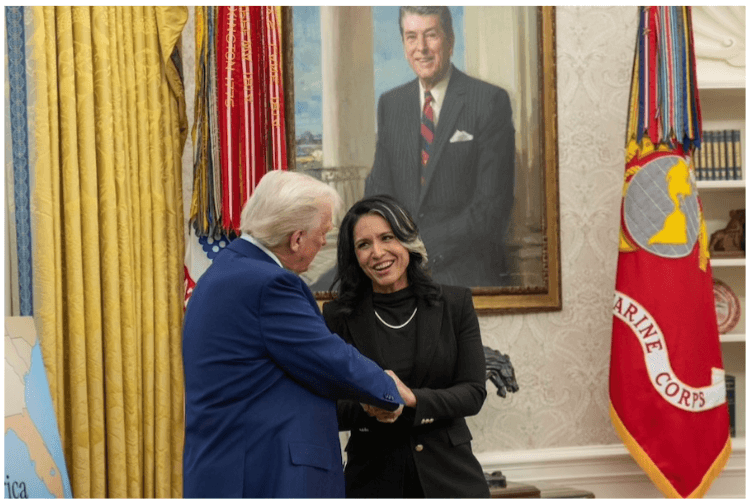
Of course, this whole scenario is utter poppycock, hogwash, humbug ,and malarkey all rolled into one malefic lie. There is not a shred of evidence that Putin has anything in mind other than the preventing the implantation of a NATO advance guard on his doorstep and cruise missiles within 30 minutes of Moscow. Indeed, the entire “Putin is coming for Europe” lie was repudiated this very week from the heart of the US Intelligence Community by DNI Tulsi Gabbard.
In response to yet another Reuters leak of Deep State propaganda saying Putin is coming for all of Europe, Gabbard minced no words:
“No, this is a lie and propaganda Reuters is willingly pushing on behalf of warmongers who want to undermine President Trump’s tireless efforts to end this bloody war that has resulted in more than a million casualties on both sides. Dangerously, you are promoting this false narrative to block President Trump’s peace effort, and fomenting hysteria and fear among the people to get them to support the escalation of war, which is what NATO and the EU really want in order to pull the United States military directly into war with Russia.”
“The truth is” that US intelligence has briefed policymakers that “Russia seeks to avoid a larger war with NATO.” She added: “It [the U.S. intelligence – ed.] also assesses that, as the last few years have shown, Russia’s battlefield performance indicates it [Russia] does not currently have the capability to conquer and occupy all of Ukraine, let alone Europe.”
The whole Ukraine War saga, in fact, amounts to a Cuban Missile Crisis in reverse.
In turn, the fact that official Washington does not even remotely see the irony is due to the fact that the War Machine on the banks of the Potomac has so thoroughly polluted the intellectual waters and ethers alike with the incipient Hitler/Stalin canard that it has just robotically slotted “Putin” into the latest incarnation of this hoary formula without even a tinge of embarrassment.
To be sure, Vlad Putin is no prince of men, and he does have his contemporary, if small time, gulags to show for it. But he is way, way too smart and historically literate to wish to fall on his sword in Poland or anywhere else west of the Dnieper where Russians are distinctly unwelcome. Indeed, the very thought that this canard is a valid argument for the mayhem Washington is now conducting in Ukraine is a veritable affront to adult reasoning.
So let us turn to the predicate. How in the world did the notion that the planet is teeming with incipient monsters that can only be tamed by the global presence and continuous vigilance of a Washington-led and -kitted planetary gendarme ever take such deep roots and persevere for so long?
Alas, the answer lies in the truth that much of the 20thcentury was an unforced error—a giant mistake that reaches back to Woodrow Wilson’s utter folly in bringing America into World War I, thereby ignominiously extinguishing the wisdom of John Quincy Adams in the mud and blood of northern France.
Wilson’s unforgivable error was to put the United States into the Great War for utterly no good reason of homeland security, which is the only valid basis for foreign policy in a peaceful Republic. The European war posed not an iota of threat to the safety and security of the citizens of Lincoln, NE, or Worcester, MA, or Sacramento, CA.
In that respect, Wilson’s putative defense of “freedom of the seas” and the rights of neutrals was an empty shibboleth; his call to make the world safe for democracy, a preposterous pipe dream.
Actually, his thinly veiled reason for plunging the US into the cauldron of the Great War was none of the above. Instead, what he really sought was a big seat at the peace conference table—so that he could remake the world in response to God’s calling.
But this was a world about which he was blatantly ignorant; a task for which he was temperamentally unsuited; and an utter chimera based on 14 points that were so abstractly devoid of substance as to constitute mental Play-Doh.
Or, as his alter ego and sycophant, Colonel Edward House, put it: Intervention positioned Wilson to play—
“The noblest part that has ever come to the son of man.”
America thus plunged into Europe’s carnage, and forevermore shed its century-long Republican tradition of anti-militarism and non-intervention in the quarrels of the Old World. John Quincy Adams’s wisdom got shit-canned in one fell swoop.
Needless to say, there was absolutely nothing noble that came of Wilson’s intervention. It led to a peace of vengeful victors, triumphant nationalists, and avaricious imperialists—when the war would have otherwise ended in a bedraggled peace of mutually exhausted bankrupts and discredited war parties on both sides.
By so altering the course of history, Wilson’s war bankrupted Europe and midwifed 20th century totalitarianism in Russia and Germany. That is, it gestated the sheer historical aberrations of Hitler and Stalin–neither of which would have materialized absent Wilson’s feckless intervention in April 1917.
The present-day Washington hegemons, therefore, are not fighting the perennial battle of mankind’s better angels against the totalitarian darkness that is always incipient in the geo-political intercourse of nations. To the contrary, Hitler and Stalin were sheer accidents of history, whose evil interludes can be traced not to mankind’s collective DNA, but to that of the vainglorious fool who lied to the American public in the 1916 election about keeping the nation out of war, and promptly plunged it into the cauldron that made Hitler and Stalin possible.
Moreover, Wilson’s intervention in the Great War and the deplorable aftermath at Versailles, in turn, eventually led to the Great Depression, the Welfare State and Keynesian economics, World War II, the Holocaust, the Cold War, the permanent Warfare State, and today’s malignant military-industrial complex.
They also spawned Nixon’s 1971 destruction of sound money, Reagan’s failure to tame Big Government, and Greenspan’s destructive cult of monetary central planning.
So, too, flowed the Bushes’ wars of intervention and occupation, their fatal blow to the failed states in the lands of Islam foolishly created by the imperialist mapmakers at Versailles and the resulting endless waves of blowback and terrorism that afflicted the world 70 years later.
And not the least of the ills begotten in Wilson’s war is the modern rogue regime of central bank money printing, and the Greenspan-Bernanke-Yellen-Powell plague of bubble economics which never stops showering the 1% with the monumental windfalls from central bank-enabled speculation.
So let us briefly review the building blocks of that lamentable detour of history. None of it was inevitable or unavoidable. And all of the claims about stopping still another Hitler or Stalin which have kept it alive are bogus to the core.
That is to say, once you grasp the utter perfidy and senselessness of Wilson’s plunge into the Great War in April 1917—then all of the mythical 20th century justifications for the Great Hegemon on the Potomac—Lenin, Hitler, Munich, Stalin, the Iron Curtain, world communism on the march—vanish with alacrity. At length, there was and is no need to seek monsters to destroy because America’s homeland security has never been seriously imperiled.
So let us amplify on the contrafactual history upon which this proposition rests.
First, had the Great War ended without American intervention in the spring of 1917 by a mutual withdrawal from the utterly stalemated trenches of the Western Front, as it was destined to, there would have been no disastrous summer offensive by the Kerensky government, or subsequent massive mutiny in Petrograd that enabled Lenin’s flukish seizure of power in November. That is, the 20th century would not have been saddled with what metastasized into the Stalinist nightmare or barnacled with a Soviet state that poisoned the peace of nations for 75 years. Even as the nuclear sword of Damocles hung over the planet.
Likewise, there would have been no abomination known as the Versailles peace treaty; no “stab in the back” legends owing to the Weimar government’s forced signing of the “war guilt” clause; no continuance of England’s brutal post-armistice blockade that delivered Germany’s women and children into starvation and death and left a demobilized 3-million-man army destitute, bitter, and susceptible to a permanent political rampage of vengeance.
So too, there would have been no acquiescence in the dismemberment of Germany and the spreading of its parts and pieces to Poland, Czechoslovakia, Denmark, France, Austria, and Italy—with the consequent revanchist agitation that nourished the Nazis with patriotic public support in the rump of the fatherland.
Nor would there have materialized the French occupation of the Ruhr and the war reparations crisis that led to the destruction of the German middle class in the 1923 hyperinflation; and, finally, the history books would have never recorded the Hitlerian ascent to power in 1933 and all the evils that flowed thereupon.
In short, on the approximate 111th anniversary of Sarajevo, the world has been turned upside down.
First and foremost, the Great War and then most especially the “peace of victors” made possible by Woodrow Wilson’s intervention destroyed the classic liberal international economic order of the late 19th century. Honest money, relatively free trade, rising international capital flows, and rapidly growing global economic integration had all blossomed during the 40-year span between 1870 and 1914.
That golden age had brought rising living standards, stable prices, massive capital investment, prolific technological progress, and pacific relations among the major nations—a condition that was never equaled, either before or since.
Now, owing to Wilson’s fetid patrimony, we have the opposite: A world of the Warfare State, the Welfare State, Central Bank omnipotence, and a crushing burden of private and public debts. That is, a thoroughgoing statist regime that is fundamentally inimical to capitalist prosperity, freedom-based economic life, and the flourishing of private liberty and constitutional safeguards against the relentless encroachments of the state.
In a word, Wilson has a lot to answer for. So let us try to summarize his own “war guilt” in the eight major propositions below. Together they explain the fallacious origins of the perpetual Hitler-Stalin syndrome and why the Washington Hegemon which has falsely arisen to contest it is the ultimate barrier to peace on earth in the year 2025.
Proposition #1: The Great War was about nothing worth dying for and engaged no recognizable principle of human betterment. There were many blackish hats, but no white ones.
Instead, it was an avoidable calamity issuing from a cacophony of political incompetence, cowardice, avarice, and tomfoolery.
So you can blame the bombastic and impetuous Kaiser Wilhelm for setting the stage with his foolish dismissal of Bismarck in 1890, failure to renew the Russian reinsurance treaty shortly thereafter, and his quixotic buildup of the German Navy after the turn of the century, thereby generating fears in London that its dominance of the seas would be compromised.
Likewise, you can blame the French for lashing themselves to a war treaty that could be triggered by the intrigues of a decadent court in St. Petersburg, where the Czar still claimed divine rights and the Czarina ruled behind the scenes on the hideous advice of Rasputin.
So too, you can censure Russia’s foreign minister Sergey Sazonov for his delusions of greater Slavic grandeur that had encouraged Serbia’s provocations after Sarajevo; and castigate the doddering emperor Franz Joseph for hanging onto power into his 67th year on the throne and thereby leaving his crumbling empire vulnerable to the suicidal impulses of General Conrad’s “war party.”
Similarly, you can indict the duplicitous German Chancellor, Theobald von Bethmann Hollweg, for allowing the Austrians to believe that the Kaiser endorsed their declaration of war on Serbia; and pillory Winston Churchill and London’s “war party” for failing to recognize that the Schlieffen Plan’s invasion through Belgium was no threat to England, but an unavoidable German defense against a two-front war on the continent.
But after all that—most especially don’t bother to talk about the defense of democracy, the vindication of liberalism, or the thwarting of Prussian autocracy and militarism.
To the contrary, the British war party led by the likes of Winston Churchill and General Herbert Kitchener was all about the glory of empire, not the vindication of democracy; France’s principal war aim was the revanchist drive to recover Alsace-Lorraine—mainly a German-speaking territory for 600 years until it was conquered by Louis XIV, only to be lost back to the Germans after France’s humiliation in the 1870 Franco-Prussian War.
In any event, German autocracy was already on its last leg as betokened by the arrival of universal social insurance and the election of a socialist-liberal majority in the Reichstag on the eve of the war.
Likewise, the Austro-Hungarian, Balkan, and Ottoman goulash of nationalities, respectively, would have erupted in interminable regional conflicts, regardless of who won the Great War.
In short, nothing of principle or higher morality was at stake in the outcome.
Proposition # 2: The Great War posed no national security threat whatsoever to the United States. Presumably, of course, the danger was not the Entente powers—but Germany and its allies.
The reasons why this is true are not difficult to divine. After the Schlieffen Plan offensive failed on September 11, 1914 at the Marne River in France, the German Army became incarcerated in a bloody, bankrupting, two-front land war that ensured its inexorable demise. Likewise, after the battle of Jutland in May 1916, the great German surface fleet was bottled up in its homeports—an inert flotilla of steel that posed no threat to the American coast 4,000 miles away.
As for the rest of the central powers, the Ottoman and Habsburg empires already had an appointment with the dustbin of history. Nor need we even bother with the fourth member of the central powers—that is, the Kingdom of Bulgaria?
Proposition #3: Wilson’s pretexts for war on Germany—submarine warfare and the Zimmermann telegram—are not half what they are cracked up to be by Warfare State historians.
As to the so-called freedom of the seas and neutral shipping rights, the story is blatantly simple. In November 1914, England declared the North Sea to be a “war zone;” threatened neutral shipping with deadly sea mines; declared that anything which could conceivably be of use to the German army—directly or indirectly—to be contraband that would be seized or destroyed; and announced that the resulting blockade of German ports was designed to starve Berlin into submission.
A few months later, Germany retaliated, announcing its submarine warfare policy designed to stem the flow of food, raw materials, and armaments to England. It was the desperate antidote of a land power to England’s crushing sea-borne blockade.
Accordingly, there existed a state of total warfare in the northern European waters, meaning that the traditional “rights” of neutrals were irrelevant and were, in fact, disregarded by both sides. In arming merchantmen and stowing munitions on passenger liners, England was hypocritical and utterly cavalier about the resulting mortal danger to innocent civilians—–as exemplified by the 4.3 million rifle cartridges and hundreds of tons of other munitions carried in the hull of the Lusitania.
Likewise, German resort to so-called “unrestricted submarine warfare” in February 1917 was brutal and stupid but came in response to massive domestic political pressure during what was known as the “turnip winter” in Germany. By then, the country was starving from the English blockade—literally.
Before he resigned on principle in June 1915, Secretary William Jennings Bryan got it right. Had he been less diplomatic he would have said never should American boys be crucified on the cross of a Cunard liner state room so that a few thousand wealthy plutocrats could exercise a putative “right” to wallow in luxury while knowingly cruising into harm’s way.
As to the Zimmermann telegram, it was never actually delivered to Mexico at all. Instead, it had been sent from Berlin as an internal diplomatic communique to the German ambassador in Washington, who had labored mightily to keep his country out of war with the US. But British intelligence had intercepted it, and sat on it for more than a month waiting for an opportune moment to incite America into war hysteria.
As it happened, this so-called bombshell was actually just an internal foreign ministry rumination about a possible plan to approach the Mexican president regarding an alliance in the event that the US first declared war on Germany.
So the so-called Zimmermann telegram was neither surprising nor a legitimate casus belli. Furthermore, contingent alliance making was aggressively practiced by both sides.
For instance, did not the entente bribe Italy into the war with promises of large chunks of Austria? Did not the hapless Rumanians finally join the entente when they were promised Transylvania? Did not the Greeks bargain endlessly over the Turkish territories they were to be awarded for joining the allies? Did not Lawrence of Arabia bribe the Sharif of Mecca with the promise of vast Arabian lands to be extracted from the Ottomans?
Why, then, would Germany—if attacked by the US—not promise the return of Texas?
Proposition #4: Europe had expected a short war, and actually got one when the Schlieffen Plan offensive bogged down 30 miles outside of Paris on the Marne River in mid-September 1914. Within three months, the Western Front had formed and coagulated into blood and mud——a ghastly 400-mile corridor of senseless carnage, unspeakable slaughter, and incessant military stupidity that stretched from the Flanders coast across Belgium and northern France to the Swiss frontier.
The next four years witnessed an undulating line of trenches, barbed wire entanglements, tunnels, artillery emplacements, and shell-pocked scorched earth that rarely moved more than a few miles in either direction, and which ultimately claimed more than 4 million casualties on the Allied side and 3.5 million on the German side.
If there was any doubt that Wilson’s catastrophic intervention converted a war of attrition, stalemate, and eventual mutual exhaustion into Pyrrhic victory for the allies, it was memorialized in four developments during 1916—all of which occurred before Wilson’s gratuitous intervention.
In the first, the Germans wagered everything on a massive offensive designed to overrun the fortresses of Verdun—-the historic defensive battlements on France’s northeast border that had stood since Roman times, and which had been massively reinforced after the France’s defeat in the Franco-Prussian War of 1870.
But notwithstanding the mobilization of 100 divisions, the greatest artillery bombardment campaign ever recorded until then, and repeated infantry offensives from February through November 1916 that resulted in upwards of 400,000 German casualties, the Verdun Offensive failed.
The second event was its mirror image—the massive British and French offensive known as the second battle of the Somme, which commenced with equally destructive artillery barrages on July 1, 1916, and then for three months sent waves of infantry into the maws of German machine guns and artillery. It too ended in colossal failure, but only after more than 600,000 English and French casualties including a quarter-million dead.
In between these bloodbaths, the stalemate was reinforced by the aforementioned naval showdown at Jutland that cost the British far more sunken ships and drowned sailors than the Germans, but also caused the Germans to retire their surface fleet to port and never again challenge the Royal Navy in open water combat.
Finally, by year-end 1916 the German generals who had destroyed the Russian armies in the East with only a tiny one-ninth fraction of the German army—Generals Paul von Hindenburg and Erich Ludendorff —were given command of the Western Front. Presently, they radically changed Germany’s war strategy by recognizing that the growing allied superiority in manpower, owing to the British homeland draft of 1916 and mobilization of forces from throughout the empire, made a German offensive breakthrough will nigh impossible.
So they ordered a strategic volte-face, resulting in the Hindenburg Line. The latter was a military marvel based on a checkerboard array of hardened pillbox-based machine gunners and maneuver forces rather than mass infantry on the front lines, and an intricate labyrinth of highly engineered tunnels, deep earth shelters, rail connections, heavy artillery, and flexible reserves in the rear. It was also augmented by the transfer of Germany’s eastern armies to the Western Front—-giving it 200 divisions and 4 million men on the Hindenburg Line.
This absolutely and totally precluded any hope of Entente victory. By 1917 there were not enough able-bodied draft-age men left in France and England to overcome the Hindenburg Line, which, in turn, was designed to bleed white the Entente armies led by butchers like British General Douglas Haig and French General Joseph Joffre until their governments sued for peace.
Thus, with the Russian army’s disintegration in the east and the stalemate frozen indefinitely in the west by early 1917, it was only a matter of months before mutinies among the French lines, demoralization in London, mass starvation and privation in Germany, and bankruptcy all around would have led to a peace of mutual exhaustion and a European-wide political revolt against the warmakers.
Wilson’s intervention thus did not remake the world. But it did radically rechannel the contours of 20th century history. And, as they say, not in a good way.
Proposition #5: Wilson’s epic error not only produced the Entente’s victory and the abomination of Versailles and all its progeny, but also the transformation of the Federal Reserve from a passive “banker’s bank” to an interventionist central bank knee-deep in Wall Street, war finance, and macroeconomic management.
This, too, was a crucial historical hinge point because Carter Glass’ 1913 act did not empower the new Reserve banks to even own government bonds. Instead, it authorized them only to passively discount for cash good commercial credits and receivables brought to the rediscount windows of the 12 regional reserve banks by local commercial banks; and contemplated no open market interventions in the debt markets of Wall Street or any remit at all with respect to GDP growth, jobs, inflation, housing, or all the rest of modern-day monetary central planning targets.
In fact, Carter Glass’ “banker’s bank” didn’t care whether the GDP growth rate was positive 4%, negative 4% or anything in between; its modest job was to channel liquidity into the banking system in response to the ebb and flow of commerce and production on Main Street.
Jobs, growth, and prosperity were to remain the unplanned outcome of millions of producers, consumers, investors, savers, entrepreneurs, and speculators operating on the free market, not the business of the state.
But Wilson’s war took the national debt from about $1 billion or $11 per capita—a level which had been maintained since the Battle of Gettysburg—to $27 billion, including upwards of $10 billion reloaned to the allies to enable them to continue the war. But there is not even a slim chance that this massive eruption of Federal borrowing could have been financed out of domestic savings in the private market.
So the Fed’s charter was changed owing to the exigencies of war to permit it to own government debt and to discount loans to private citizens collateralized by Treasury paper.
In due course, the famous and massive Liberty Bond drives became a glorified Ponzi scheme. Patriotic Americans borrowed money from their banks, bought war bonds, and then pledged their war bonds as collateral.
In turn, the banks borrowed money from the Fed, and rehypothecated their customer’s collateral. Finally, the Reserve banks created the billions they loaned to the commercial banks out of thin air, thereby suffocating the forces of supply and demand, and, instead, pegging interest rates at arbitrarily low levels for the duration of the war.
So when Wilson was done saving the world, America had an interventionist central bank schooled in the art of interest rate pegging and rampant expansion of fiat credit not anchored in the real bills of commerce and trade; and its incipient Warfare and Welfare states had an agency of public debt monetization that could permit massive government spending without the inconvenience of high taxes on the people or the crowding out of business investment by the high interest rates otherwise needed to balance supply and demand in the bond pits.
Proposition # 6: By prolonging the war and massively increasing the level of debt and money printing on all sides, Wilson’s folly prevented a proper post-war resumption of the classical gold standard at the pre-war parities.
This failure of “resumption,” in turn, paved the way for the breakdown of monetary order and world trade in 1931—a break which turned a standard post-war economic cleansing into the Great Depression, and a decade of protectionism, beggar-thy-neighbor currency manipulation, and ultimately rearmament and statist dirigisme.
In essence, the English and French governments had raised billions from their citizens on the solemn promise that it would be repaid at the pre-war gold parities. That is to say, the massive emissions of war bonds were to be money good in gold at the end of hostilities.
But the combatant governments had printed too much fiat currency and inflation during the war, and through domestic regimentation, heavy taxation, and unfathomable combat destruction of economic life in northern France had drastically impaired their private economies.
Accordingly, under Churchill’s foolish leadership England repegged to gold at the old parity in 1925 but had no political will or capacity to reduce bloated war-time wages, costs, and prices in a commensurate manner, or to live with the austerity and shrunken living standards that honest liquidation of its war debts required.
At the same time, France ended up betraying its wartime lenders, and repegged the Franc two years later at a drastically depreciated level. This resulted in a spurt of beggar-thy-neighbor prosperity and the accumulation of pound sterling claims that would eventually blow up the London money market and the sterling-based “gold exchange standard” that the Bank of England and British Treasury had peddled as a poor man’s way back to the gold standard.
Yet under this “gold lite” contraption based on Sterling as the reserve currency, it transpired that France, Holland, Sweden, and other surplus countries accumulated huge amounts of sterling liabilities in lieu of settling their accounts in gold bullion. That is, they essentially had made billions of unsecured loans to the British. They did this on the British government’s “promise” that the pound sterling would remain at $4.87 per dollar come hell or high water—just as it had for 200 years of peacetime before.
But British politicians betrayed their promises and their central bank creditors in September 1931 by suspending redemption and floating the pound, thereby shattering the parity and causing the decade-long struggle for resumption of an honest gold standard to fail. Depressionary contraction of world trade, capital flows, and capitalist enterprise inherently followed.
Proposition # 7: By turning America overnight into the granary, arsenal, and banker of the wartime Entente, the US economy had been distorted, bloated, and deformed into a giant, but unstable and unsustainable global exporter and creditor.
During the war years, for example, US exports increased by 4x, GDP soared from $40 billion to $90 billion and Washington accumulated the aforementioned $10 billion debt from England and France. Consequently, incomes and land prices soared in the Farm Belt, while steel, chemical, machinery, munitions, and ship construction boomed like never before. In substantial part this occurred because Uncle Sam essentially provided vendor finance to the bankrupt allies in desperate need of both military and civilian goods.
Under classic rules, there should have been a nasty correction after the war—as the world got back to honest money and sound finance. But it didn’t happen because the newly unleashed Fed fueled an incredible boom on Wall Street and a massive junk bond market in foreign loans.
In today’s economic scale, the so-called foreign bond market amounted to upwards of $1.5 trillion and, in effect, kept the war boom in exports and capital spending going right up until 1929. Accordingly, the great collapse of 1929-1932 was not a mysterious failure of capitalism; it was the delayed liquidation of Wilson’s war boom.
After the crash, exports and capital spending plunged by 80% when the foreign junk bond binge ended in the face of massive defaults abroad; and that, in turn, led to a traumatic liquidation of industrial inventories and a collapse of credit-fueled purchases of consumer durables like refrigerators and autos. Sales of the latter, for example, dropped from 5 million to 1.5 million autos per year after 1929.
Proposition # 8: In short, the Great Depression was a unique historical event owing to the vast financial deformations of the Great War—deformations which were drastically exaggerated by its prolongation from Wilson’s intervention and the massive credit expansion unleashed by the Fed and Bank of England during and after the war.
Stated differently, the trauma of the 1930s was not the result of the inherent flaws or purported cyclical instabilities of free market capitalism; it was, instead, the delayed legacy of the financial carnage of the Great War and the failed 1920s efforts to restore the liberal order of sound money, open trade, and unimpeded money and capital flows.
But this trauma was thoroughly misunderstood, and therefore did give rise to the curse of Keynesian economics and did unleash the politicians to meddle in virtually every aspect of economic life, culminating in the statist and crony capitalist dystopia that has emerged in this century.
And the worst of these consequent afflictions of governance, of course, was the Hitler-Stalin syndrome. It is the linchpin upon which the Warfare State and the Washington Hegemon were erected, and it is baseless and malefic to the bone.
At the end of the day, there is still no peace on earth because Wilson’s foolish intervention in April 1917 turned Washington into the War Capital of the World; America into a failing, debt-entombed simulacrum of free market capitalism; and national governance into a statist repudiation of constitutional liberty and republican self-government.
Reprinted from the author’s private service
Join the conversation:

Published under a Creative Commons Attribution 4.0 International License
For reprints, please set the canonical link back to the original Brownstone Institute Article and Author.