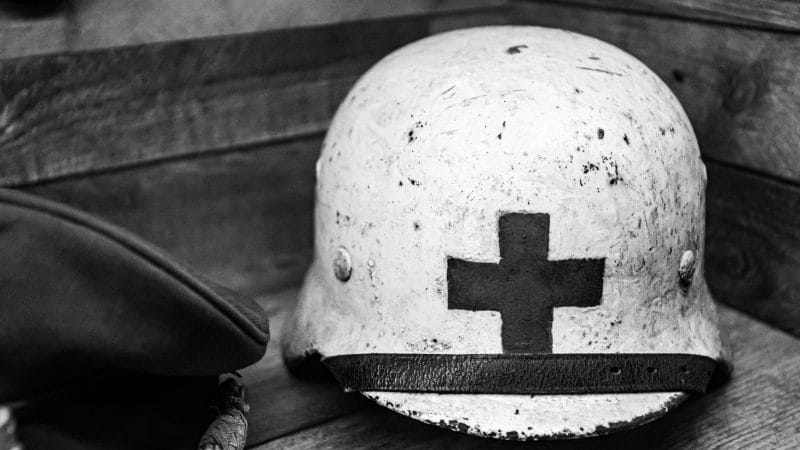

War is the most unrestrained expression of humanity’s destructive capacity, a setting where order disintegrates, moral boundaries are tested, and life is reduced to its most vulnerable state. Medicine, by contrast, stands as a deliberate act of resistance against that collapse, a disciplined and unwavering commitment to preserve life even when surrounded by death. Despite these opposing identities, war and medicine have remained deeply intertwined across history, not by design, but by inevitability.
Again and again, the battlefield has served as medicine’s most unforgiving classroom, stripping away theory and exposing only what truly works under pressure. In that environment, progress is not driven by curiosity or careful planning but by urgency, necessity, and the relentless demand to save lives hanging by a thread. It is in these moments of chaos and human suffering that medicine evolves most rapidly, forced forward not because it is prepared, but because failure is measured in lives lost and there is no option but to improve.
From the fields of Waterloo to the trenches of World War I, and from the mechanized devastation of World War II to the asymmetric conflicts of the modern era, war has shaped the trajectory of medical progress in both extraordinary and deeply troubling ways. Notably, some of the most significant advances in medicine have arisen during periods marked by profound human failure. However, war not only drives medical advancement but also exposes how easily medicine can lose its ethical direction. This narrative examines both the lessons gained and the critical principles that must be preserved.
The Good: Innovation Forged in Crisis
Modern medicine owes much of its development to wartime innovation. The concept of organized trauma care, now standard in emergency departments worldwide, originated amid the chaos of conflict. During the Napoleonic Wars, Dominique Jean Larrey, surgeon to Napoleon Bonaparte, introduced the revolutionary principle that wounded soldiers should be treated according to the severity of their injuries rather than their rank or status.¹
This concept, now universally recognized as triage, represented a radical departure from the hierarchical norms of the time. It was not only a logistical innovation; it was a moral one. Larrey’s approach emphasized the intrinsic value of human life over social or military position, laying the foundation for modern emergency medicine.²
Larrey’s contributions extended beyond triage. His early implementation of rapid evacuation systems, known as “flying ambulances,” and his observations on environmental exposure and resuscitative physiology anticipated concepts that would only be fully recognized centuries later.³ Subsequent analyses, including recent scholarship, have demonstrated how Larrey’s insights align with principles now seen in therapeutic hypothermia and prehospital care systems.⁴
The 19th and early 20th centuries saw further transformation. During World War I, physicians faced injuries that had no precedent: massive blast trauma, chemical burns, and overwhelming infection in an era before antibiotics. The scale of suffering forced rapid advances in surgical technique, wound management, and infection control.⁵
The development of blood transfusion systems during this period, particularly the introduction of blood typing and storage, represented a turning point in the management of hemorrhagic shock.⁶ For the first time, physicians could meaningfully intervene in one of the leading causes of battlefield death.
World War II accelerated this progress dramatically. The widespread use of penicillin, the refinement of surgical debridement techniques, and the development of forward surgical units significantly improved survival rates.⁷ The concept of rapid evacuation—getting the wounded away from the battlefield and into definitive care as quickly as possible became a central principle of military medicine.
By the time of the Korean and Vietnam Wars, these ideas had evolved into fully integrated systems of care. Helicopter evacuation, mobile army surgical hospitals (MASH units), and coordinated trauma care. These advances extended beyond the battlefield, forming the foundation of civilian trauma care and influencing the development of emergency medical services and intensive care unit design. War compelled medicine to address a fundamental question: how to sustain life in cases previously deemed unsalvageable. Repeatedly, medical innovation provided solutions. Who should be dead? And, time and again, medicine found an answer.
The Bad: Progress at a Moral Cost
However, the history of medicine in war is not solely characterized by progress. Alongside innovation exists a darker narrative in which physicians, rather than opposing the brutality of war, became complicit in its execution. The most infamous example remains the medical atrocities committed during World War II under the Nazi regime. Physicians participated in inhumane experiments on prisoners, often without anesthesia, consent, or any scientific justification.⁹ These acts were not aberrations committed by a few individuals. They were systematic, organized, and sanctioned by the state. The aftermath of these crimes led to the Nuremberg Trials and the establishment of the Nuremberg Code, which articulated fundamental principles of medical ethics, including the requirement for voluntary informed consent.¹⁰
Yet it would be a mistake to view these failures as confined to a single regime or moment in history. In the United States, for example, the Tuskegee Syphilis Study conducted between 1932 and 1972 revealed a similarly disturbing willingness to sacrifice ethical principles in the name of research.¹¹ African-American men with syphilis were deliberately left untreated, even after effective therapy became available, in order to study the natural progression of the disease.
These examples underscore that ethical failures in medicine are not confined to wartime or to foreign contexts. Such failures occur whenever physicians permit external pressures—political, ideological, or institutional—to supersede their primary duty to patients. War does not generate these failures; rather, it reveals them.
The Ugly: When Medicine Becomes a Tool of Power
While the ‘bad’ in wartime medicine reflects ethical failure, the ‘ugly’ represents the transformation of medicine into an instrument of power. Historically, physicians have often been expected to serve state objectives rather than patient welfare. This has included direct participation in acts of harm, withholding care, prioritizing certain populations, or redefining eligibility for treatment. At this point, medicine loses its essential character.
The physician’s duty is not conditional. It does not depend on nationality, ideology, or allegiance. The wounded soldier on one side of the battlefield is no less deserving of care than the wounded soldier on the other. This principle is reflected in the foundational documents of humanitarian medicine, including the Geneva Conventions, which emphasize the impartial treatment of the wounded and sick.¹² It is embodied in the work of organizations such as the International Committee of the Red Cross, which operates under the principle of neutrality. And it is deeply rooted in the ethical traditions of medicine itself.
Maimonides, the medieval Jewish physician and philosopher, wrote: “The physician should not treat the disease but the patient who is suffering from it.” This perspective transcends time, culture, and circumstance. It reminds us that medicine is, at its core, a human endeavor, one that must remain grounded in compassion, even in the face of conflict.
The Forgotten Lesson
A central paradox exists within wartime medicine. War compels the development of life-saving techniques under extreme conditions, driving innovation, refining clinical judgment, and necessitating systems capable of addressing overwhelming needs. However, it also poses the risk of imparting misguided lessons.
During the chaos of war, there is a tendency to categorize patients as members of groups rather than as individuals, viewing them as assets, liabilities, or adversaries rather than as human beings. This shift is perilous, as adopting the logic of war causes medicine to lose its foundational identity.
Physicians are not soldiers, hospitals are not battlefields, and patients are not adversaries. These distinctions must remain clear, particularly during periods of societal division.
Modern Parallels: When the Battlefield Comes Home
Although the context of war may appear remote to many contemporary physicians, similar dynamics persist. In recent years, medicine has become increasingly politicized, mirroring pressures observed in wartime settings. Physicians have been encouraged, both explicitly and implicitly, to conform to prevailing narratives, suppress dissenting perspectives, and prioritize institutional or political objectives over individualized patient care. While this is not traditional warfare, it shares a critical characteristic: the erosion of medical neutrality.
For example, during the Covid-19 pandemic, healthcare providers worldwide reported pressure to follow government directives or institutional messaging that sometimes conflicted with evolving clinical evidence or patient-centered care. Similarly, in ongoing conflict zones such as Ukraine and Syria, attacks on medical facilities and personnel have highlighted the vulnerability of medical neutrality, as physicians have been targeted or coerced based on political alignment. When physicians take sides based on external pressures rather than clinical evidence, they risk repeating historical errors.
Holding the Line
War is likely to persist, reflecting humanity’s enduring tragedy. Medicine, however, must remain steadfast, anchored in principles that transcend conflict, ideology, and time. It should not become a weapon, a tool of power, or an instrument of politics, but must remain a profession dedicated to the care of each individual, regardless of circumstance. The wounded do not choose the side on which they fall, and neither should those who provide care.
References
- Larrey DJ. Mémoires de chirurgie militaire et campagnes. Paris: Smith; 1812.
- Richardson RG. Larrey: surgeon to Napoleon’s Imperial Guard. J Med Biogr. 2004;12(4):204–208.
- Soto-Ruiz KM, Varon J. George W. Crile: a visionary mind in resuscitation. Resuscitation. 2009;80(1):6–8.
- Jasqui-Remba S, Rivera A, Varon J, Sternbach GL. Dominique Jean Larrey: the effects of therapeutic hypothermia and the first ambulance. Resuscitation. 2010;81:268–271.
- Wangensteen OH, Wangensteen SD. Military surgeons and surgery, old and new. Bull N Y Acad Med. 1971;47(10):1265–1290.
- Starr D. Blood: an epic history of medicine and commerce. New York: Knopf; 1998.
- Hardaway RM. Wound shock: a history of its study and treatment. Am Surg. 2000;66(8):720–728.
- Bellamy RF. The evolution of battlefield trauma care. Mil Med. 1987;152(12):617–620.
- Lifton RJ. The Nazi doctors: medical killing and the psychology of genocide. New York: Basic Books; 1986.
- Shuster E. Fifty years later: the significance of the Nuremberg Code. N Engl J Med. 1997;337(20):1436–1440.
- Brandt AM. Racism and research: the case of the Tuskegee Syphilis Study. Hastings Cent Rep. 1978;8(6):21–29.
- Geneva Convention for the Amelioration of the Condition of the Wounded and Sick in Armed Forces in the Field. 1949.
Join the conversation:

Published under a Creative Commons Attribution 4.0 International License
For reprints, please set the canonical link back to the original Brownstone Institute Article and Author.