
There are two possible ways history will treat the Covid era.
The establishment preference is for a story of a killer pathogen that leapt from the animal kingdom into humans to create a deadly pandemic that was fixed by an innovative vaccine. This is the preferred line in shrunken form, one already told in countless books and articles. This is how regime historians – cowards who stood by and watched while people were treated like lab rats – want to tell the story.
The real version of events is far more complicated. It is a story of dangerous scientific experiments mixed with misleading propaganda, mass psychosis, and outright lies, and given forward motion by profiteering pharmaceutical companies, censorial media, government grift, opportunistic bureaucrats, and agency malfeasance.
It is also a story of great heroes who stood up and said no.
Who will tell the real story in a way that can cut through the static?
Many documentaries already exist to get the truth out, but much more is needed. What we need is a narrative, a metaphorical telling, a quasi-historical fiction that puts all the absurdity on display in a slightly changed framework. Ideally, this story would exist in its most compelling form as a satirical film.
The master of this genre is literary critic, author, and screenwriter Walter Kirn, a living treasure of cultural commentary. He was educated at Princeton University and Oxford University, he achieved literary success with novels such as Thumbsucker (1999), adapted into a 2005 film, and Up in the Air (2001), which was adapted into a 2009 film nominated for six Academy Awards including Best Picture.
His 2014 memoir Blood Will Out chronicles a decade-long friendship with Christian Gerhartsreiter, an impostor who posed as Clark Rockefeller and was later convicted of murder.
A former contributing editor at Time, The Atlantic, The New York Times Book Review, and Spy, Kirn has critiqued meritocratic illusions and institutional media in works like Lost in the Meritocracy (2009) and as co-host of the podcast America This Week with Matt Taibbi.
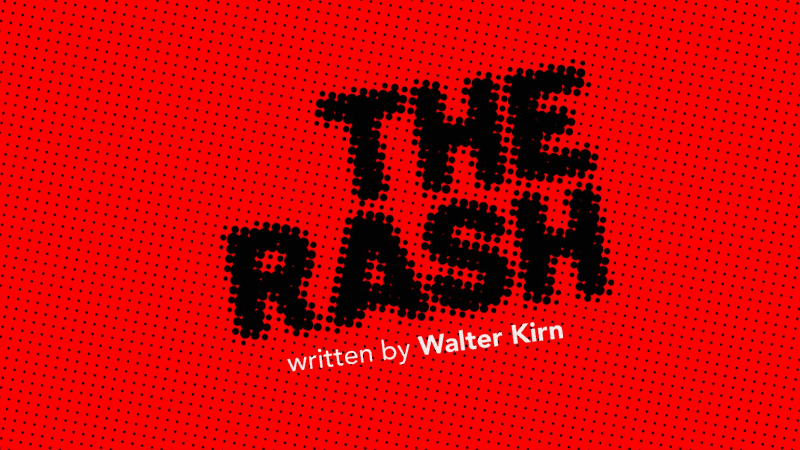
Kirn has also written the screenplay to the film we need. It is called The Rash. It tells the story of an emergent health problem that captures the public mind with contagious fear and loathing. This rash – real, imagined, or created – is viewed as a financial opportunity by dominant institutions on the cultural landscape.
Among them is a pharmaceutical company with an off-the-shelf product called Zenvidia that seems to address the rash by making people forget all about it (with major side effects). Hilarity ensues as a Stanford public-health professor speaks out against the mania.
In preparation for writing, Kirn spent many hours with NIH head Jay Bhattacharya and studied all the details of the Covid period. He has written a masterful allegory with a message of resistance.
There is one major and inevitable problem with this project: funding. Investors are terrified of the topic and Hollywood elites don’t even want it made. That said, the project already has a top production company lined up along with some notable talent to make a first-rate film.
Brownstone Institute is well-positioned to be a fiscal sponsor of this effort. As a non-profit, the film exists squarely within the purview of our mission. This is why Brownstone is stepping up to help with raising the necessary capital to see this project to fruition.
If you are interested in major gifts toward this effort, let us know by writing to our president.
Here are some assets by way of promotion.
Older interview with Kirn from Booknotes:
Join the conversation:

Published under a Creative Commons Attribution 4.0 International License
For reprints, please set the canonical link back to the original Brownstone Institute Article and Author.