
President Joe Biden’s decision to limit his Supreme Court nominees to black women was widely criticized as a product of DEI-mania, but the ensuing racial controversy was a red herring, a political sleight of hand, designed to distract Americans from Justice Ketanji Brown Jackson’s true purpose on the bench: to protect, preserve, and defend the deep state from the constraints of the Constitution.
The fallout from the nomination was familiar; CNN’s opinion pages called Republican Senators, including Tom Cotton (R-AR), Josh Hawley (R-MO), and Ted Cruz (R-TX), “racist and sexist” for opposing Jackson; Georgetown Law Professor Ilya Shapiro was suspended for stating that the most qualified candidate was an Indian man, not a black woman; Al Sharpton threw his support behind President Biden.
But Justice Jackson’s position was never intended to be a statement of racial representation or judicial excellence; it was the Biden administration’s anointment of a praetorian guard for the unelected and unaccountable bureaucracy that seeks to prevent President Trump from gaining control of the nation.
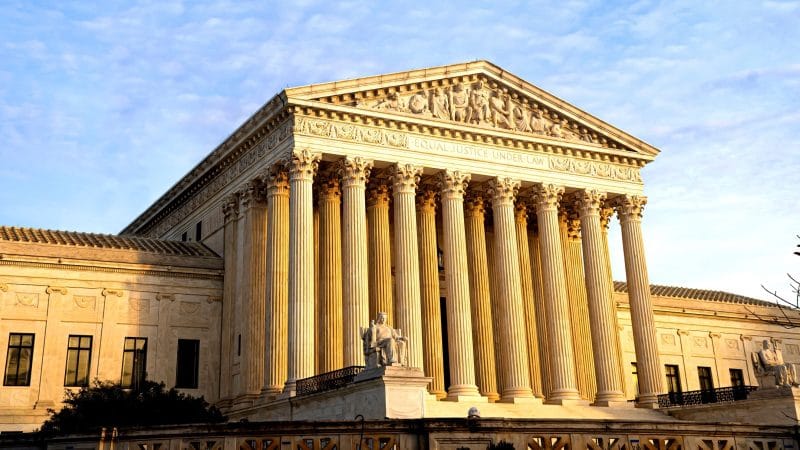
On Monday, the Supreme Court considered whether the President of the United States has the power to remove members of the Executive Branch. The Constitution’s Vesting Clause, which states that the “executive Power shall be vested in a President of the United States of America,” offers an unequivocal answer.
But Jackson, assuming her role as a corporatist advocate on a government salary, acted as the mouthpiece for those opposed to accountability for the bureaucracy that lives off the taxpayers’ wages. She warned of “the danger of allowing…the President to actually control the transportation board and potentially the Federal Reserve and all these other independent agencies.”
Jackson, never known for speaking concisely or deliberately (in oral arguments, she speaks 50 percent more than any of her fellow colleagues and more than Justices Amy Coney Barrett, John Roberts, and Clarence Thomas combined) waxed longingly for a nation with no presidential control over the executive branch:
My understanding was that independent agencies exist because Congress has decided that some issues, some matters, some areas should be handled in this way by nonpartisan experts, that Congress is saying that expertise matters with respect to aspects of the economy and transportation and the various independent agencies that we have. So having a President come in and fire all the scientists and the doctors and the economists and the Ph.D.s and replacing them with loyalists and people who don’t know anything is actually not in the best interest of the citizens of the United States. This is what I think Congress’s policy decision is when it says that these certain agencies we’re not going to make directly accountable to the President.
This is not a mere coincidence; when nominated, the Biden administration knew that she was devoted to bureaucratic supremacy.
In the first Trump administration, Jackson, then a District Court Judge, overturned four executive orders (numbers 13837, 13836, 13839, and 13957) that sought to rein in the power of the nearly three million federal employees who effectively inhabit permanent jobs. Most notably, in 2020, she invalidated President Trump’s order “Creating Schedule F in the Excepted Service.”
In March 2024, the Supreme Court heard oral arguments in Murthy v. Missouri, which considered the Biden administration’s collusion with Big Tech to censor Americans during the Covid response. There, Justice Jackson stated that her “biggest concern” was that an injunction would result in “the First Amendment hamstringing the Government.”
Earlier this year, Justice Barrett chastised Justice Jackson as “embracing an imperial Judiciary” after Justice Jackson voted to increase federal courts’ power to issue nationwide injunctions.
Jackson’s defense of the unelected cabal that dominates American life is not a mere issue of legalese; it animates the chief question of the second Trump administration: does the commander-in-chief control the Executive Branch? The Constitution tells us that he should, but in practice, entrenched interests threaten that governmental structure.
Those who believe that this gives the president too much power might consider an alternate path to shredding the Constitution, e.g. abolishing all these rogue agencies to reduce and contain executive power itself.
Jackson’s verbose monologues, often disguised as questions, reveal that she understands the importance of this struggle despite her cognitive limitations. She may not be able to define a woman, but she knows that her benefactors depend on her denying the President from obtaining “actual control” over the agencies that the Constitution designates to his realm.
Join the conversation:

Published under a Creative Commons Attribution 4.0 International License
For reprints, please set the canonical link back to the original Brownstone Institute Article and Author.