The most courageous person I know was involved in a collision with a kudu – a very large South African antelope – in the year 2000, when he was 21 years old. ‘The kudu lost,’ as he put it laconically when an orthopaedic surgeon inquired about the accident where he lay in the emergency ward of a hospital. He had been driving to a city 120 kilometres from where he lived, taking his girlfriend back to the university where she was a student, when the kudu scaled a low fence on the side of the road and landed on their car’s windscreen. This was the equivalent of a bull, or a big cow, landing on a car’s windscreen.
I visited him the day after he was admitted to the intensive care ward of a hospital in the city where he lived. To see this once healthy, strong, and active young man reduced to a person who has essentially lost the use of his body – someone who has become an ‘I cannot,’ instead of the ‘I can’ he was before, in the words of phenomenologist Maurice Merleau-Ponty – was heart-wrenching. Particularly because he is my son. This was exacerbated by his wry rhetorical comment to me: ‘What is worse than waking up from a nightmare? When you realise that you have awakened to the nightmare.’
Marco is now in his late forties, and despite his disability, has a good job and earns a decent salary. Most importantly – attesting to my observation, that he is the most courageous person I know – he never complains, has a sense of humour and likes going out with us, despite the difficulties involving moving into the car from his wheelchair and back again. He faces a difficult life with resolve and fortitude, and I never stop learning from him about the question concerning the meaning of one’s life. As he put it to me once: ‘Dad, I used to ask the obvious question, why this happened to me. Then, when reading Nietzsche, I realised that I am the only one who can answer that – by the way I live.’
Why have I related this story about my younger son and how an unpredictable event changed his life forever? Because there is an analogy to be drawn between the nightmare he awakened to, on the one hand, and waking to the nightmarish world we have inhabited since roughly 2020, on the other. Every day when I wake up, it dawns on me, once more, that this is the true nightmare, and one may add that, as in the case of Marco, the answer to the question, why it has happened to (or been inflicted upon) humanity, is one that only we ourselves can provide – through the manner in which we respond to it.
Filipe Rafaeli has given us a vivid account of the apathetic ‘response’ – if it could be called that – to the ongoing attempt to enslave humanity, by comparing the creative cultural ‘answer’ to the threat of nuclear catastrophe behind the Cold War by particularly young people – in the guise of life-affirming music, among other things – to the cowardly withdrawal from the possibility of totalitarian rule, today. Instead of finding creative ways to resist it, the majority of people at present resort to hiding in cyberspace, or not questioning questionable decisions by ‘authorities,’ for instance. Rafaeli is right to describe ours as a ‘cowardly society.’
Just yesterday a friend of ours told me about someone throwing up his arms in the course of a conversation (which presumably involved what are still, incongruously, called ‘conspiracy theories,’ instead of ‘conspiracy realism,’ as it should be), and querulously wondering aloud why people are ‘so distrustful.’ That’s a manifestation of cowardice, because acknowledging that the stench of a large rat hangs everywhere in the air would entail the need to adopt a stance to it: either acceptance or rejection, with their respective consequences for action.
Such a person would probably question my use of the term ‘nightmare,’ above. However, apart from the analogy in question, between a disabled person realising what a nightmare he has awakened to, and humanity having a similarly disconcerting experience upon awakening to extant reality today, there is something highly informative in the status of nightmares (in this regard), according to Freud.
In his monumental study of 1900 – The Interpretation of Dreams – where he first established the notion of ‘the unconscious’ as a heuristically fecund hypothesis (some would say, not without reason, ‘invention’) Freud elaborates on what he calls the ‘dream-work.’ The name suggests that dreams ‘do’ something – and indeed, as Freud shows at length, dreams transform repressed, anxiety-provoking, or threatening conflicts, thoughts, and prohibited desires into disguised images and symbols that allow the dreamer to sleep.
According to Freud, dreams are ‘the royal road to the unconscious.’ The reason is that they comprise a direct route to the unconscious, even if it is in a disguised form. The concept of the ‘unconscious’ is all-important here. Freud was not the first one to acknowledge the working of the unconscious in the human psyche; the ancient Greek playwright, Sophocles, already showed his awareness of this in the 5th century BCE, in his tragedy, Oedipus Rex, where the protagonist, Oedipus, unwittingly (that is, being unconscious of his true identity) kills his father and marries his mother, with whom he has children. In psychoanalytic therapy, the unconscious plays an indispensable role, insofar as it is the repository of the subject’s fears and desires, which can be uncovered by the psychoanalytic therapist through her or his interpretation of their ‘slips of the tongue’ and free associations.
The psychic process of ‘dream-work’ refers to the unconscious mechanisms that transform repressed, unacceptable fears and wishes into a less threatening, metaphoric, or symbolic form that is experienced in the course of dreaming during sleep, without causing anxiety and hence, preventing the dreamer from waking up. Dream-work operates through processes such as ‘condensation’ (which combines multiple ideas into one image), ‘symbolisation’ (representing abstract fears and desires through multivocal symbols), ‘displacement’ (shifting emotional and psychic significance from an important symbol or object to a less significant one), and ‘secondary revision’ (the linguistic, more or less coherent account of the dream upon waking (which unavoidably ‘smooths out’ the dream, which is usually not coherent, in retrospect).
All of this disguises or distorts the latent content (the true, unconscious meaning) of the dream into the manifest content, or the remembered dream narrative. By analysing the manifest content through psychoanalytic techniques like free association, the latent content and underlying unconscious wishes can be uncovered by a skilled psychoanalyst, allowing insight into the individual’s deeper psychological conflicts.
Freud calls dreams ‘wish-fulfilment,’ which may seem incongruous, if one considers that nightmares are also dreams. Dreams of a pleasing, soothing nature – such as dreaming of a pleasant sea cruise, or of being given a flower by a person you know – clearly fit the description of ‘wish-fulfilment,’ albeit not literally. In the first of these examples the sea cruise may symbolise a quest or desire to reach a certain ‘destination,’ again not literally, but in the form of a life goal, for instance. In the case of the second instance the flower could represent anything that one unconsciously desires, from friendship or sexual favours to trust.
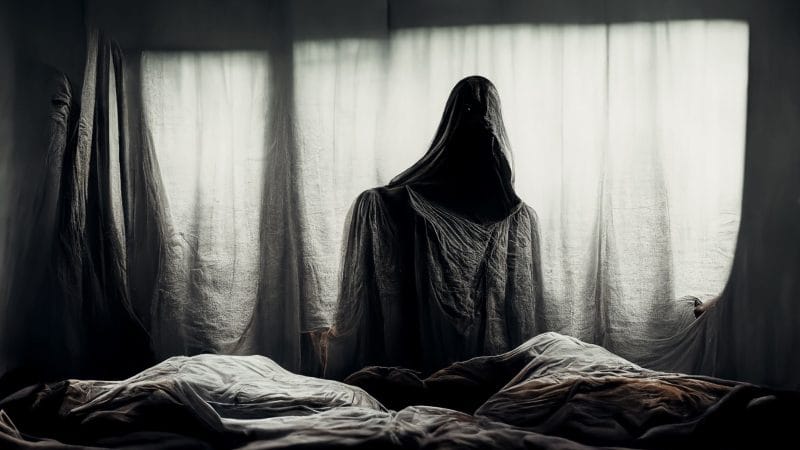
Nightmares are a special case. They cannot successfully do the work that dreams usually perform, simply because the relevant, repressed materials in the unconscious – which the dream work has to transform into dreams – are just too disturbing and anxiety-provoking to disguise in the shape of metaphors, and so on, for the sleeper to carry on sleeping while dreaming. That’s why one wakes up.
Paradoxically, therefore, even nightmares are wish fulfilments, insofar as they represent what one wishes to avoid at all costs, which is why being confronted by them in the dream has the disruptive effect of being awakened by their disturbing symbolic or metaphorical content. After all, instead of disguising disturbing events, as the dreamwork usually does, nightmares resist successful disguise, take us by the scruff of our necks and force us to look them in the face, no matter how disturbing they may be.
In other words, nightmares embody wish fulfilment, but in a negative sense. The lesson concerning the nightmare in which we are living today, is precisely that: we cannot, should not, carry on living in the dream, or hallucination, that everything is hunky dory, despite perhaps some indications to the contrary, which some of us choose to ignore. We should face the nightmare and wake up! We should allow it to do its nightmarish work by awakening us to the events that embody the nightmare. Awakening to the nightmare of the present time should galvanise us into action. The first requirement, however, is that people acknowledge the nightmare.
What are those nightmarish events? One gets a good idea by scrutinising the title of Michel Chossudovsky’s book (2022), The 2020-22 Worldwide Corona Crisis Destroying Civil Society, Engineered Economic Depression, Global Coup d’état and the ‘Great Reset,’ which is freely available online. The ‘corona crisis’ needs no introduction; those of us who are alive and have lived through this nightmare with our senses and critical intellect intact, will recall the sense of crisis that it induced in us, even – or especially – when we knew that the whole thing was staged.
The ‘engineered economic depression’ alluded to in Chossudovsky’s book’s title is already perceptible, both in retrospect, when we recall how many small and medium-sized businesses were destroyed during the so-called ‘lockdowns,’ and in the present, when the attempt to push through with this nightmarish economic destruction at several levels is continuing. To be sure, to the best of my knowledge, both President Donald Trump and President Vladimir Putin are doing their best to prevent this from succeeding – Trump by making a concerted effort to return the United States to a functioning, productive economy, and apparently succeeding, and Putin by maintaining such productivity despite massive sanctions against Russia and the ongoing conflict in Ukraine (something that mainstream media carefully hide; in fact, they routinely allege the contrary), and also succeeding. Here is how Lidia Misnik and Anna Fedyunina characterise Russia’s economic resilience:
In 2025, the Russian economy looks very different from the one analysts feared would crumble in 2022. State-owned giants are booming, trade is shifting decisively eastward, and domestic industries are rapidly substituting imports. Over the past three years, GDP growth has consistently outpaced the global average, unemployment has fallen to historic lows, and the groundwork for a fundamentally reshaped economic model has been laid. The economy has reinvented itself under pressure, revealing a resilience that few outside Russia anticipated.
‘Destroying civil society’ is clearly visible in the attempts made to collapse societies through uncontrolled, illegal immigration – attempts which nearly succeeded in the US, and appear to be close to succeeding in Britain and Europe.
The ‘global coup d’état and the “Great Reset,”’ which Chossudovsky notes in the book title, go hand-in-hand, insofar as all indications amount to the same conclusion; namely, that the Covid crisis was deliberately brought about, with all its concomitant draconian measures, to pave the way for establishing a central, totalitarian world government, as Chossudovsky persuasively argues in his book. He is not the only one, of course; several other scholars and researchers have noticed, and remarked on, the totalitarian thrust driving the events since 2020, including Naomi Wolf (The Bodies of Others, p.26, 132; Facing the Beast, p. 18); Kees van der Pijl (States of Emergency, p.66); and Reiner Fuellmich.
If there is anything about the present that qualifies as being nightmarish, it is the prospect of living under totalitarian control, which, by controlling every aspect of our lives, is capable of destroying the very capacity of human beings to experience all the good things in life, such as love, tenderness, joy, togetherness, and a sense of community. Wolf acknowledges this truth – which was thoroughly elaborated by Hannah Arendt in her work on totalitarianism – where she writes (The Bodies of Others, p. 256):
In the magnitude of the evil around us; in its awe-inspiring level of
darkness and inhumanity; in the policies aimed at killing children’s joy,
restricting their breath, speech, and laughter; at killing ties between
families and extended families; at killing churches and synagogues and
mosques; and, from the highest levels, from the president’s [Biden’s] own bully
pulpit, demanding people to collude in excluding, rejecting, dismissing,
shunning, hating their neighbors and loved ones and friends: in all of
this the presence of such rampant, elemental evil I felt a darkness beyond
anything human. I don’t think humans are smart or powerful enough to
have come up with this horror all alone.
The sobering thought accompanying these reflections on the implications of the nightmarish aims listed by Chossudovsky is that they have not, by any means, been abandoned by (what Dr Reiner Fuellmich calls) the ‘monsters’ driving the process of collapsing existing society. Wolf puts it succinctly (Facing the Beast, p. 110): ‘No, evil is not done with us.’ On the contrary, given that the bearers of evil are experiencing stiff resistance from Trump, Putin, and (by now) millions of people around the globe, who have at last cottoned on to what is happening, they have become increasingly desperate, and hence, more dangerous.
It is therefore all the more imperative that, instead of shrinking back in fear when we behold the nightmare – the ‘face of the beast’ – we confront it with courage and resolve. The mere act of doing so openly instead of ignoring it, effectively denying its existence, is already an act of resisting it. Ignoring it is the equivalent of dreaming on, of allowing the ‘dream-work’ to do its job; acknowledging the nightmare amounts to waking up.
Join the conversation:

Published under a Creative Commons Attribution 4.0 International License
For reprints, please set the canonical link back to the original Brownstone Institute Article and Author.