When Scott Adams died, People Magazine led with a line that dominated most of the media for days: “Scott Adams, Disgraced Dilbert Creator, Dies at 69.” It’s a message for the living: depart from saying what you are supposed to say and you will lose everything. Even in death, your life will be called worthless. This was not eulogy but rather an enforcement action to keep the opinion cartel functioning.
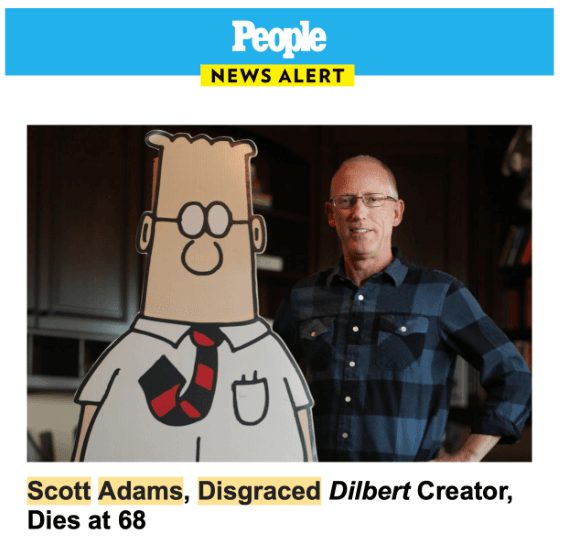
It was in 2015 that the famed creator of the Dilbert cartoon first started speculating that Donald Trump had what it takes to become president. The feeling of shock was palpable. No one else was saying anything like this – more specifically, no one of his status and reach as a cultural influence. In those days, the opinions of The Nation and National Review were identical: this clown cannot be president.
For my own part, I recall feeling appalled by Adams’ statements. At the time, I was firmly in the Never Trump camp, without fully understanding that I was then accepting the most conventional opinion possible at the time. I further failed to understand the complex dynamic operating beneath the surface, namely that a broken system of government/media/tech had long ago stopped serving the cause of freedom and dignity and turned to full-time exploitation in surreptitious forms.
In words, Trump was out there saying that the system was gravely broken and needed to be fixed. This was Adams’ view as well, and he further saw that Trump had the gravitas necessary to pull people over to this view.
Adams of course turned out to be correct about this. It’s difficult to recreate the sense of those times to understand just how disruptive his views were. It was a universally shared opinion at the time that Trump was an unwelcome and deeply dangerous invader into electoral politics.
The establishment figured that the best way to shut down Trump’s effort was to treat them as wholly inadmissible to public life. The Huffington Post put their coverage under the entertainment category, while every other mainstream venue ran countless millions of articles on his evils.
Adams saw something others did not. He saw that Trump was compelling in ways no other political figure was. He was talking about real issues no one else would mention. He was a master improviser on stage. He was also funny. It was only after Adams’s comments that I started to listen. I realized that he was onto something important.
For holding this view, and then becoming ever more open about his support of Trump, Adams lost everything. His high-paid corporate speaking gigs were cancelled. He lost his income stream and social/cultural status. Eventually his syndication was cancelled too, on thin pretext. This cannot have come as a shock to him. He knew exactly what the consequences would be for departing from the status quo. He did it anyway.
We need to appreciate just how rare this is in higher circles of public influencers. This is a world in which everyone knows what they are supposed to say and what is unsayable. No one needs to send memos or give marching orders. The proper orthodoxy is in the air, discerned from all the signs by all intelligent people.
Entering into the upper echelons of opinion making, whether in academia or media or civil society generally, requires three types of training. First, you need to develop expertise in some area or at least be able to present evidence that other experts regard you as an expert. Second, you need to show evidence that you can speak the rarified form of language that is reserved to elite opinion, which has its own special vocabulary for communication and cultural signalling. And third, you need to develop proficiency in knowing what to say and believe.
This is what advanced training amounts to. Master all three, and you cross into a different realm from that inhabited by the rabble. Staying in that place requires close adherence to the rules and the presentation of ongoing evidence that you are willing to play the game, even better if you strongly believe in the game itself.
There is a narrow bound of opinion holding that pertains at all times. In moments of genuine crisis – disruptive political leaders, wars, huge legislative changes, trade agreements, pandemic responses – when the stakes grow much higher, the enforcement of these rules becomes much more strict. The slightest deviation raises eyebrows and reduces trust in your reliability.
Everyone in these realms knows what to do and say. That’s not even a question. The issue becomes: what does one do when the intellect and conscience conspire to lead one into a position of dissent from the prevailing orthodoxy? That’s when you have to size up the costs and benefits of courage. The costs are overwhelming: the risk of power, position, material support, reputation, and legacy. The benefits come down to the feeling of having done the right thing.
Adams knew this better than anyone. He could not stay quiet. Not only that, he stuck to his opinions, always checking himself to make sure they came from an honest and sincere position based on existing evidence.
After all, the whole point of the cartoon he had drawn for years and years was to poke fun at the pretense, pomp, and sheer fakery of management speak and corporate protocols within the heavily bureaucratized world of big business. This is why he was beloved: he told the truth that no one else would. He afflicted the comfortable and made big shots look ridiculous. He mocked elites and denied expertise.
This is why he was popular. But when he turned the same method and eagle eye to matters of politics, taking a position not unlike that he had developed toward the corporate world, his fortunes dramatically changed, as he surely knew they would. He lost everything.
Oddly, as so many others have discovered, there is something freeing about that. He eventually started his own daily show in which he would spend hours calmly talking through the day’s headlines and trying to make sense of the unspoken orthodoxies that frame permissible opinions in a heated environment of political division.
On matters related to Covid, Adams proved himself overly credulous. He waited too long to join the dissidents on masking but eventually did. And when the shot came out, he agreed publicly to go along because he needed the vaccination to travel. He later agreed that they failed to stop transmission but maintained that they surely reduced severe injury. After his cancer diagnosis, he finally conceded in January 2023: “Anti-vaxxers clearly are the winners.” He spent the next two years repeatedly expressing regret that he had ever believed that it was fine to get the shot.
Adams was an honest critic. This worked for him professionally for decades, until he became too honest. The point is that Adams looked at the costs and benefits of compliance with prevailing opinion norms and decided it was not worth it. He chose courage instead. Thousands of others did too, and they have paid a heavy price. Even now, scientists who are looking honestly and truthfully at vaccine injury, the costs of lockdowns, the conflicts of interest in science and medicine, and are trying to reform the system face unrelenting attack and outright cancellation.
Just for example, the journal Oncotarget published a peer-reviewed paper by Charlotte Kuperwasser, and Wafik S. El-Deiry called “COVID vaccination and post-infection cancer signals: Evaluating patterns and potential biological mechanisms.” It’s a meta-analysis of vast reports linking the Covid shots with the rise of cancer. The journal was hit with DDOS attacks that lasted a full week and took down the entire site.
Brownstone stepped in to post the paper on its servers. We served more than 5,000 downloads before we too were hit with a massive DDOS attack. We fended it off by requiring a CAPTCHA check from every user, and eventually the attacks died down. It’s hard to see what was achieved by those who wanted this paper to go away.
The Streisand effect (warning people against something only draws more attention to it) is real. Not only real but the main path to truth for a public increasingly convinced that prevailing orthodoxies are a tissue of lies, sustained only by money, careerism, and the paucity of courage in public life today.
Adams was an early dissident and among the most famous. He showed the way. To make sure that he is not an example for others, reliable ruling-class venues made sure to attempt to humiliate him in death. It’s been this way since the ancient world, apparently: those who dare challenge elite opinion cartels will always pay the price. But they can live and die with a clean conscience. What matters more?
Join the conversation:

Published under a Creative Commons Attribution 4.0 International License
For reprints, please set the canonical link back to the original Brownstone Institute Article and Author.