

A cache of internal emails obtained from within the US National Institutes of Health has exposed years of strategic planning for future pandemics involving governments, foundations, international organisations, and pharmaceutical companies.
The documents, stretching back to at least 2016, show that Dr Francis Collins, Director of the NIH from 2009 to 2021, was at the centre of these efforts.
In that role, he oversaw the allocation of the agency’s substantial research budget, which ran into tens of billions of dollars annually.
The emails reveal Collins working closely with the Gates Foundation, Wellcome Trust, World Bank, World Economic Forum, the African Academy of Sciences, and major pharmaceutical companies to strengthen research infrastructure, regulatory readiness, and international coordination well before Covid appeared.
For the public, the Covid response was presented as an unexpected crisis. Governments appeared to be making difficult decisions while navigating profound uncertainty.
But these emails tell a different story.
Many of the same organisations that later shaped the Covid response had already spent years building capacity, influence, and institutional power under Collins’ leadership.
Billions of dollars flowed through the sprawling network. Careers were built around it, reputations depended on it, and political and financial interests became invested in its success.
By the time Covid arrived, much of the framework was already in place.
Building the Machinery
The planning gained momentum after the 2014-16 Ebola outbreak highlighted gaps in global preparedness. Vaccines took too long to develop, trials were hard to organise, and funding was fragmented.
The response, according to the emails, was to build permanent capacity in advance rather than react after the fact.
One major outcome was the launch of the Coalition for Epidemic Preparedness Innovations (CEPI) in 2017 at the World Economic Forum (WEF), which hosts an annual gathering of globalist elites in Davos, Switzerland.
CEPI focused on vaccines against emerging infectious diseases and became a key part of pandemic planning alongside the NIH and major foundations.
During Covid, CEPI became one of the major funders of vaccine development, investing hundreds of millions of dollars in multiple vaccine platforms that eventually led to vaccines from companies such as Moderna.
The internal documents show there was particular focus on expanding research capacity in Africa, a region long criticised for weak regulatory oversight and less stringent enforcement of clinical trial standards.
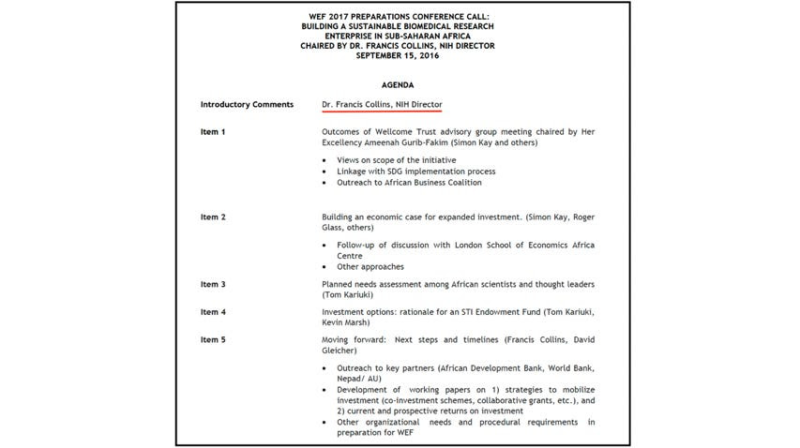
Collins chaired a 2017 WEF meeting on building a sustainable biomedical research enterprise in Sub-Saharan Africa.
The call brought together senior figures from the Wellcome Trust and other partners to advance plans for major new investment, including a proposed $10 billion African science, technology and innovation fund.
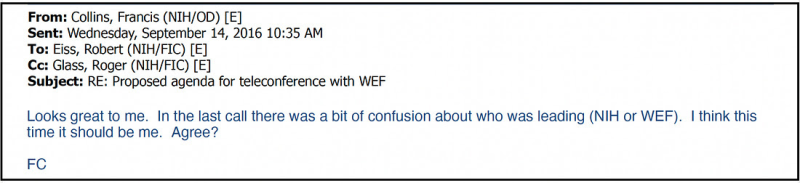
Collins appeared keen to ensure there was no confusion about who was in charge. After one teleconference with the WEF he wrote to his NIH colleagues:
“In the last call there was a bit of confusion about who was leading (NIH or WEF). I think this time it should be me. Agree?”
By 2018, senior pharmaceutical executives were discussing long-term investments in infrastructure designed to endure well beyond any single outbreak.
One project focused on SMART Vaccines, a decision-support tool designed to help governments and funders systematically prioritise vaccine candidates and guide investment decisions ahead of future outbreaks.
Workshops for the project brought together a who’s who of global health institutions, government agencies, philanthropic foundations, vaccine manufacturers, and international organisations.
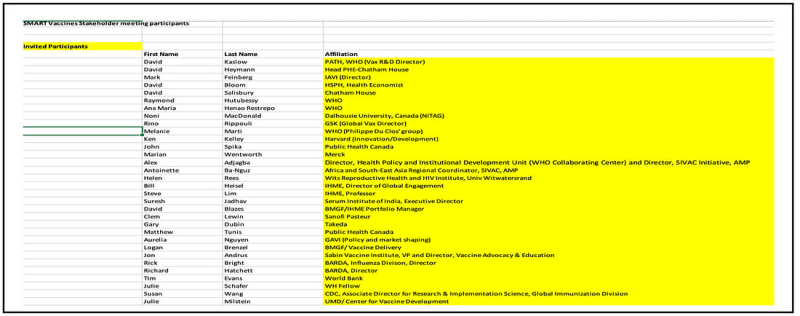
The language of the initiative emphasised “consensus-building” and “public-private partnerships,” to keep major organisations and stakeholders in lockstep—many of whom would later play influential roles during Covid.
By 2019, the core elements of modern pandemic preparedness were already in place.
Covid Emerges
When Covid emerged in early 2020, many of these organisations stepped directly into the roles they had spent years preparing for.
CEPI directed major vaccine funding. The Gates Foundation supported financing and distribution efforts. The World Bank mobilised resources. The WHO coordinated international guidance, and so on.
In turn, societies were locked down, people were ordered to wear face masks, and told to wait for vaccines.
In October 2020, three epidemiologists—Jay Bhattacharya, Sunetra Gupta, and Martin Kulldorff—authored the Great Barrington Declaration, arguing against broad lockdowns and favouring more targeted protections for vulnerable populations.
The declaration effectively challenged the centralised, top-down model that Collins and his network had spent years building.
Collins responded by leveraging the authority of the NIH to marginalise dissenting scientists and called for a “quick and devastating published takedown” of the Declaration and its authors.
Taken together, these emails show that Covid was not the beginning of the story. It was the moment years of planning, investment, and institution-building were set in motion.
That system influenced how resources were allocated, which policies were pursued, and how dissent was managed.
Years later, we are still living with the unintended consequences of those decisions.
Republished from the author’s Substack
Behind closed doors at the World Economic Forum in Davos in January 2016, senior figures from the Gates Foundation and the World Bank proposed a new approach to pandemic preparedness: large-scale simulations modelled on military war games.
Newly obtained internal emails show how the idea — referred to as “Germ Games” — gained rapid momentum and drew in the US National Institutes of Health (NIH).
A Potential Land Mine
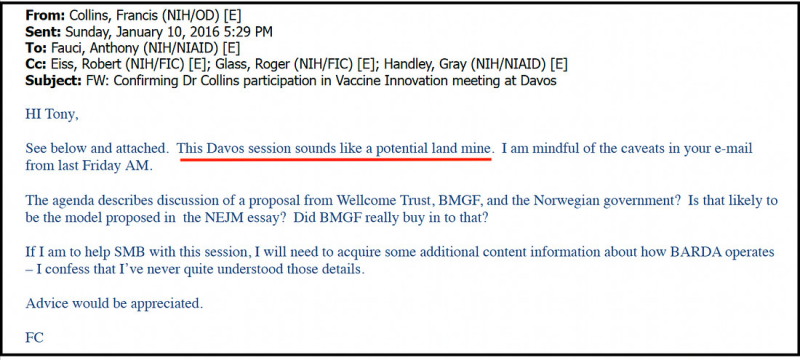
On January 10, 2016, as then-NIH Director Francis Collins prepared to attend the World Economic Forum’s annual meeting in Davos, he emailed an advance copy of his schedule to Anthony Fauci, one of his closest advisers.
One session, in particular, caught his attention.
“This Davos session sounds like a potential land mine,” Collins wrote.
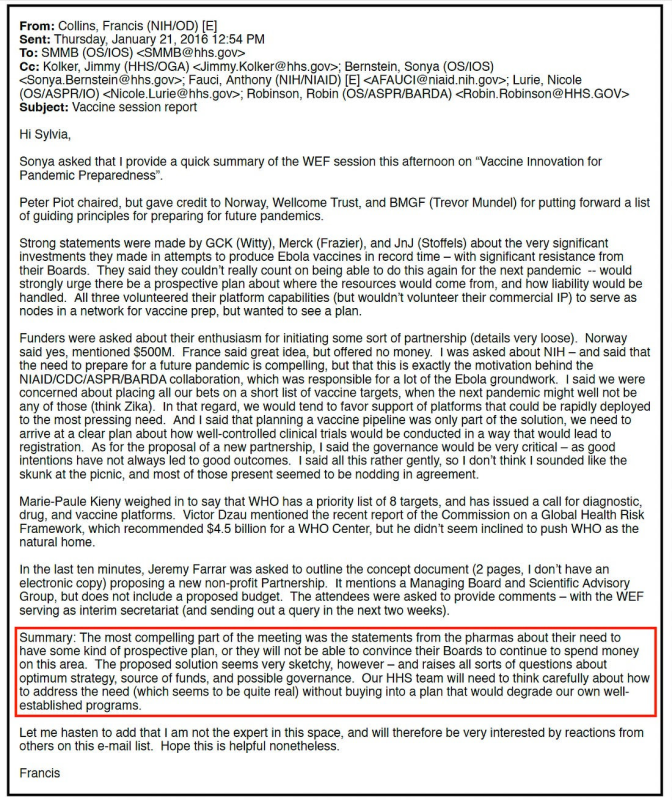
The meeting, titled “Vaccine Innovation for Pandemic Preparedness,” brought together executives from GSK, Merck, and Johnson & Johnson, along with representatives from the Gates Foundation and the Wellcome Trust.
According to Collins’ report to Health and Human Services Secretary Sylvia Burwell, the pharmaceutical companies were blunt about the conditions for their participation — they could not commit to rapidly developing vaccines for every future outbreak unless governments first resolved who would pay and how liability would be handled.
The companies said they were willing to contribute their vaccine platforms but would not share their commercial intellectual property.
Collins described the emerging proposal as “very sketchy” and warned that it raised serious questions about governance, funding, and strategy. He cautioned against any plan that would undermine existing US programmes.
The Birth of “Germ Games”
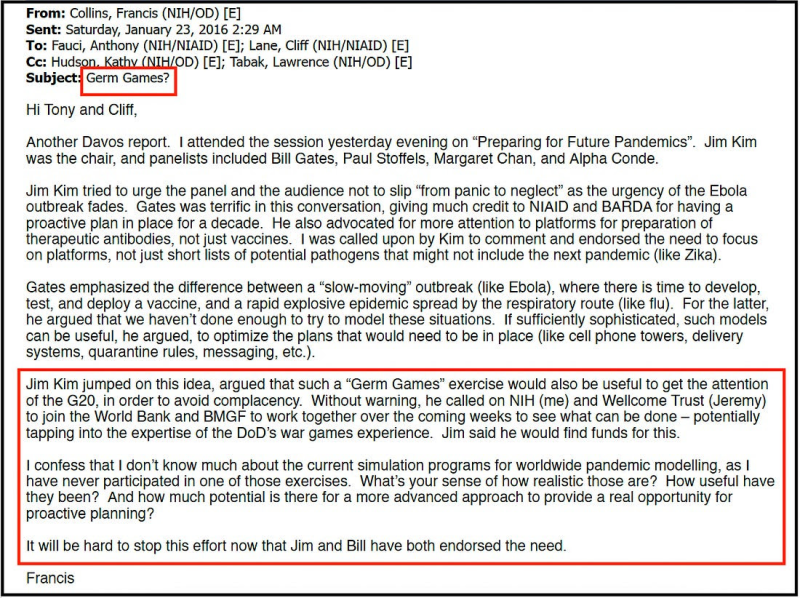
A separate session on preparing for future pandemics proved even more consequential. Chaired by World Bank President Jim Yong Kim, the discussion included Bill Gates.
Gates argued that the world was poorly prepared for a fast-spreading respiratory virus and that more sophisticated simulations could strengthen planning around logistics, communications, quarantine measures, public messaging, and vaccine deployment.
Kim seized on the idea. According to Collins’ email, the World Bank president proposed creating “Germ Games” — exercises explicitly modelled on military war games — persuade G20 leaders to invest in pandemic preparedness and avoid complacency once Ebola memories faded.
Kim suggested “tapping into the expertise” of the US Department of Defense, whose war games experience tested command structures, decision-making, and crisis response under pressure.
He publicly called on the NIH, the World Bank, the Gates Foundation and the Wellcome Trust to develop the concept together, saying he would “find funds for this.”
Writing to Fauci afterwards, Collins acknowledged that the proposal had quickly gained influential backing. With both the Gates Foundation and the World Bank endorsing the initiative, he wrote, it would be “hard to stop this effort now.”
Collins admitted that large-scale pandemic simulations fell outside his expertise and asked Fauci for his assessment.
Fauci’s Reply
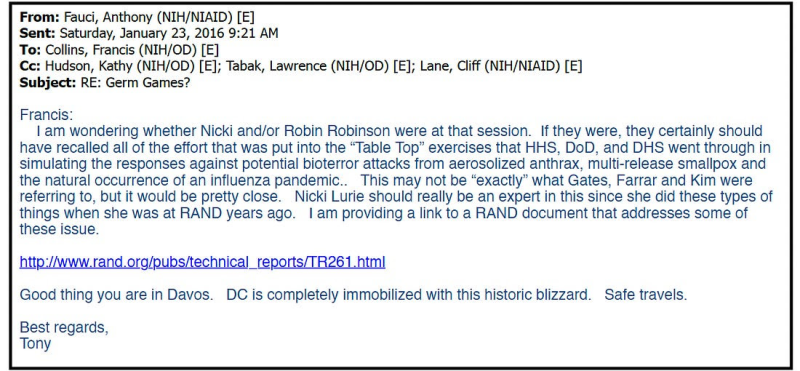
Fauci responded that the US government already had considerable experience running simulated “bioterror attacks.”
He explained that the Department of Health and Human Services, the Department of Defense, and the Department of Homeland Security had conducted extensive “Table Top” exercises—simulated crisis scenarios in which officials rehearsed responses to biological threats, including aerosolised anthrax, multi-release smallpox, and influenza pandemics.
“This may not be ‘exactly’ what [Bill] Gates, [Jeremy] Farrar and [Jim Yong] Kim were referring to,” Fauci wrote, “but it would be pretty close.”
He also suggested involving Nicole Lurie, then Assistant Secretary for Preparedness and Response, noting her previous experience at the RAND Corporation.
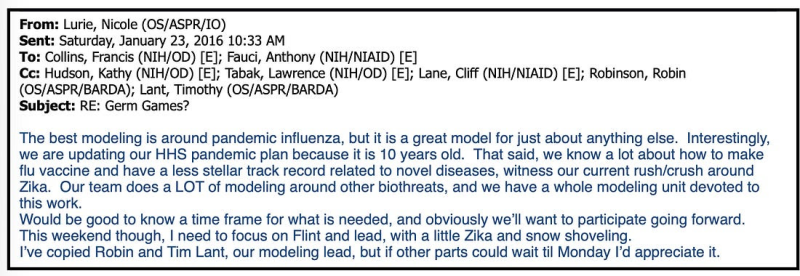
Collins quickly looped Lurie and BARDA Director Robin Robinson into the discussion, asking whether support from the World Bank and the Gates Foundation could help upgrade existing US modelling and preparedness work.
Lurie replied that HHS was already updating its pandemic influenza plan and had an entire team conducting regular modelling for a range of biological threats, including H7N9, MERS, Ebola and Zika.
From “Germ Games” to Global Agenda
The “Germ Games” concept did not remain a one-off idea.
A year later, Collins returned to Davos for the 2017 World Economic Forum meeting.
His schedule included a pilot pandemic simulation organised by the World Bank and the Gates Foundation. The exercise was designed to place senior decision-makers inside a simulated pandemic crisis, using the kind of scenario-based role-playing employed in military war games.
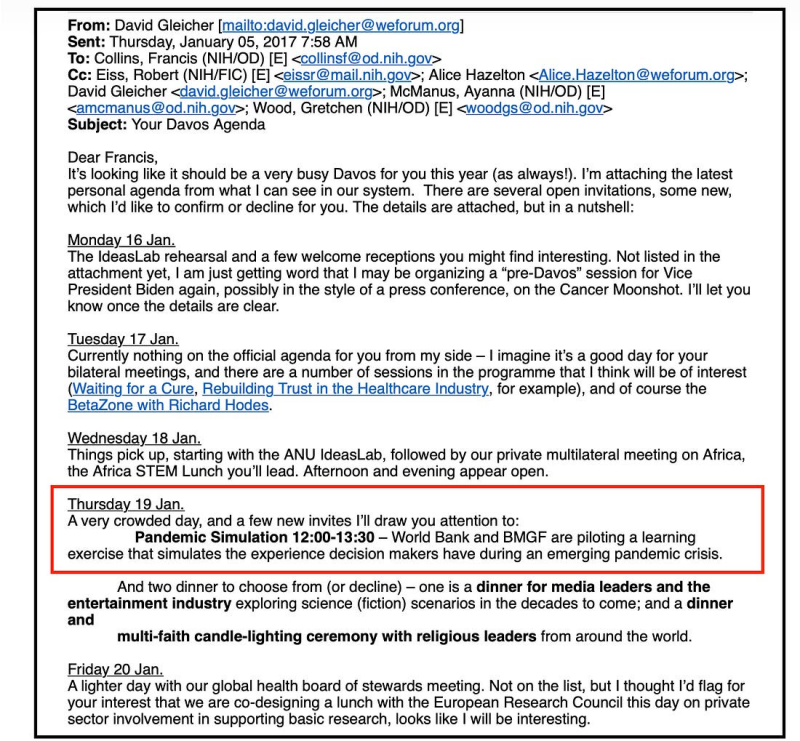
The same approach was later reflected in Event 201, a high-profile simulation of a “fictional coronavirus pandemic” held in October 2019 by the Johns Hopkins Centre for Health Security in partnership with the WEF and the Gates Foundation.
That exercise brought together business leaders, government officials and public health experts to role-play responses to a “hypothetical” pandemic, using the same structured, scenario-based decision-making discussed at Davos three years earlier.
In early 2018, Collins invited Jim Yong Kim to the NIH.
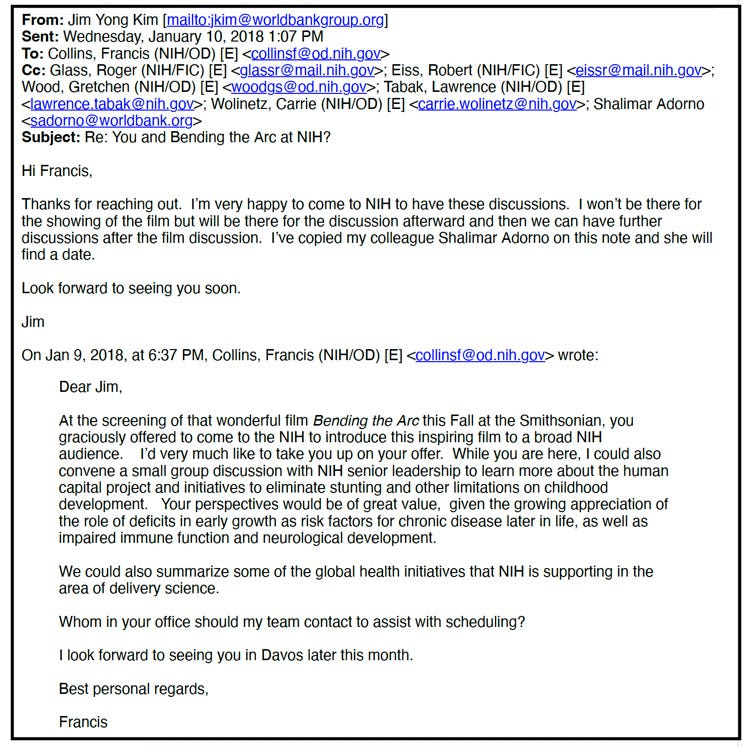
While the public event was a screening of the documentary Bending the Arc, internal planning documents show that officials arranged a closed-door roundtable with Collins, Fauci, and nearly every NIH institute director.
The agenda covered pandemic preparedness, airborne threats and deeper collaboration between the NIH and the World Bank.
Collectively, these internal documents show how, from 2016 onwards, pandemic preparedness was increasingly shaped by military planning concepts and biodefence thinking.
What began as discussions at Davos evolved into a sustained international effort to embed simulation-based, war-game-style approaches into global health security — approaches that would later become central to the response to Covid-19.
Republished from the author’s Substack
Join the Conversation
Published under a Creative Commons Attribution 4.0 International License
For reprints, please set the canonical link back to the original Brownstone Institute Article and Author.