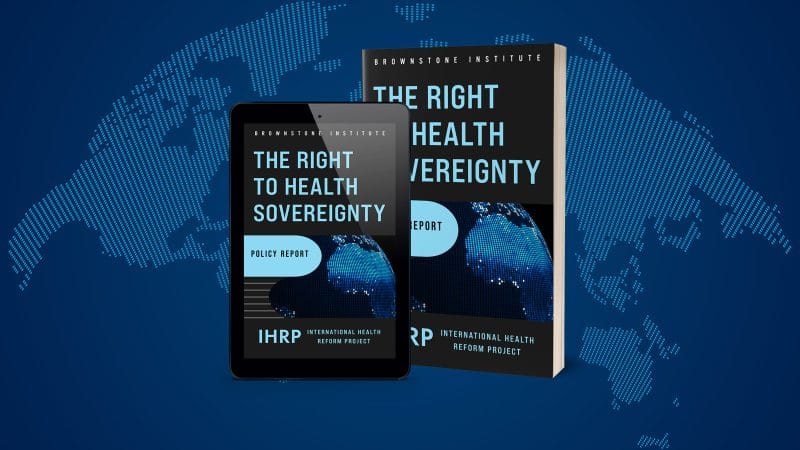
[This report of the International Health Reform Project is more than a year in preparation. The full policy report and technical reports are embedded below this foreword and executive summary. The policy report is also available from Amazon in physical and digital forms. The IHRP is sponsored by Brownstone Institute, which had no involvement in forming contents and conclusions.]
International cooperation on health is a widely accepted global good. Capacity building and development assistance reduce historic health inequalities and, as a result, strengthen economies. Management of cross-border infectious disease threats is best done through joint surveillance, data sharing, and response.
Collaboration on norms and standards provides efficiencies and facilitates trade in health products. However, the interaction between disease, the environment, and human populations is complex, and threats are heterogenous in their effects and gravity. Collaboration must therefore take such variability into account, with decision-making ultimately based around those affected.
Experience has demonstrated that international health cooperation can, when poorly governed, undermine trust, distort priorities, and produce significant unintended harm. Recent trends of centralized decision-making, emergency exceptionalism, and donor-driven agendas, exemplified during the Covid-19 response, displaced proportionality, local context, and established public-health ethics. These failures revealed structural weaknesses rather than temporary lapses.
At the same time, cooperation in public health also requires an understanding of the sovereignty and equality of individuals, and of the states that represent them – an understanding that underpins the United Nations itself. Thus, any institution tasked with managing health cooperation must be based on this understanding and be fully subject to the states it is intended to serve.
It should surprise no one that, after nearly 80 years of existence in a greatly changed world, the World Health Organization (WHO) is perceived by many to have drifted from its original model. Fundamental shifts in its funding base, and now the exit of its largest state funder, present both an opportunity and an urgency to reassess the optimal way in which states should work together to serve the health needs of their populations, applying the fundamental principles on which public health should be based to a greatly changed and evolving world.
WHO and the state of international health cooperation
The WHO constitution, signed in 1946 by 51 states then comprising the United Nations, had little input from most current African and Asian states. Its governing body, the World Health Assembly, gradually expanded as states broke from colonialism or foreign mandates to achieve sovereignty.
Defining health in its constitution as “a state of complete physical, mental, and social well-being and not merely the absence of disease or infirmity,” the WHO took on a broad mandate including support for these less-resourced states, coordinating cross-border outbreak management, disease elimination, and the setting of international normative standards. It was hoped that the improvements in health and longevity that economic development had brought to wealthier countries could be accelerated in the lower income countries, reducing the inequalities resulting from colonialism and neglect.
The WHO’s 150 country offices have formed a framework to strengthen local capacity and health systems. The organization is well known for successes such as smallpox eradication and early focus on the major drivers of well-being and longevity such as improved sanitation, nutrition, and access to basic healthcare. Major programmes in tuberculosis, malaria, vaccination, and child health have set standards for disease management and reduced overall disease burdens. A global decline in infectious disease mortality, continuing today, is testament to the success of multilateral cooperation in improving the basic drivers of longevity, reducing poverty, and improving healthcare access.
However, a drift over recent decades towards a focus on centralized, commodity-driven responses to relatively low-burden disease outbreaks, rather than the major drivers of health resilience and the high-burden endemic diseases that paralyze many countries, raises questions as to the influence of both state and non-state actors in directing WHO priorities through specified funding. A parallel rise of public-private partnerships and private philanthropy has further driven these changes. Such homogenous commodity-based responses to highly heterogeneous disease risks are an inevitable outcome of the shift in how WHO policy is financed and therefore influenced. This must be reversed if international health cooperation is to fulfill its promise.
The International Health Reform Project (IHRP) report
The IHRP brings together independent professionals with experience in the WHO, UN, academia, and global health from a diverse range of countries. The policy report presented here, and the companion technical report, address the crisis in the management of international public health, reviewing the ethical principles upon which public health and the collaboration of states must be based and the key attributes of an international health organization (IHO) fit for such a purpose. The WHO is then assessed against this standard.
The report is intended to provide a template that countries can use as a basis for discussions on deep reform, or the creation of a new organization which may replace the WHO in its entirety, or complement the WHO by taking on functions that are poorly compatible with an organization focussed on what should be the WHO’s core mandate. Deep reform is necessary to return international public health to an ethical and effective footing.
Control needs to reside in states, with a decentralized structure that reflects their diversity and interests, whilst maintaining the advantages of global collaboration. An emphasis on building resilience of peoples to disease, and of states to promote and sustain the well-being of their populations, should form the basis of endemic disease control and mitigation of cross-border health threats. Human rights and medical ethics must be the fundamental building blocks of any such approach. Whether the radical reform needed to achieve this can be achieved through the WHO, or can only be achieved through a replacement organisation, is a question that only countries can debate and decide.
The report which we now present has been agreed by the ten IHRP panel members. As co-chairs we are indebted to our fellow panellists for the exceptional depth of knowledge, experience, and judgment they brought to the preparation of this report over a long and gruelling year of meetings and conversations. They brought many different personal views to the table, and the report on which we have agreed does not necessarily reflect in all respects the preferred views of any one of them.
This is particularly true of the optimum levels of autonomy and the terms of the engagement among the different levels of local, national, and international health actors; of the list and hierarchy of principles of international public health; and of the key question of the choice between reforming the WHO or establishing a new international health organisation (IHO). But we are agreed that the existing set of arrangements and practices is not the best that we can or should hope for.
EXECUTIVE SUMMARY
Overview and purpose
The Right to Health Sovereignty argues for a new international health framework grounded in human rights and dignity, national sovereignty, and medical ethics. It contends that the current system – dominated by the World Health Organization (WHO) – has drifted from its founding mission of scientific neutrality and technical assistance. The Panel calls for a renewal of international public health cooperation, requiring either deep reform of the WHO or the creation of a new international health organisation (IHO) that reflects post-1945 human-rights norms and the ethical foundations of healthcare.
The report situates health not merely as a development or humanitarian issue but as an essential attribute of sovereign responsibility: the right and duty of every state to protect the health and welfare of its citizens while engaging cooperatively, but voluntarily, with others. Sovereignty in this report is not presented as a guarantee of good policy, but as a necessary condition for accountability, proportionality, and ethical consent. The IHO envisioned here would serve as a transparent, decentralized network of states – reflecting diversity of need, facilitating cooperation but never controlling them.
The Panel concludes that current arrangements for international health cooperation are failing to deliver proportionate, ethical, and accountable outcomes. Over-reliance on earmarked funding has distorted priorities; emergency preparedness has crowded out wider system capacity building and high-burden disease management; authority has become centralized without accountability; and public-health ethics are being compromised.
These are structural problems. Incremental technical reform alone is insufficient.
The policy challenge
The central question is: How can international health cooperation strengthen rather than dilute individual agency, and avoid eroding state sovereignty and responsibility? That is: How can we structure an international health organisation to help states meet their sovereign responsibility to support and protect the health of their people?
The answer lies in subsidiarity – ensuring that decisions are made at the lowest level capable of acting effectively, whilst facilitating global cooperation on joint priorities.
Under this principle:
- National governments coordinate health policy and finance, working through their network of facilities and practitioners.
- Regional bodies act as intermediaries between national and global priorities and manage cross-border cooperation. Regional governance is a sweet spot in that it can capture the benefits of economies of scale and collective action, while allowing for better policy contextualization via smaller, more focused, representational processes and need-based recognition.
- Global institutions play supportive and advisory roles, limited to technical assistance, capacity building, data sharing, and normative guidance. The aim is to support the medium-to-long-term goal of creating localized, self-reliant, and sustainable health systems.
This reverses the drift towards centralization and the creation of aid dependency cycles, reanchoring global health in the 1948 vision of sovereign equality under the UN Charter, whilst also recognizing the expansion of the international community since the WHO’s inauguration.
The ethical foundation of public health
An international health organisation must rest on universal basic human rights, and the resultant principles that underpin all legitimate medicine and international cooperation. These principles derive from classical and modern bioethics, notably the Hippocratic Oath and Geneva Declarations and the Universal Declaration of Human Rights. The report identifies four primary moral principles:
- Beneficence – the duty to act for the good of the patient and community.
- Non-maleficence – “First, do no harm;” the obligation to avoid preventable injury or suffering.
- Confidentiality – respect for privacy as the foundation of trust in medical relationships.
- Informed consent – recognition of individual autonomy and voluntary decision-making.
These principles represent the negative rights of the person – freedoms from coercion, manipulation, or experimentation – that must be protected in all public-health systems.
From these arise the consequent principles of international health: sovereignty, accountability, transparency, and the subordination of global administration to individual and state agency.
Rebuilding international health cooperation
The Panel outlines the roles and limits of a reformed WHO or a successor IHO consistent with these principles:
IHO role and functions
- Policy dialogue: Facilitate open consultation and coordination among countries.
- Normative guidance and harmonization: Develop and maintain international health standards, including the International Health Regulations, without coercive enforcement.
- Knowledge and data sharing: Serve as a repository of trusted information, free from commercial or private influence.
- Capacity building: Support national strategies and primary health systems, emphasizing technical assistance, training and health system strengthening.
- Focus on root determinants: Prioritize the main drivers of improved health and resilience – sanitation, nutrition, education, economic well-being, and chronic-disease prevention – over bureaucratic emergency management.
- Disease prioritization: Concentrate resources on high-burden and preventable illnesses – both infectious and non-communicable – based on local need.
- Balanced emergency response: Outbreak response should be integrated within overall health-system resilience, not treated as a separate global command function.
- Monitoring and evaluation: Maintain transparent, centralized, and standardized data systems to track progress.
- National and regional response: Operational response to remain primarily at community, country, and regional levels.
- Sustainability: Promote time-bound interventions that build capacity and eventually render IHO assistance unnecessary, reducing dependency and encouraging national self-reliance.
The WHO’s drift
This report, in conjunction with the Technical Report, chronicles the WHO’s transformation from a technical agency into a politicized bureaucracy directed increasingly by non-state and vested interests.
- Early decades delivered triumphs like smallpox eradication.
- Later decades produced mission creep, dependence on earmarked funding (over 80 percent of its budget), and alignment with corporate and ideological agendas.
- The Covid-19 response – marked by contradictory messaging, censorship, and neglect of established pandemic science – revealed how far the WHO has strayed from its founding principles.
The pandemic accords of 2024-25 (the Pandemic Agreement and revised International Health Regulations) risk institutionalizing this drift by centralizing authority and legitimizing censorship under the pretext of combating “misinformation,” consolidating priorities of invested funders whilst misrepresenting relative health risks and expected returns on further investment to member states. The Pandemic Agreement is also a raw deal for many low- and middle-income countries, which make up most of the world’s population. It entrenches unfair practices while shouldering lower resource states with unrealistic demands and expenditure, for example with respect to One Health.
Sovereignty and the new global context
Since 1945, global interdependence has deepened, but so too has resistance to technocratic governance detached from democratic legitimacy. Across democracies, a populist or people-centred reassertion of sovereignty should be seen as a challenge to supranational overreach. The report considers this to be an opportunity to engage in healthy dialogue to address present shortcomings and undue mission creep. Cooperation remains essential. However, cooperation that is voluntary, accountable, and anchored in the sovereign equality of states, so that they are better able to self-fulfill their responsibility for the health and development needs of their peoples.
The US withdrawal from the WHO illustrates further demands consistent with this vision: international coordination that is scientific, transparent, and accountable, not politicized or donor-driven.
Principles for IHO structure and governance
To embody these values, the governance and structure of the proposed IHO would differ from that of the WHO.
Structure
- Decentralized organisation: Regional offices hold operational responsibility, consistent with existing regional WHO or sub-regional groupings [e.g., the Pan-American Health Organization (PAHO), the South-East Asia Regional Office (SEARO), West, Central, and East African].
- Smaller, modular staffing: Focus resources at regional and national levels rather than an inflated Geneva-style headquarters.
- Direct country representation: Smaller voting blocs to balance influence among large and small states.
- Streamlined secretariat: Leadership limited to coordination, knowledge management, and facilitation.
Constitution
- Embed fundamental human rights based on individual sovereignty and consequent medical and public health ethics discussed in this report into the constitution as inviolable guiding principles for policy and implementation.
- Codify equality of states, the organisation’s independence from non-state actors, and improved checks and balances to prevent capture.
- Explicit and more robust conflict-of-interest clauses and financial transparency requirements.
Funding
- Prefer assessed national contributions to preserve independence.
- If voluntary or private funds are accepted, they must remain unspecified and within capped, transparent limits.
- Budget formulas should allocate resources to reflect needs of high-burden, low-income regions with emphasis on time-bound capacity-building programmes structured to achieve self-reliance.
Staffing
- Enforce term limits, rotation, and periodic external service to avoid institutional ossification.
- Prioritize technical competence and field experience over political patronage.
- Create clear conflict-of-interest disclosure and cooling-off requirements for staff moving to or from private industry.
Transition from WHO to IHO
The report acknowledges the obstacles to reforming or replacing the WHO:
- Centralized structures and ossified bureaucracy will resist power redistribution.
- A dense ecosystem of public-private partnerships and non-state actors (e.g., World Bank, Wellcome Trust, Gates Foundation) has vested interests in the existing model.
- Leadership culture steeped in close private-sector collaboration has normalized opacity and fear-based communication.
The Panel notes the League of Nations precedent: major institutional reform can be achieved under the banner of “replacement.” A new organisation can retain valuable assets – such as national and regional office networks – while resetting governance and purpose.
Regional structures could be rationalized (e.g., dividing Africa into more coherent West, East, Central, and Southern blocs; decoupling Central Asia from Europe).
A reformed funding formula could direct higher proportions towards populous, high-burden regions.
Recommendations
A. Underlying principles
- Base all international health activity on four cardinal ethical principles:
- Beneficence
- Non-maleficence
- Confidentiality
- Informed consent
- Recognize these four cardinal principles as fundamental rights that protect individuals from coercion and serve as the ethical substrate for international cooperation.
- Affirm the UN Charter principle of sovereign equality of states and the post-WWII human rights framework as the constitutional foundation of any IHO.
- Present a set of principles for international public health cooperation based on this foundation.
B. Role of an IHO
- Facilitate dialogue and technical cooperation among states while preserving national ownership and autonomy.
- Provide normative guidance and promote harmonized health standards, including international health regulations, without coercive enforcement.
- Act as a transparent repository for verified data and scientific evidence.
- Support states in health system strengthening and developing and implementing national health strategies.
- Focus on root determinants of health – sanitation, nutrition, education, and chronic disease prevention – over prioritizing emergency micromanagement.
- Prioritize interventions against high-burden diseases with the greatest impact on life expectancy and poverty reduction.
- Integrate proportionate levels of pandemic preparedness within the overall context of health-system resilience.
- Maintain centralized monitoring and evaluation but devolve operational response to regional and national levels.
- Build sustainable national capacity and plan for the eventual redundancy of IHO interventions as health outcomes improve.
C. Governance and structure
- Establish a decentralized, regionally focused structure aligned with existing economic and health blocs.
- Ensure equitable staffing representation through smaller blocs.
- Maintain a staff and budget proportionate to mandate, with concentration at regional and country levels.
- Codify equality of states and checks against conflict of interest in a constitution.
- Incorporate term limits and rotation policies for staff and leadership.
D. Funding
- Prioritize assessed national contributions to maintain independence.
- Limit voluntary and private funding to transparent, capped proportions that remain unspecified.
- Allocate funding using formulas that favour high-burden, low-income regions.
- Require full public disclosure of all donors as a partial check against the major contributors influencing priorities unduly.
E. Transition and reform
- Pursue reform through an external, state-led process rather than internal WHO mechanisms.
- Retain useful components of the WHO’s current architecture (e.g., country offices) but reconstitute governance and finance.
- Decentralize regional offices for genuine subsidiarity while maximizing the benefits of economies of scale (e.g., divide Africa and Europe into smaller sub-regions).
- Use transitional arrangements that include conflict-of-interest rules, equality of states, and super-majority amendment requirements.
- Ensure that leadership, staffing, and decision-making are independent of non-state (e.g. private sector or philanthropic foundation) direction.
F. Long-term vision
- Build an IHO that acts primarily as a forum and facilitator, not a governing authority.
- Emphasize capacity-building over control, self-reliance, and sovereignty over supranationalism.
- Design time-limited programmes that strengthen local systems rather than perpetuate dependency.
- Measure success not by expansion of the IHO but by its progressive redundancy as national capacities mature.
Conclusion
The Right to Health Sovereignty concludes that the restoration of trust in international health governance depends on rediscovering the moral foundations of medicine and public health, and the sovereign responsibilities of the nation state. The WHO’s model – centralized, donor-captured, and ideologically driven – may not be able to meet that challenge.
The future of global health lies in an ethical, sovereign, decentralized architecture designed to serve people through their states, not to govern them. An International Health Organization built on sovereignty, subsidiarity, and ethics would integrate universal moral principles (beneficence, non-maleficence, confidentiality, informed consent) and consequently a set of public health principles derived from these including an architecture of accountability and decentralization. It would preserve the benefits of cooperation while upholding the freedoms of individuals and nations.
Join the conversation:

Published under a Creative Commons Attribution 4.0 International License
For reprints, please set the canonical link back to the original Brownstone Institute Article and Author.