
You read the labels. You check the ingredients. You avoid seed oils, limit sugar, and side-eye anything with a barcode longer than a haiku. You subscribe to Substacks that dissect institutional capture. You understand, probably better than most, that “the science” can be quietly purchased by the people it is supposed to regulate.
So let me ask you a question that might sting.
What did you feed your dog this morning?
If the answer is a brown pellet from a bag, you are running the same ultraprocessed food experiment on your dog that you have spent the last few years learning to reject for yourself and your family. And you are doing it for entirely understandable reasons, because the same machinery of institutional capture, industry-funded research, and reassuring pseudo-scientific language that once told you margarine was healthier than butter has been quietly operating in veterinary medicine for decades.
I am a practising veterinary surgeon in the UK. I have spent over 30 years in clinical practice, and I am the founding president of the Raw Feeding Veterinary Society. I also lecture on canine nutrition at the University of Glasgow and around the world. I was in Florida last year and San Diego the year before. I am writing a book on ultraprocessed food for dogs, because someone needs to say plainly what the pet food industry would rather you never thought about: your dog has been subjected to the most sustained ultraprocessed feeding experiment in mammalian history, and almost nobody noticed.
The Cleverest Marketing You Never Saw
Here is how it works, and it will feel familiar to anyone who has followed the corruption of nutritional science in human medicine.
The major pet food corporations do not merely sell food. They fund the university departments in the UK and the US where veterinary nutritional science is researched. They endow professorships. They provide free student packs and educational materials to veterinary schools. They sponsor the conferences where vets gather for continuing professional development. They supply the textbooks. They fund the bursaries. They stock the waiting room shelves and put posters on the surgery walls.
They do this so quietly and so comprehensively that most vets do not even realise they have been swimming in industry-sponsored water since the first day of vet school.
The result is predictable. Almost all large-scale nutrition studies published over the past 50 years have been conducted on extruded, grain-based diets produced by the very companies that funded the research. That research became what vets are taught.
Raw and fresh diets, by contrast, have received almost no industry funding, which means almost no large-scale trials. Vets are then honestly told there is “no evidence” for raw, because nobody with money has paid for that evidence to exist.
It is rather like sponsoring every study on buses and then declaring there is “no evidence” that bicycles work.
The World Small Animal Veterinary Association’s Global Nutrition Committee now explicitly warns that most pet nutrition studies are industry-funded and says conflicts of interest should always be declared. RCVS Knowledge, the Royal College of Veterinary Surgeons in the UK, which runs the Evidence-Based Veterinary Medicine Network, notes that funding source is one of the strongest predictors of outcome in nutrition trials. JAVMA News has run pieces on corporate influence in veterinary education.
This is in the official documents. It is no longer fringe grumbling.
What Is Actually in the Bag
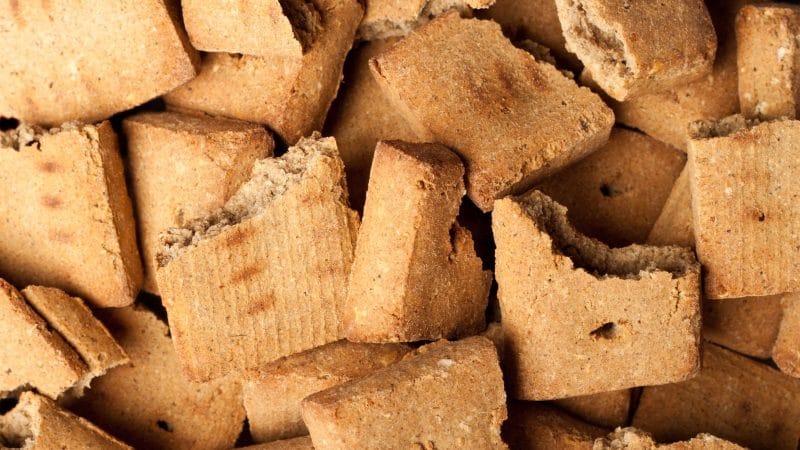
Commercial kibble is manufactured through a process called extrusion: ingredients are forced through a barrel at extreme temperatures and pressures, then puffed, dried, and coated with fats and flavour enhancers to make the result palatable. The process is industrial and efficient, producing a product with a shelf life measured in months or years.
It also does things to food that would alarm you if you thought about them for more than a minute.
A 2026 study by the Clean Label Project tested 79 dog food products across an ISO 17025-accredited laboratory and found that dry kibble contained 21.2 times more lead than fresh or frozen food, 20.7 times more mercury, 13.3 times more arsenic, and 6.1 times more cadmium. The highest lead level in a dry food sample was 1,576.5 parts per billion. Fresh and frozen dog food tested lower for heavy metal contamination than the average of over 3,000 human food products in the same database.
There are currently no federal regulations for these contaminants in pet food. The food you are told is “complete and balanced” by authorities you trust is not even tested for heavy metals by the authorities who are supposed to be watching.
If you have studied regulatory capture, this pattern will not surprise you. But it may make you look at your dog’s bowl differently tonight.
The Parallel You Already Understand
The Brownstone readership needs no introduction to the concept of institutional capture. You have watched it unfold in public health, in pharmaceutical regulation, in the suppression of early treatment protocols, and in the corruption of once-trusted scientific institutions.
The veterinary profession has its own version, quieter but no less consequential.
When pet food companies fund education, research, conferences, and clinical guidelines, the profession develops a sincere, well-meaning blind spot. Vets are not corrupt. They are simply trained within a system in which the “evidence-based” default was built and paid for by the people selling the product.
The vet who tells you kibble is the safest option is not lying to you. He is repeating what they were taught by lecturers whose departments were funded by the manufacturers.
Understanding this is not about blame. It is about context.
Beyond the Bowl: The Whole Dog
But this article is not just about food, because the food problem does not exist in isolation.
If you have questioned the reflexive overmedicalisation of human health, you should ask the same questions about your dog. Modern veterinary practice, like modern human medicine, has developed an enthusiasm for pharmaceutical intervention that sometimes outpaces the evidence for its necessity.
Routine neutering is a good example. For decades, it has been presented as an unambiguous good: responsible ownership, full stop. But the evidence is considerably more nuanced than that. Large studies now show that neutering, particularly early neutering, is associated with increased risks of certain cancers, joint disorders, obesity, and behavioural changes.
This does not mean neutering is always wrong. It means the conversation deserves more honesty than it currently receives, and owners deserve to make informed decisions rather than being shamed into compliance.
The same applies to the ubiquitous prescription of pharmaceuticals for conditions that might respond to dietary and environmental changes first. Chronic skin problems, recurring gut issues, persistent ear infections, anxiety, and weight gain are among the most common reasons dogs visit the vet. They are also among the conditions most frequently reported to improve when dogs are moved from ultraprocessed diets to fresh or raw food.
I am not anti-medicine. I use drugs when they are needed. But the best drug is the one that stays in the cupboard, and the best first question a vet can ask about a chronically unwell dog is: “What are we feeding it?”
The concept of whole-dog health means treating the animal as a biological system, not a collection of symptoms to be managed with monthly prescriptions. Good food, appropriate exercise, sensible parasite management, cautious use of pharmaceuticals, and honest conversations about neutering are all part of the same picture.
Raw Food and the Regenerative Question
There is a larger conversation here, too, one that connects the dog bowl to the soil.
If you care about regenerative agriculture, and I suspect many Brownstone readers do, then what you feed your dog is not a separate question from what kind of farming system you support.
Ultraprocessed pet food is built on the same industrial agricultural model that degrades soil, depletes biodiversity, and depends on monocultures, synthetic fertilisers, and globally traded commodity ingredients. The raw materials are interchangeable. The supply chains are opaque. The system is designed to produce the cheapest possible input for the highest possible margin, and neither the health of the animal at the end of the chain nor the health of the land at the beginning of it features prominently in the accounting.
Raw and fresh dog food, sourced from farms that practise regenerative methods, plugs into a fundamentally different model. It supports livestock systems that rebuild soil biology rather than strip it. It keeps money in local food economies. It shortens supply chains. And it produces food that, when you actually test it in a laboratory, turns out to contain fewer contaminants and more of the nutrients dogs evolved to thrive on.
Joel Salatin, who has spoken at Brownstone events, has made the case for food freedom with characteristic clarity. The freedom to choose what fuel goes into your body, and into the bodies of those you are responsible for, is not a secondary liberty. It is foundational. That principle extends to the animals in our care.
What You Can Do Tonight
You do not have to throw the bag out tomorrow. Dietary transitions in dogs should be gradual, and poorly planned changes can cause digestive upset. But you can start tonight with something simple.
Turn your dog’s food bag around and check how many of the vitamins and minerals are sourced from a synthetic premix rather than recognisable ingredients. If most of the micronutrients come from a long chemical list, consider adding one simple, safe, whole-food topper to tomorrow’s meal: a spoonful of cooked or raw sardine, a cube of raw or lightly cooked heart, or a small piece of liver once or twice a week.
Small, consistent steps towards fresher, less processed food do most of the heavy lifting. You do not have to become a raw feeding evangelist overnight. You just have to nudge the balance from factory to fridge.
If you want to go further, seek out a vet who is comfortable discussing raw and fresh feeding honestly, with clear information about both benefits and risks. The Raw Feeding Veterinary Society (rfvs.info) maintains an international directory of veterinary professionals who can help.
The Dog Deserves the Same Scrutiny
You already know that institutional capture is real. You already know that “the science” can be manufactured to serve commercial interests. You already know that the food system is not designed with your health as its first priority.
Your dog is eating from the same captured system. The only difference is that the dog cannot read the label, cannot question the vet, and cannot choose to opt out. That part is up to you.
I write more about this at holisticvet.co.uk and on my Substack. My book, addressing the ultraprocessed food issue in dogs, examines the evidence in detail, from what extrusion does to nutrients, to what independent studies are now revealing about the health differences between fresh-fed and kibble-fed dogs, to the quiet mechanics of how an entire profession was educated to trust a product without ever being taught to question it.
If you have spent the last few years learning to think critically about what goes into your own body, it may be time to extend that same care to the creature lying at your feet. They have been waiting patiently. They always do.
Join the conversation:

Published under a Creative Commons Attribution 4.0 International License
For reprints, please set the canonical link back to the original Brownstone Institute Article and Author.