
At the turn of the century, America held unchallengeable sway in the world, its economy the strongest and most dynamic, its military the most powerful, its globe-spanning alliances unrivalled, and its global leadership uncontested. The year 2001 seemed to be the pivot on which everything began heading south, with 9/11 serving as the most potent symbol of the all-round decline of US military power, financial muscle, societal cohesion, and global leadership.
Political gridlock domestically was accompanied by failed interventions abroad. In a parallel development pregnant with profound ramifications for the world’s trajectory, China began a rapid ascent up the global power rankings on most dimensions, helped by US-led Western generosity in granting WTO membership, market access, and shift of manufacturing and production chains. The Wall Street Journal columnist William A. Galston describes this first quarter-century of the new millennium as ‘an era of folly’ for America.
This is the global geopolitical landscape against which the US National Security Strategy (NSS) was published on 5 December, the seventh such document in this century and the most transactional ever. President Donald Trump’s more muscular and singular approach to foreign and national security policy was already foreshadowed with his multifront assault on the central pillars of the liberal international order created in the aftermath of the Second World War under US leadership, and with the renaming of the Department of War. The 33-page NSS gives institutional form to his foreign policy.
Sent by the president to Congress, the NSS articulates the administration’s national security vision and how the several elements of US power will be used in pursuit of national security goals. It is meant to bring the different elements of his international policies into some sort of a coherent strategic framework, to steer the various branches of the national security apparatus into implementing his priorities, to rally public support behind the administration’s goals, to reassure friends and allies, and to deter adversaries.
It marks an explicit repudiation of the worldview of post-Cold War US administrations: ‘The days of the United States propping up the entire world order like Atlas are over’ (p. 12). In his foreword, Trump describes it as ‘a roadmap to ensure that America remains the greatest and most successful nation in human history’ and is made ‘safer, richer, freer, greater, and more powerful than ever before’ (p. ii).
The NSS addresses the world as Trump sees it today, not as it was in 1991. The key sentence for me is:
President Trump’s foreign policy is…realistic without being ‘realist,’ principled without being ‘idealistic,’ muscular without being ‘hawkish,’ and restrained without being ‘dovish’ (p. 8).
The backdrop to this is the denunciation of the elite consensus at the Cold War’s end, following which successive administrations:
lashed American policy to a network of international institutions, some of which are driven by outright anti-Americanism and many by a transnationalism that explicitly seeks to dissolve individual state sovereignty (p. 2).
NSS 2025 accepts the imperative to prioritise competing regions and goals in a world of limited resources, instead of presenting a comprehensive laundry list of all the good-to-have objectives. It makes the obvious and common-sense point that the principal US strategic interest is the defence of the homeland and its own hemisphere, with special emphasis on preventing extra-hemispheric powers such as China, Russia, and Iran from meddling. But it also reaffirms the need for a ‘free and open Indo-Pacific’ (p. 19). The region that accounts for almost half the world’s GDP in purchasing power parity (PPP) dollars and one-third in nominal GDP, is critical to the world’s economic development and political stability.
The Logic of Geography
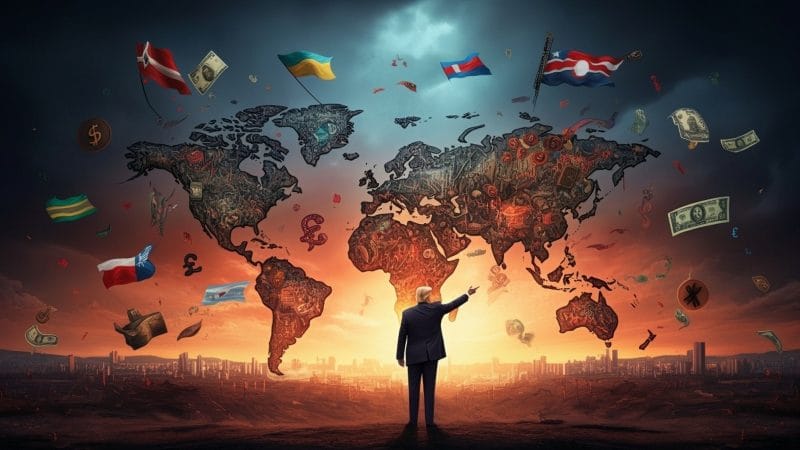
The NSS should put to rest the notion that Trump is isolationist. However, the document fails on the first and most important purpose. Instead of strategic coherence, there is clear tension between the logics of geography, security, and trade. On geographic logic, the retreat from a globe-spanning strategy that is no longer sustainable to focus on its own hemisphere of the Americas as the top priority makes good sense.
One of the most commented-on phrases from the NSS is the declaration of the ‘Trump Corollary.’ The NSS asserts a four-part interest in the Western Hemisphere: to ensure that governments are stable and well-governed enough ‘to prevent and discourage mass migration’ to the US; to cooperation with US counterparts ‘against narco-terrorists, cartels, and other transnational criminal organizations;’ to preserve a region that is free of hostile foreign incursion and ownership of key assets; and to ensure continued US access to strategic locations. To that end, ‘we will assert and enforce a “Trump Corollary” to the Monroe Doctrine’ (pp. 5, 15–19).
The language has intentional echoes of the Roosevelt Corollary from President Theodore Roosevelt over a century ago that was the doctrinal underpinning of US gunboat diplomacy. It is imperialist in conception and interventionist in practice. Operationally, US strikes that have sunk drug-running boats, the heavy naval presence and the seizure of oil tankers off Venezuela, and the demand that President Nicolás Maduro leave the country are contemporary examples of gunboat diplomacy. The justification for the unilateral yet deadly strikes on alleged drug-running boats proved almost immediately hollow with the presidential pardon of convicted drug smuggler Juan Orlando Hernández, the former president of Honduras who was serving a 45-year sentence in a US federal prison.
The Logic of Security
The geographic logic of prioritising the Western Hemisphere notwithstanding, the primary threat to US security is not Latin America but Russia in Europe and China in the Indo-Pacific. At the same time, NSS 2025 resurrects a world of global and regionalised geopolitical balances of power within an overarching US primacy in order to prevent the emergence of globally or regionally dominant adversaries (p. 10). Soft power gives way to the application of economic and military hard power. Its vision is a return to the pre-League of Nations and United Nations world of great powers managing world affairs by accommodating one another’s interests and priorities among themselves.
However: If the US can unilaterally declare the Western Hemisphere to lie within its sphere of interest from which rival great powers should stay out, then the logical and inescapable corollary is that eastern Europe and East Asia fall into Russia’s and China’s spheres of interest, respectively.
Recreating a world of balances of power thus leads inexorably to the logic of re-establishing ‘strategic stability with Russia,’ which requires the US ‘to negotiate an expeditious cessation of hostilities in Ukraine’ (p. 25). In turn this entails sacrificing parts of Ukraine, much as was done in the aftermath of World War II. Europe is criticised as an obstacle to this because of ‘officials who hold unrealistic expectations for the war’ even though ‘A large European majority wants peace’ (p. 26).
And yet, the NSS asserts that the US will dominate the Americas and mediate balances of power in other regions. This is not defensible in principle and may not be feasible in practice as the world has moved decisively away from the unipolar moment of the post-Cold War era.
The ‘civilisational erasure’ theme – that Eurocentric Western Civilisation itself is under attack from a toxic combination of hostile migrants, cultural degeneracy, and effete liberals – is in essence a reprise of Trump’s campaign rhetoric from last year as it applies to Europe. It is particularly painful for an Australian as the terrorist massacre of Jews gathered to celebrate the start of Hanukkah on the Beach took place on Sunday 14 December, barely a week after the NSS was published. It brought home the spectre of the West committing cultural suicide.
NSS 2025 is openly disdainful of European decline and chastises its leaders as enablers of the loss of European character by allowing the situation to deteriorate to this point. The NSS censures European governments for the scale of immigration and for persecuting patriotic parties. If present trends continue, Europe will be ‘unrecognisable’ within 20 years as several nations become ‘majority non-European’ (p. 27). The document uses passages of unusually sharp language on Europe that has sent shockwaves rippling through Europe’s cultural elites and political establishments. Foreign Minister Johann Wadephul responded that Germany does not need ‘outside advice.’ While the US is its most important ally, how Germany organises its free society is not a matter for alliance security policy.
Unfortunately, he speaks from a position of growing weakness that is impossible to conceal. This is shown starkly in the European Union’s declining share of global GDP from 29 percent in 1992 to 17 percent in 2026. Wadephul’s protestations notwithstanding, to have a seat at the table, Europeans will need to bring something to the table beyond a sense of legacy entitlement. Most NATO allies are de facto protectorates, not equal partners. European rearmament in pursuit of military self-sufficiency and reduced reliance on the US will require energy-intensive industrial production that is incompatible with accelerated net zero timetables. Strategic autonomy is unachievable with dependence on US precisions munitions, satellites, intelligence, and logistics.
According to demographic projections by Professor Matt Goodwin based on official data, the share of white British in the UK population will halve from 70 percent today to 34 percent in 2100. They will be a minority by 2063 and the foreign-born and descendants will be a majority by 2079. White Britons will be minorities in the UK’s three biggest cities (London, Birmingham, Manchester) by 2050 and by 2075 all three could well be Muslim-majority cities.
Some Western countries and several commentators are indeed in denial about the double civilisational equation that confronts them:
- Can a host country survive with its civilisation intact when mass immigration implants a parallel culture with its own claim to moral and political authority, loyalties, and religiously-based laws?
- How unethical is it for a host country to resist invasion by an alien culture in order to ensure the survival of its own?
Mass inflow of peoples from diverse cultures with radically differing belief systems, values, and rights is not the best recipe for creating an integrated, harmonious, and cohesive new community. Instead, other than in countries like Japan that refused to go along with the mantra that uncontrolled ‘immigration and diversity’ are always an unqualified good, existing bonds of cohesion are breaking down with alarming speed and creating fresh security headaches.
Immigrants often bring inherited hatreds and conflicts which caused them to flee their homelands in the first place, creating major problems for their adopted countries whose values they neither understand nor respect.
That said, the criticism lacks balance and nuance. For one thing, polls consistently show that Europeans overwhelmingly support the EU, the object of particular scorn in the NSS as an example of ‘transnational bodies that undermine political liberty and sovereignty’ in Europe, even while critical of some particular policies. The fervent public displays of patriotism by Americans has always troubled many European visitors and the continent has been less hung up on national sovereignty, possibly because of the history of violent wars it triggered on the continent.
For another, the EU has begun to wake up to the cost of too rapid a transition to a carbon-neutral economy and decided to make haste slowly. Thus, on 11 December it announced that the 2035 date for the ban on petrol, diesel, and hybrid cars is to be pushed back. Third and most importantly, the Atlantic allies have always been divided on some core civilisational values. The organising principle of several European political systems rests on a different normative settling point in the fundamental relationship between citizens, markets, society, and the state. And fourth, the US itself is not free of this challenge as indicated in the massive fraud scandal embroiling the Somali community in Minnesota as an alien civic culture exploited the host state’s generous social welfare network.
The Logic of Trade
The centrepiece of Trump’s international policy is that the biggest strategic threat comes from China’s rise as an economic and military power. The NSS re-engages with the narrative of China as the strategic rival that will be countered economically and technologically. The NSS commits the US to ‘keeping the Indo-Pacific free and open, preserving freedom of navigation in all crucial sea lanes, and maintaining secure and reliable supply chains and access to critical materials’ (p. 5).
One-third of global shipping passes through the South China Sea. Accordingly, Taiwan is high priority for the US, ‘partly because of Taiwan’s dominance of semiconductor production, but mostly because Taiwan provides direct access to the Second Island Chain and splits Northeast and Southeast Asia into two distinct theaters’ (p. 23). The US will continue prioritising conflict deterrence over Taiwan by ‘preserving military overmatch’ and continuing with the declaratory policy of not supporting any unilateral change to the status quo. Consistent with the retreat from the US burden as the global hegemon, allies including Japan and Australia will be required to play a larger role.
Insulting and offending historic allies in Europe and imposing punitive tariffs on friends and partners in the Global South (Brazil, India) risks rebuffing their overtures to strengthen bonds with America and driving them into the welcoming arms of China and Russia. This has already and demonstrably happened in the case of India, best symbolised by the summit between Prime Minister Narendra Modi and President Vladimir Putin that was held in New Delhi (4–5 December) at the same time as the NSS was published in Washington (4 December). Is that really the purpose and best use of American power?
Join the conversation:

Published under a Creative Commons Attribution 4.0 International License
For reprints, please set the canonical link back to the original Brownstone Institute Article and Author.