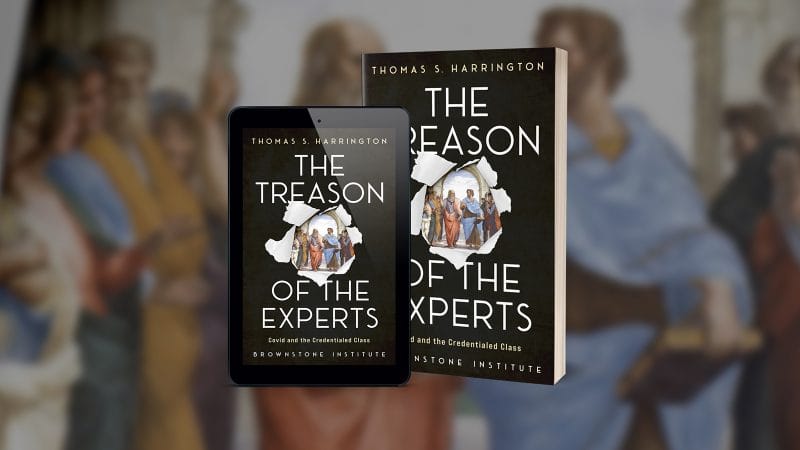

The following is an excerpt from Dr. Thomas Harrington’s book, Treason of the Experts: Covid and the Credentialed Class.
Sadly, for most people today, World War I, or what some older Brits still refer to as the Great War, doesn’t mean too much. This is too bad, as it is perhaps the best mirror we have on the behavior of people and countries during the Covid era.
For those who have forgotten, WWI occurred at a time when technological advances enabled a sudden quantum leap in man’s ability to slaughter his fellow man. And armed with these new killing powers, people proceeded to go out and do precisely that in absolutely staggering numbers, and on the most flimsy of nationalist pretexts.
But, believe it or not, this heretofore unthinkable level of calculated murder is not even the most instructive element of this history for us today.
Rather, it is the fact that, at the time, most people not only bought into these flimsy pretexts, but that they did so with an astonishingly high degree of zeal and enthusiasm.
The officer-butchers standing in the trenches sending wave after wave of innocent boys “over the top” – boys who could in many cases not even speak the official language of the country they were fighting for – were consistently portrayed as wise men and heroes when they were, in fact, as mad as the proverbial hatter.
Under the influence of what we can now see was the first great wave of mass propaganda, the young cannon fodder proudly marched off to war, convinced they were doing something important and valuable for their families and communities, when in fact they were just being sacrificed like farm animals for the delusions of men wearing epaulets or seeking to secure election victories.
It was mass stupidity in a way humanity had never seen it…and embraced by nearly all on the home front out of the fear of not wanting to be ostracized by their neighbors.
And when it was over, and millions had perished, or been displaced and disfigured, none of the architects of this unprecedented human disaster was ever really held to account.
For the most part, citizens continued to accept the notion that military wise men were, in fact, wise, and that the government leaders who had whipped everyone up into a mortal frenzy were still basically worth listening to and following.
Though the remaining sparks of our Enlightenment mindset often inhibit us from thinking frankly along these lines, the fact is herd stupidity and group hysteria are among the most powerful and enduring human traits.
The big mistake of so-called rational thinking is consistently underestimating the power of people’s need to believe in something transcendent of what they, at one point or another in their life, come to realize is their own cosmic insignificance.
Some fill this existential lack by building loving and creative relationships with those around them. But many others, struggling under the cruel burdens imposed by often predatory consumer capitalism, find they are unable to do so.
Instead, they seek to fill this spiritual gap with the self-interested myths of togetherness provided by the cynical elites and gaily walk off the cliffs before them convinced that by doing so, they will finally bring an end to that nagging empty feeling inside.
Or, to paraphrase the title of the wonderful book by Chris Hedges on the perverse attractions of war, “Hysteria is a Force that Gives us Meaning.”
30 January 2021
Join the conversation:

Published under a Creative Commons Attribution 4.0 International License
For reprints, please set the canonical link back to the original Brownstone Institute Article and Author.