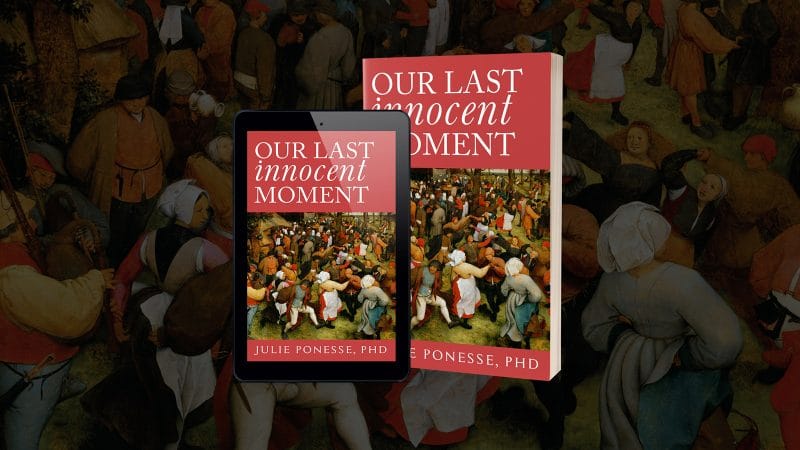
[The following is an excerpt from Julie Ponesse’s book, Our Last Innocent Moment.]
I have often wondered what it would have been like in Babel in the early days after its destruction. We don’t know that God actually destroyed the tower but imagination conjures images of people wandering in the dust of the ruins, living in the rubble of failed hopes and broken dreams. “What now?” they must have wondered.
One interesting thing about the Babel story is that the tower was built not just as an hubristic attempt to reach heaven but to preserve unity among themselves. “Come, let us build ourselves a city and a tower…; otherwise we shall be scattered…” It’s hard to blame them for that.
The Covid narrative revealed our own goal of unity, an ostensibly noble one: “We are all in this together,” “Do your part.” Though punctuated in 2020, a sociocultural shift towards a particular species of unity — unity by uniformity — started gaining momentum years before.
To accomplish a utopian human project as grand as Babel, creating a rip in time or eradicating a virus, there is little room for individual difference. If someone wants to take time to develop a different kind of brick or pause to consider the broader meaning of genetic manipulation, the momentum for the project would wane. Individualism — a sense of who one is apart from the group — is a threat to collective utopian projects and, since these are what define us now, it is the greatest threat to the ethos of our time. We are told that our individual lives are a reasonable sacrifice to make for the sake of a grand human project, and it’s a sacrifice most people seem to be quite happy to make.
Why?
Because the trade-off is the promise of immortality, the promise of something greater than itself.
We are born, we make what we can out of our own little lives, we grow old, and then we die. Our time on earth passes in the blink of an eye and, unless you are a spiritual person, you believe that, when you die, that’s it. So we try to prolong life artificially or we invest our identity in the stock of the group so that at least we may live on through others. “War is peace,” “Freedom is slavery,” “We are all in this together.” Recite them enough and eventually they become the normal, even virtuous, way to inject meaning into our lives.
If we take a bird’s eye view of human history, we can see a series of cycles between accelerations in reason and technology, and then decelerations and eventual decline. We innovate, we progress, and then we stagnate, and sometimes regress or even collapse. We developed tools, perfected metalworking, invented the printing press, and then the internet. Never has our world felt so large, yet also so interconnected and unified in language, lifestyle, and thought. In many ways, we are closer than ever to being “one people.” But never, in my lifetime anyway, have things felt so precarious, and so aimless and futile. As Canadian songwriter Matthew Barber wrote recently: “Oh we may have sharper tools, But we don’t always know how to use them, After all we’re only human…”
Babel isn’t just a story about tribalism. It’s a story about the loss of stability, about displacement to a new reality. It’s a metaphor for what’s happening not just between the right and the left, pro- and anti-narrative, but for what’s shifting in our institutions, in our culture, and in ourselves. It’s a story of alienation and brokenness.
Metaphorically, I don’t know if we are living the days leading up to ‘the tower’s destruction or the days just after. But it’s pretty clear that our disagreements with each other are core; when it comes to meaning and morality, we don’t speak the same language on a very fundamental level.
I can’t help but wonder, if humanity cycles through these Babel moments periodically, why? What do all these “Babel moments” have in common? Are we doomed to repeat them? And if we recognize the moment while we are in it, can we do something to change our course, to make the outcome less disastrous than it might otherwise be?
Join the conversation:

Published under a Creative Commons Attribution 4.0 International License
For reprints, please set the canonical link back to the original Brownstone Institute Article and Author.