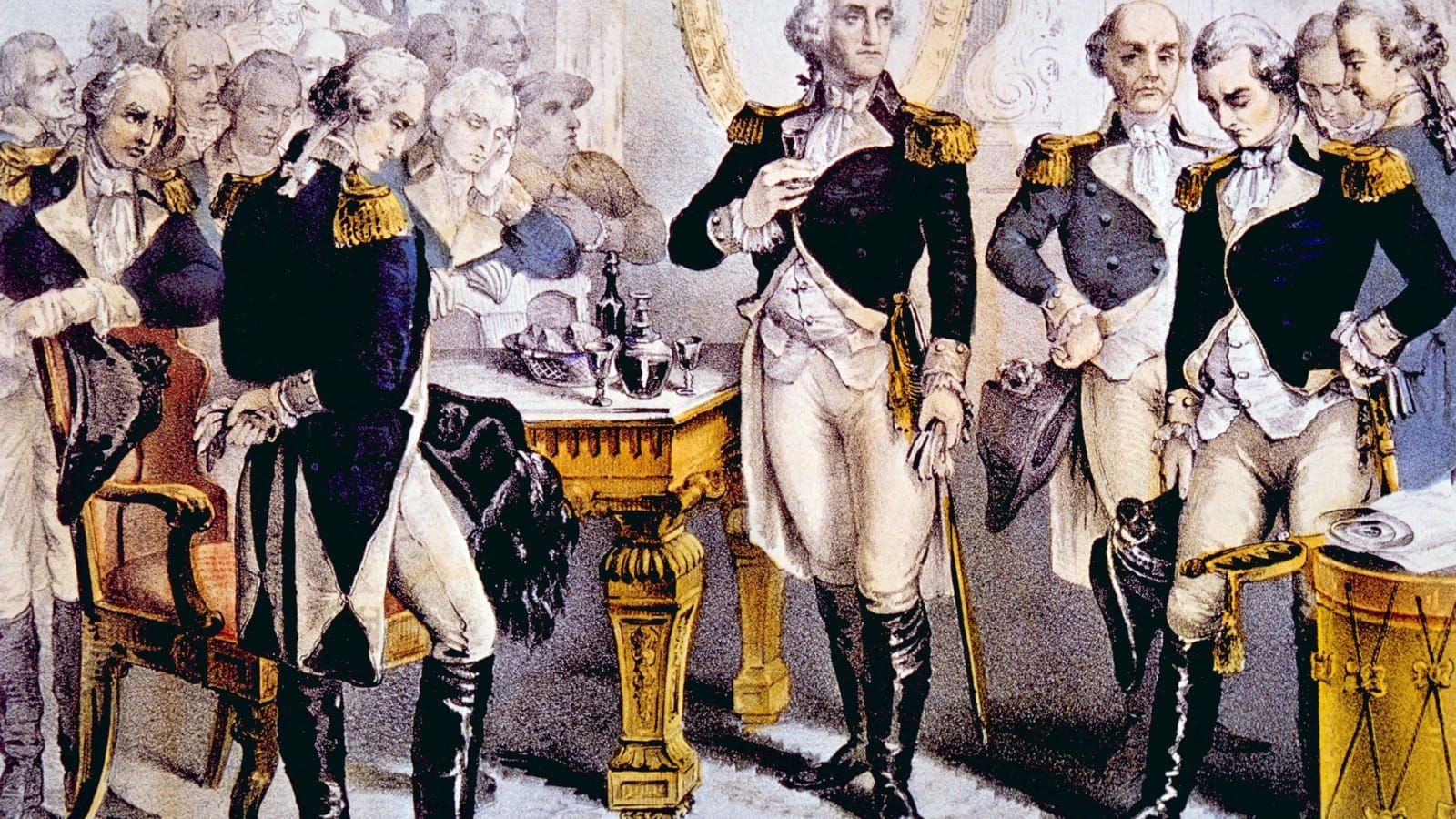

The grim circumstances behind the death of George Washington (1732-1799), America’s first president and popularly known as the Father of the Country, are not wholly unknown. The details have been reported by historians for more than two centuries.
What’s strange about this dry biographical knowledge is that it is not reported with shock and alarm and hence never conveyed to popular culture with lessons for our lives. This is because Washington’s physicians were following standard protocols when they bled him to death.
The facts: Washington came down with a throat infection. Three doctors, all convinced of the settled wisdom of the healing arts deployed since the Middle Ages, participated in draining blood from his body, to the point that they took 5 pints or fully half his blood, while giving him an enema on top of it all.
They literally drained the life out of him, not from malice but simply by following the established protocols as recommended by the best physicians at the time.
To invoke a popular phrase, where is the outrage? Nineteenth-century biographies reported the details but celebrated Washington for his bravery in enduring the treatment, then called phlebotomy, which was considered the best science.
John Marshall’s (later Justice) famous early biography, published in five volumes from 1804 to 1807, simply says:
“Believing bloodletting to be necessary, he procured a bleeder who took from his arm twelve or fourteen ounces of blood, but he would not permit a messenger to be despatched for his family physician until the appearance of day. About eleven in the morning Doctor Craik arrived; and perceiving the extreme danger of the case, requested that two consulting physicians should be immediately sent for. The utmost exertions of medical skill were applied in vain. The powers of life were manifestly yielding to the force of the disorder; speaking, which was painful from the beginning, became almost impracticable: respiration became more and more contracted and imperfect, until half past eleven on Saturday night; when, retaining the full possession of his intellect, he expired without a struggle.”
Necessary. Medical skill. Protocols. Best Practices. Standards of Care. Death. No one knows why: just a yielding to the forces of disorder.
That account set the tone. No one dared say that the doctors killed him – a very clear example of iatrogenic death – because no one believed that. So long as it is credentialed experts doing the killing, we are led to believe that nothing really went wrong. The system works, just that sometimes the system cannot stop the inevitable.
That consensus surrounding Phlebotomy began to change in the coming decades, even if some experts were still on board as late as 1842. By the end of the 19th century, bleeding had been thoroughly discredited. Still, the overall judgment that the doctors did the best they could with the tools and knowledge they had remained. It’s as if the literary culture simply could not grasp the fullness of the implications that it was the physicians themselves who turned a common flu into a death event by draining the former president’s blood from his body.
Another biography written for kids in 1917 by Calista McCabe Courtenay comes closer to the truth.
“Before morning of the third day, he was very ill and when the doctors came, they bled him. It was the stupid practice of those days and in a few hours Washington was so weakened as to be past hope of recovery. He died on December 14, 1799, as bravely as he had lived.”
Even on the 250th anniversary of the nation’s founding, the full lesson of this horrible death has not sunk in.
The most recent and most celebrated biography is by Ron Chernow. Even here, while we get more detail, the account is lacking in severe judgment against the medical professionals, much less what that implies.
Although he experienced hoarseness and chest congestion that evening [November 12, 1799], Washington’s mood was cheerful. He smarted at old political wounds from onetime allies. When he read aloud a newspaper story that James Madison had nominated James Monroe for Virginia governor, he allowed himself some acerbic comments. He spurned Lear’s advice to take medicine. “You know I never take anything for a cold,” he protested. “Let it go as it came.” Instead, he sat up late in his library before mounting the steps to his bedroom.
Martha expressed dismay that he had not come upstairs earlier, but he said that he had done so as soon as he had finished his business. In the middle of the night, he awoke with a raw, inflamed throat. When he shook Martha awake, she grew alarmed by his labored breathing and wanted to fetch a servant, but he feared she might catch a chill on this cold night. Once again relying on his body’s restorative powers, he had Martha wait until daybreak to call for help.
When a slave named Caroline kindled a fire in the early morning, Martha asked her to scout out Tobias Lear, who found Washington breathing with difficulty and scarcely able “to utter a word intelligibly.” Christopher Sheels propped up his master in a chair by the fire as Lear sent a swift slave to Alexandria for Dr. Craik, the Scottish physician who had served Washington with such fervent devotion since the French and Indian War.
Meanwhile, to soothe his flaming throat, Washington consumed a syrupy blend of molasses, vinegar, and butter… With preternatural self-control, he had an overseer named George Rawlins bleed him before Dr. Craik arrived. When Rawlins blanched, Washington gently but firmly pressed him. “Don’t be afraid,” he said, and once Rawlins had sliced into the skin, making the blood run freely, he added, “The orifice is not large enough.”
Martha showed better medical judgment and pleaded for a halt to the bleeding, but Washington urged Rawlins on, saying “More, more!” until nearly a pint of blood had been drained. A piece of moist flannel was wrapped around his throat while his feet were soaked in warm water. As they awaited Dr. Craik, Martha summoned the eminent Dr. Gustavus Richard Brown of Port Tobacco.
Dr. Craik, arriving first, perpetuated the medieval treatments already in use, emptying more blood and applying to the throat cantharides, a preparation made from dried beetles, to draw the inflammation to the surface. He also had Washington inhale steam from a teapot filled with vinegar and hot water. When Washington tilted back his head to gargle sage tea mixed with vinegar, he nearly suffocated.
Alarmed, Dr. Craik summoned a third doctor, Elisha Cullen Dick, a young Mason from Alexandria, who had studied under Dr. Benjamin Rush. Upon entering, he joined Craik in siphoning off more blood, which “came very slow, was thick, and did not produce any symptoms of fainting,” wrote Lear. They also evacuated Washington’s bowels with an enema. Joined at last by Dr. Brown, they took two more pints from Washington’s depleted body.
It has been estimated that Washington surrendered five pints of blood altogether, or about half of his body’s total supply. Dr. Dick recommended a still rare and highly experimental procedure—a tracheotomy that would have punched open a hole in Washington’s trachea, easing his breathing—only to be overruled by Craik and Brown. “I shall never cease to regret that the operation was not performed,” Dick said afterward, likening the three physicians to drowning men grasping at straws.
It is highly improbable, however, that Washington would have survived such a procedure, given his already weakened state….It was December 14, 1799. Washington had died at age sixty-seven.
The implications of such an account are profound concerning the purported wisdom of medical consensus. Every generation imagines that it is way ahead of the others in the past in terms of science and medicine. Sure, what they did in the past was grim, barbaric, ignorant, cruel, not based in science but we are so much better. And yet in every age, the physicians have always believed that. Nor is it enough to say that knowledge is always improving because we know that this is simply not true.
Even now, Washington, D.C. and the psychiatry profession is in an uproar over what appears to be a sudden awareness that what is called “psychiatric medication” is not fixing or medicating a “chemical imbalance” at all but rather sedating and creating a dependency that allows for further medicating in a vicious cycle. It seems rather obvious now, thanks to decades of work by outside writers and activists, but it was not apparent until recently. Lobotomies have not been repudiated so much as chemicalized.
And only a few years ago at the height of the worst of Covid, between 10,000 and 17,000 people in New York City were likely killed by the hospital protocols that involved ventilation from which most people died. Ventilation in this case was a death sentence not that different from phlebotomy, a consensus practice that only months after so many were harmed was deeply regretted. Meanwhile, those deploying the practice were indemnified with a liability shield.
We still have no clear answers as to why off-label therapeutics for a coronavirus were taken off the shelf while doctors who distributed Ivermectin and Hydroxychloroquine with great results are still being persecuted. Vaccine refuseniks were demonized as prolonging the pandemic, and then the product turned out to be one of the more dangerous ever distributed.
TheNew York Times attacked the idea that Ivermectin could be effective against Hantavirus as disinformation; after all, a “vaccine” is on its way, no doubt one declared to be both safe and effective. Remember that vaccination was discovered around the same time that Washington was bled to death by a generation of physicians that could not think its way out of an existing paradigm. Bleeding is finally gone but it took another 75 or so years.
From that time forward, vaccination as a go-to intervention for everyone has benefited from subsidies, celebrity endorsements, patents, mandates, a philosophical overlay over utilitarianism, agency blessings, media campaigns, liability shields, suppression of data of injury and death, and the demonization of any resistors. Is it any wonder so many now have their doubts?
What’s happening in medicine right now is a massive rethinking of many conventional practices coming out of the allopathic monopoly that is a century old. In pursuit of keeping an orthodoxy in place, how many healthy practices have been left behind from other traditions such as Chinese medicine, homeopathy, chiropathy, or naturopathy, all of which are discouraged by conventional insurance and disparaged by pharma-funded media? How many practices today called the Standard of Care will in a generation or two be regarded as obviously horrible as the practice of bleeding?
George Washington’s terrible fate ought to have sounded a national alarm to ring through our long history. The lesson should be never to replace epistemic humility in medicine with institutionalized dogma. That lesson did not stick because then and now, the prevailing medical wisdom gets a pass even when it kills people. Even the Father of the Country.
Join the Conversation
Published under a Creative Commons Attribution 4.0 International License
For reprints, please set the canonical link back to the original Brownstone Institute Article and Author.